Short Communication - (2025) Volume 15, Issue 5
Received: 01-Oct-2025, Manuscript No. mccr-25-173809;
Editor assigned: 03-Oct-2025, Pre QC No. P-173809;
Reviewed: 17-Oct-2025, QC No. Q-173809;
Revised: 22-Oct-2025, Manuscript No. R-173809;
Published:
29-Oct-2025
, DOI: 10.37421/2161-0444.2025.15.806
Citation: Hassan, Noura. ”Novel Cardiovascular Pharmacotherapy: A Paradigm Shift.” Med Chem 15 (2025):806.
Copyright: © 2025 Hassan N. This is an open-access article distributed under the terms of the Creative Commons Attribution License, which permits unrestricted use, distribution and reproduction in any medium, provided the original author and source are credited.
SGLT2 inhibitors represent a crucial development in cardiovascular pharmacotherapy, extending their benefits beyond diabetes management. These drugs significantly reduce the risk of heart failure hospitalization and cardiovascular death across various heart failure phenotypes, including both reduced and preserved ejection fraction. Their mechanism involves improving cardiorenal outcomes through multifaceted effects on glucose metabolism, renal hemodynamics, and cardiac remodeling, marking a paradigm shift in managing chronic heart failure and associated comorbidities [1].
GLP-1 receptor agonists (GLP-1 RAs) have shown impressive cardiovascular protective effects, particularly in patients with Type 2 Diabetes and established cardiovascular disease or multiple risk factors. These agents reduce major adverse cardiovascular events, including cardiovascular death, non-fatal myocardial infarction, and non-fatal stroke. Beyond their glycemic effects, GLP-1 RAs offer benefits like weight reduction, blood pressure lowering, and improvements in lipid profiles, positioning them as key players in comprehensive diabetes and cardiovascular risk management [2].
PCSK9 inhibitors represent a highly effective class of lipid-lowering drugs, dramatically reducing LDL-cholesterol levels and subsequent cardiovascular events. These monoclonal antibodies target proprotein convertase subtilisin/kexin Type 9, preventing it from degrading LDL receptors. For patients with high cardiovascular risk, including those with familial hypercholesterolemia or established atherosclerotic cardiovascular disease who cannot achieve target LDL-C levels with statins, PCSK9 inhibitors offer a powerful therapeutic option, significantly improving clinical outcomes [3].
Fixed-dose combination therapies for hypertension simplify treatment regimens and improve medication adherence, leading to better blood pressure control. Triple combination therapies, in particular, are gaining traction for patients with moderate to severe hypertension or those not adequately controlled on dual therapy. By combining agents with complementary mechanisms, such as an ACE inhibitor or ARB, a calcium channel blocker, and a diuretic, these formulations offer enhanced efficacy and a reduced pill burden, which is crucial for achieving and maintaining target blood pressure levels [4].
Sacubitril/valsartan, an angiotensin receptor-neprilysin inhibitor (ARNI), has revolutionized the treatment of heart failure with reduced ejection fraction (HFrEF). Its efficacy in reducing cardiovascular death and heart failure hospitalizations is well-established. More recently, evidence supports its benefit in heart failure with preserved ejection fraction (HFpEF), demonstrating a significant reduction in total heart failure hospitalizations and cardiovascular mortality. This broad applicability across the heart failure spectrum highlights its critical role in improving patient outcomes [5].
Finerenone, a novel non-steroidal mineralocorticoid receptor antagonist, provides significant renal and cardiovascular protection in patients with chronic kidney disease and Type 2 Diabetes. Unlike traditional steroidal MRAs, finerenone selectively blocks the mineralocorticoid receptor with reduced risk of hyperkalemia, making it a safer option for vulnerable populations. It effectively lowers the risk of kidney failure, cardiovascular death, non-fatal myocardial infarction, and heart failure hospitalization, addressing a significant unmet need in this high-risk patient group [6].
New antiplatelet agents continue to emerge, offering improved efficacy and safety profiles for preventing thrombotic events in cardiovascular disease. While aspirin and P2Y12 inhibitors remain cornerstones, novel targets and drug combinations are being explored to mitigate the risk of bleeding while maintaining potent antithrombotic effects. These advancements aim to personalize antiplatelet therapy, optimizing outcomes for patients undergoing percutaneous coronary intervention, experiencing acute coronary syndromes, or requiring long-term prevention of recurrent ischemic events [7].
RNA-based therapeutics represent a cutting-edge frontier in cardiovascular medicine, offering the potential to address previously untreatable conditions or provide highly targeted interventions. This includes approaches like mRNA vaccines, Small Interfering RNAs (siRNAs), and microRNAs, designed to modulate gene expression relevant to cardiovascular diseases. These therapies promise to interfere with disease pathways at a molecular level, offering novel strategies for managing dyslipidemia, heart failure, and atherosclerosis, moving towards highly personalized and precise treatments [8].
Targeting inflammation has emerged as a promising strategy in the management of atherosclerotic cardiovascular disease (ASCVD). Beyond lipid lowering, chronic inflammation plays a pivotal role in plaque development and rupture. Anti-inflammatory drugs, such as colchicine, have demonstrated efficacy in reducing cardiovascular events in patients with ASCVD, offering a complementary approach to traditional therapies. The focus is now on identifying optimal anti-inflammatory targets and patient populations who stand to benefit most, furthering our understanding of atherosclerosis as an inflammatory disease [9].
The landscape of anticoagulant therapy continues to evolve with the introduction of novel anticoagulants, predominantly Direct Oral Anticoagulants (DOACs). These agents offer advantages over traditional warfarin, including predictable pharmacokinetics, fewer drug-drug interactions, and no need for routine coagulation monitoring. DOACs are now standard of care for conditions like atrial fibrillation and venous thromboembolism, significantly reducing the risk of stroke and recurrent VTE while maintaining a favorable safety profile, particularly regarding intracranial hemorrhage [10].
The management of cardiovascular diseases is undergoing a significant transformation, marked by a range of innovative pharmacological strategies. Hereâ??s the thing, for heart failure patients, SGLT2 inhibitors have emerged as a cornerstone, demonstrating remarkable efficacy in reducing hospitalizations and mortality across both reduced and preserved ejection fractions. These agents improve cardiorenal outcomes through a complex interplay of metabolic and hemodynamic effects [C001]. What this really means is that Sacubitril/valsartan, an angiotensin receptor-neprilysin inhibitor, has also revolutionized heart failure treatment, showing established benefits in reduced ejection fraction and increasingly recognized advantages in preserved ejection fraction, ultimately improving patient outcomes across the spectrum of this challenging condition [C005].
Let's break it down further regarding metabolic disorders. For individuals with Type 2 Diabetes and cardiovascular risk, GLP-1 receptor agonists offer substantial cardiovascular protective effects, reducing major adverse events beyond their glycemic control. They also contribute to weight loss, blood pressure reduction, and improved lipid profiles, making them crucial for comprehensive management [C002]. A related advancement is Finerenone, a non-steroidal mineralocorticoid receptor antagonist, which provides significant renal and cardiovascular protection in patients with chronic kidney disease and Type 2 Diabetes. Its unique profile, with a reduced risk of hyperkalemia compared to older agents, addresses a vital unmet need in this high-risk population [C006].
In terms of lipid management and atherosclerosis, PCSK9 inhibitors represent a powerful therapeutic option. These monoclonal antibodies effectively lower LDL-cholesterol levels and reduce cardiovascular events, especially for those with familial hypercholesterolemia or established atherosclerotic cardiovascular disease who struggle to reach target LDL-C with statins [C003]. Beyond cholesterol, targeting inflammation directly offers a complementary strategy in atherosclerotic cardiovascular disease. Drugs like colchicine have shown promise in reducing cardiovascular events by addressing chronic inflammation, a key driver of plaque development and rupture [C009]. This approach broadens our understanding of atherosclerosis as an inflammatory disease.
For the crucial aspect of blood pressure control and antithrombotic therapy, fixed-dose combination treatments for hypertension simplify regimens and boost adherence, leading to better blood pressure management. Triple combination therapies, in particular, provide enhanced efficacy by combining agents with complementary mechanisms, significantly reducing the pill burden for patients with moderate to severe hypertension [C004]. Meanwhile, the field of antiplatelet agents continues to advance, aiming for improved efficacy and safety in preventing thrombotic events. Novel targets and drug combinations are being explored to personalize therapy and optimize outcomes for various ischemic conditions [C007]. The landscape of anticoagulation has also evolved dramatically with the introduction of Direct Oral Anticoagulants (DOACs), which offer advantages over warfarin such as predictable pharmacokinetics and no routine monitoring. They have become standard for conditions like atrial fibrillation and venous thromboembolism, reducing stroke and recurrent events with a favorable safety profile [C010].
Looking ahead, RNA-based therapeutics represent a frontier. These therapies, including mRNA vaccines, Small Interfering RNAs (siRNAs), and microRNAs, promise to modulate gene expression at a molecular level, offering novel, highly targeted strategies for managing dyslipidemia, heart failure, and atherosclerosis. This is moving medicine towards more personalized and precise treatments for cardiovascular diseases [C008]. These diverse innovations underscore a holistic approach to cardiovascular care, integrating advanced pharmacological interventions across multiple disease pathways.
Recent advancements in cardiovascular pharmacotherapy show significant progress in managing various conditions. SGLT2 inhibitors now extend benefits beyond diabetes, reducing heart failure hospitalizations and cardiovascular death across different ejection fractions. Similarly, GLP-1 receptor agonists demonstrate impressive cardiovascular protective effects in Type 2 Diabetes patients, lowering major adverse cardiovascular events while aiding in weight and blood pressure reduction. For lipid management, PCSK9 inhibitors dramatically reduce LDL-cholesterol and subsequent cardiovascular events, offering a powerful option for high-risk patients unresponsive to statins. Hypertension treatment sees improved adherence and control with fixed-dose combination therapies, especially triple combinations that offer enhanced efficacy and a reduced pill burden. Sacubitril/valsartan, an ARNI, has transformed heart failure treatment, proving effective in both reduced and preserved ejection fraction cases. Finerenone, a non-steroidal mineralocorticoid receptor antagonist, offers crucial renal and cardiovascular protection for patients with chronic kidney disease and Type 2 Diabetes, with a safer hyperkalemia profile. The field also sees ongoing developments in new antiplatelet agents, aiming for improved efficacy and safety in preventing thrombotic events, alongside RNA-based therapeutics that promise highly targeted interventions for conditions like dyslipidemia and atherosclerosis. Furthermore, targeting inflammation with drugs like colchicine has emerged as a complementary strategy for atherosclerotic cardiovascular disease. Finally, novel anticoagulants, particularly Direct Oral Anticoagulants (DOACs), have become standard for conditions like atrial fibrillation and venous thromboembolism, offering predictable pharmacokinetics and a favorable safety profile. These innovations collectively represent a paradigm shift in comprehensive cardiovascular risk management, improving patient outcomes across a broad spectrum of diseases.
None
None
1. Stephen JG, Javed B, Muthiah V. "SGLT2 Inhibitors in Heart Failure: A State-of-the-Art Review".Circulation 143 (2021):384-399.
Indexed at, Google Scholar, Crossref
2. Michael F, Ian N, Nick RB. "Glucagon-like peptide-1 receptor agonists and cardiovascular disease: a review of the evidence".Curr Med Res Opin 36 (2020):663-677.
Indexed at, Google Scholar, Crossref
3. Maciej B, Jacek R, Joanna PK. "PCSK9 inhibitors: from bench to bedside".Expert Opin Pharmacother 20 (2019):31-41.
Indexed at, Google Scholar, Crossref
4. Giuseppe M, Paolo V, Michel B. "Fixed-dose triple combination therapy for hypertension: an an update".J Hypertens 38 (2020):1877-1887.
Indexed at, Google Scholar, Crossref
5. Barry G, Sanjiv JS, Scott DS. "Sacubitril/Valsartan for Heart Failure with Preserved Ejection Fraction".N Engl J Med 381 (2019):938-948.
Indexed at, Google Scholar, Crossref
6. George LB, Javed B, Lothar H. "Finerenone in chronic kidney disease and type 2 diabetes: a narrative review".Diabetes Res Clin Pract 180 (2021):109015.
Indexed at, Google Scholar, Crossref
7. Waclaw W, Joanna N, Marek R. "Recent advances in antiplatelet therapies for cardiovascular diseases".J Clin Med 10 (2021):298.
Indexed at, Google Scholar, Crossref
8. Joseph RR, Robert FP, Robert EG. "RNA-based Therapeutics for Cardiovascular Disease".Circ Res 128 (2021):1475-1490.
Indexed at, Google Scholar, Crossref
9. Konstantinos TK, Panagiotis TK, Efstratios IE. "Anti-inflammatory therapies for atherosclerosis: current clinical evidence and future directions".Heart 106 (2020):12-21.
Indexed at, Google Scholar, Crossref
10. Sanjit SJ, Peter PC, David JM. "Novel Anticoagulants: A Review of Clinical Trials".Circulation 139 (2019):1333-1349.
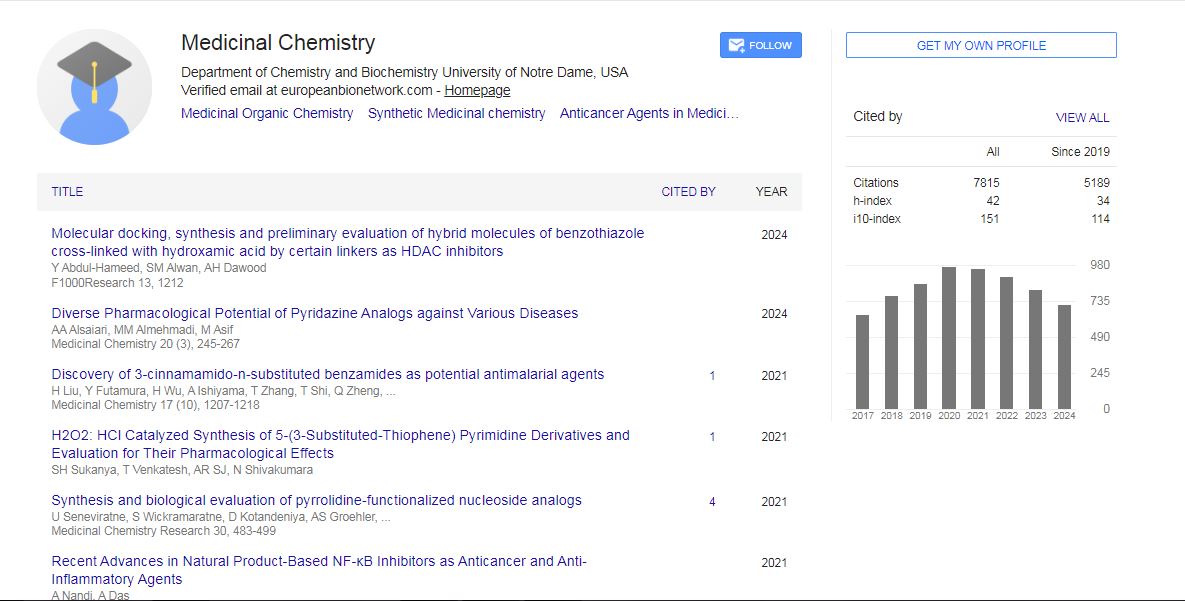
Medicinal Chemistry received 6627 citations as per Google Scholar report