Brief Report - (2025) Volume 15, Issue 2
Received: 02-Mar-2025, Manuscript No. jnt-26-178922;
Editor assigned: 04-Mar-2025, Pre QC No. P-178922;
Reviewed: 18-Mar-2025, QC No. Q-178922;
Revised: 24-Mar-2025, Manuscript No. R-178922;
Published:
31-Mar-2025
, DOI: 10.37421/2161-0959.2025.15.552
Citation: Sorensen, Lina. ”Novel Biomarkers for Early Kidney Dysfunction Detection.” J Nephrol Ther 15 (2025):552.
Copyright: © 2025 Sorensen L. This is an open-access article distributed under the terms of the Creative Commons Attribution License, which permits unrestricted use, distribution and reproduction in any medium, provided the original author and source are credited.
The early detection of renal dysfunction remains a critical challenge in clinical nephrology, necessitating the development and validation of novel biomarkers that can surpass the limitations of traditional markers such as serum creatinine and estimated glomerular filtration rate (eGFR) [1].
Recent advancements have focused on identifying molecular signatures that indicate kidney damage at its nascent stages, thereby enabling prompt therapeutic interventions and potentially altering disease trajectories [1].
Among these emerging markers, urinary exosomal microRNAs have demonstrated significant promise in reflecting early kidney injury and disease progression [2].
Their non-invasive nature makes them particularly attractive for routine monitoring and personalized medicine approaches in nephrology [2].
Furthermore, specific proteins like neutrophil gelatinase-associated lipocalin (NGAL) have emerged as sensitive indicators of acute kidney injury (AKI), showing superior performance compared to conventional diagnostic tools in diverse clinical scenarios [3].
The identification of NGAL as a key player in early AKI detection underscores the shift towards molecular diagnostics for timely intervention [3].
Similarly, kidney injury molecule-1 (KIM-1), a transmembrane protein upregulated in damaged tubular epithelial cells, has proven to be a valuable urinary biomarker for detecting and monitoring various forms of renal injury, including tubular damage [4].
Its elevated levels in early renal insults provide a window for therapeutic action before irreversible damage occurs [4].
Beyond single molecules, proteomic approaches are revolutionizing biomarker discovery by enabling the identification of complex protein signatures associated with kidney disease, offering a more comprehensive understanding of underlying pathologies [5].
These high-throughput techniques are paving the way for a new era of multi-analyte diagnostics in nephrology [5].
The growing interest in non-invasive diagnostics has also highlighted the potential of urinary extracellular vesicles (EVs) and their molecular cargo, such as microRNAs and proteins, as promising biomarkers for conditions like diabetic kidney disease (DKD), allowing for early detection and prognostication [6].
The intricate relationship between the gut microbiome and kidney health is also revealing new avenues for biomarker discovery, with alterations in gut bacteria potentially serving as indicators of chronic kidney disease (CKD) progression and contributing to uremic toxin production [9].
The identification of specific microbial signatures or their metabolites could lead to novel diagnostic and therapeutic strategies for CKD [9].
In the context of kidney stone disease, urinary citrate has been identified as a potential biomarker, with altered levels being associated with an increased risk of stone formation and suggesting its utility in identifying individuals predisposed to nephrolithiasis [10].
Finally, soluble urokinase plasminogen activator receptor (suPAR) has garnered attention as a versatile biomarker across a spectrum of kidney diseases, including AKI and glomerular disorders, offering insights into disease activity and prognosis [7].
The landscape of renal dysfunction diagnostics is rapidly evolving, moving beyond established metrics to incorporate a new generation of molecular biomarkers that promise earlier and more accurate detection of kidney damage [1].
Novel biomarkers such as urinary exosomal microRNAs are being investigated for their ability to reflect the earliest signs of renal injury, offering a non-invasive means to assess kidney health and disease progression [2].
This aligns with the increasing demand for personalized medicine approaches in nephrology, where tailored diagnostic strategies can lead to more effective patient management [2].
Neutrophil gelatinase-associated lipocalin (NGAL) has emerged as a particularly strong candidate for the early diagnosis of acute kidney injury (AKI), demonstrating a high degree of sensitivity and specificity in various clinical settings, often outperforming traditional markers [3].
Its utility in identifying AKI in critically ill patients and those undergoing surgery highlights its potential clinical impact [3].
Kidney injury molecule-1 (KIM-1) serves as another crucial urinary biomarker, specifically indicating tubular damage, a hallmark of many renal diseases, and its elevated levels are indicative of early renal insults and disease severity [4].
The ability of KIM-1 to reflect ongoing kidney damage provides a valuable tool for monitoring therapeutic responses and assessing overall kidney health [4].
Proteomics is opening new frontiers in biomarker discovery for renal dysfunction, with advancements in mass spectrometry enabling the identification of a broader array of protein signatures associated with kidney diseases and offering a more holistic view of renal pathology [5].
These sophisticated techniques are essential for unraveling the complex molecular underpinnings of kidney disease [5].
The role of urinary extracellular vesicles (EVs) and their encapsulated biomolecules, including microRNAs and proteins, is being explored as a non-invasive diagnostic avenue for conditions like diabetic kidney disease (DKD), with specific EV-derived molecules correlating with disease onset and progression [6].
Emerging research also points to the gut microbiome as a significant contributor to kidney disease pathogenesis, with gut microbial alterations and the associated production of uremic toxins potentially serving as novel biomarkers for chronic kidney disease (CKD) [9].
Investigating these microbial signatures could unlock new therapeutic and diagnostic strategies for CKD patients [9].
Furthermore, urinary citrate is being evaluated for its potential as a biomarker in kidney stone disease, where altered levels are linked to an increased risk of stone formation, suggesting its role in early risk stratification [10].
Lastly, soluble urokinase plasminogen activator receptor (suPAR) is recognized for its utility as a biomarker across diverse kidney diseases, including AKI and glomerular pathologies, offering insights into disease activity and predicting renal outcomes [7].
This collection of research highlights advancements in identifying novel biomarkers for early detection and monitoring of renal dysfunction. Emerging markers include urinary exosomal microRNAs, neutrophil gelatinase-associated lipocalin (NGAL), and kidney injury molecule-1 (KIM-1), which show promise in detecting kidney damage earlier than traditional methods. Proteomic analysis and urinary extracellular vesicles also offer comprehensive and non-invasive diagnostic approaches. The gut microbiome's influence on kidney health is also being explored for potential biomarker discovery, alongside urinary citrate for kidney stone disease. Soluble urokinase plasminogen activator receptor (suPAR) is recognized as a versatile biomarker for various kidney conditions. These developments aim to improve early intervention and patient outcomes.
None
None
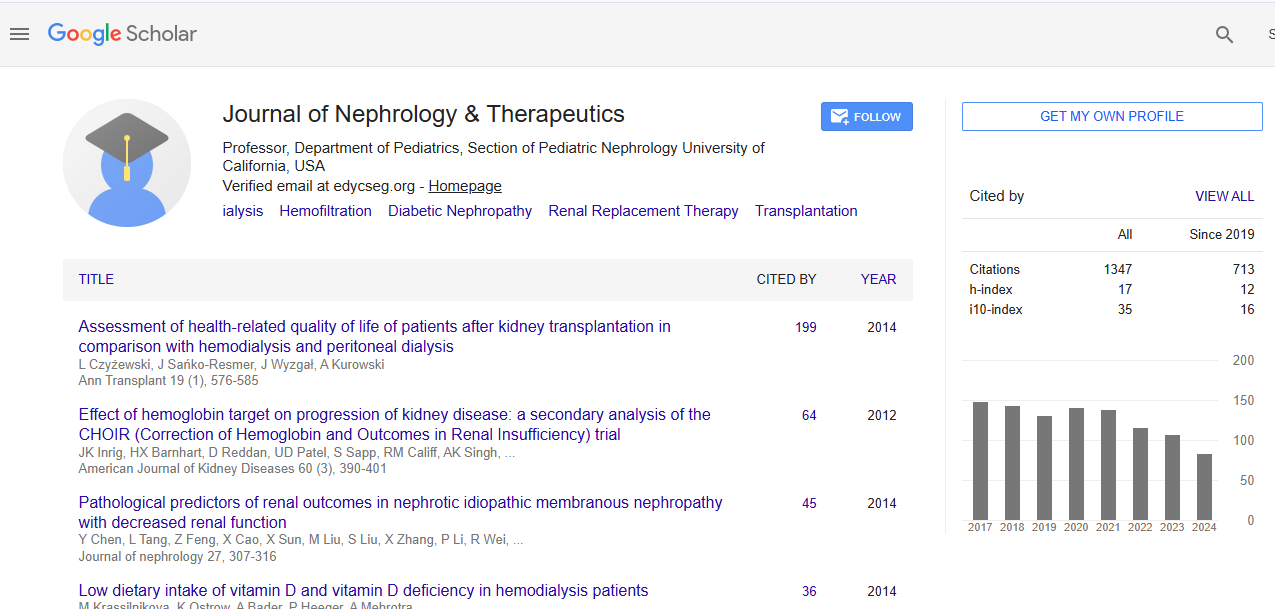
Journal of Nephrology & Therapeutics received 784 citations as per Google Scholar report