Opinion - (2025) Volume 15, Issue 6
Received: 01-Nov-2025, Manuscript No. jnt-26-178977;
Editor assigned: 03-Nov-2025, Pre QC No. P-178977;
Reviewed: 17-Nov-2025, QC No. Q-178977;
Revised: 24-Nov-2025, Manuscript No. R-178977;
Published:
29-Nov-2025
, DOI: 10.37421/2161-0959.2025.15.594
Citation: Cherif, Loubna. ”Novel AKI Therapies: Beyond Supportive Care.” J Nephrol Ther 15 (2025):594.
Copyright: © 2025 Cherif L. This is an open-access article distributed under the terms of the Creative Commons Attribution License, which permits unrestricted use, distribution and reproduction in any medium, provided the original author and source are credited.
Acute kidney injury (AKI) represents a critical clinical challenge, characterized by a rapid decline in kidney function and posing significant risks for patient morbidity and mortality. Recent advancements have begun to illuminate the complex molecular and cellular processes underpinning AKI, paving the way for novel therapeutic interventions beyond traditional supportive care. This evolving understanding is crucial for developing more effective strategies to combat this widespread condition. Emerging research has identified several promising therapeutic targets that aim to address the multifaceted nature of AKI. These targets focus on intervening at various stages of the injury cascade, from initial insult to the processes that promote repair or lead to chronic kidney disease. The exploration of these new avenues signifies a shift towards more proactive and precise management of AKI. One key area of investigation involves the modulation of inflammatory pathways, which are central to AKI pathogenesis. By understanding how inflammatory cascades contribute to tubular injury and fibrotic remodeling, researchers are identifying specific molecular targets that can be modulated to protect kidney function and prevent long-term damage. This approach holds significant promise for reducing the severity and progression of AKI. Cellular mechanisms are also at the forefront of AKI research, with a particular focus on regenerative medicine. Strategies involving stem cell-based therapies are being explored for their potential to repair damaged kidney tissue. Different types of stem cells are being investigated for their regenerative capabilities, offering hope for restoring kidney function after injury. Oxidative stress is another well-recognized contributor to kidney damage in AKI. The excessive production of reactive oxygen species during ischemic or toxic insults can lead to significant cellular damage. Consequently, the development of effective antioxidant therapies is being pursued to mitigate this damage and protect renal cells. The concept of 'nephroprotection' is being redefined to encompass active strategies that not only prevent further injury but also promote renal cell survival and repair. This involves identifying and targeting novel molecular pathways and signaling molecules that are critical for the kidney's endogenous protective mechanisms, thereby enhancing its resilience to injury. Cellular senescence, a state of irreversible cell cycle arrest, has emerged as a significant factor in AKI. The accumulation of senescent cells in injured kidney tissue can promote chronic inflammation and fibrosis, exacerbating kidney damage. Strategies aimed at clearing these senescent cells or mitigating their harmful effects are gaining traction. Ferroptosis, a distinct form of regulated cell death characterized by iron-dependent lipid peroxidation, has also been implicated in AKI. Understanding the mechanisms driving ferroptosis in the kidney opens up new therapeutic avenues targeting these pathways to prevent cell death and preserve kidney function. Exosomal microRNAs (miRNAs) are increasingly recognized for their role in mediating intercellular communication during AKI. These small non-coding RNAs can influence kidney injury and repair processes, and modulating their levels or functions represents a novel therapeutic strategy for AKI management. Finally, targeting endothelial dysfunction, a hallmark of AKI, is crucial. Damage to the endothelial barrier and microvascular alterations significantly contribute to kidney injury. Therapeutic agents that protect or restore endothelial function are being developed to maintain renal perfusion and reduce inflammation, thereby preserving kidney integrity.
The evolving landscape of acute kidney injury (AKI) treatment is characterized by a deep dive into its intricate cellular and molecular underpinnings, moving beyond conventional supportive measures to explore innovative therapeutic targets. This shift is driven by a growing understanding of the complex pathways that lead to kidney damage and dysfunction, offering new hope for improved patient outcomes. Novel therapeutic targets are being identified by focusing on the mechanisms that contribute to AKI. One significant area of research is the role of inflammation in the pathogenesis of AKI. Inflammatory cascades are known to cause tubular injury and fibrotic remodeling, and therefore, modulating these pathways through targeted agents is a key strategy being investigated to protect kidney function. Regenerative medicine offers a promising avenue for AKI treatment, with stem cell-based therapies at the forefront. Various types of stem cells, including mesenchymal stem cells and induced pluripotent stem cells, are being studied for their ability to promote tissue repair. Their mechanisms of action, such as paracrine signaling and immunomodulation, are crucial to understanding their therapeutic potential. The contribution of oxidative stress to AKI is well-established, with reactive oxygen species playing a significant role in cellular damage during insults. Consequently, the development of antioxidant therapies, including compounds like N-acetylcysteine and targeted delivery systems, is a critical area of research aimed at ameliorating AKI. Nephroprotection is being approached with a more active strategy, focusing on mechanisms that promote renal cell survival and repair. This involves identifying novel molecular targets and activating endogenous protective pathways within the kidney to enhance its resilience against injury. This proactive approach aims to preserve kidney function more effectively. Cellular senescence, a state of stable cell cycle arrest, has been recognized as a contributor to the chronic inflammation and fibrosis observed in AKI. Therapeutic strategies targeting senescent cells, such as senolytic drugs that clear these cells, are being explored to mitigate their detrimental effects on kidney tissue. Ferroptosis, a distinct form of regulated cell death driven by iron-dependent lipid peroxidation, is another emerging target in AKI research. By understanding how this process contributes to kidney damage, researchers are developing interventions aimed at targeting ferroptosis pathways to protect the kidneys from further injury. The gut-kidney axis is also gaining attention as a potential therapeutic target in AKI. Dysbiosis in the gut microbiome can lead to the production of uremic toxins and inflammatory mediators that negatively impact kidney health. Interventions aimed at restoring gut microbiome balance are being explored as a means to prevent or treat AKI. Exosomal microRNAs (miRNAs) have emerged as critical mediators of intercellular communication in AKI. These small RNA molecules can influence kidney injury and repair processes. Strategies that modulate exosomal miRNA levels are being investigated for their therapeutic potential in AKI. Targeting endothelial dysfunction is another vital strategy in AKI management. Damage to the endothelial barrier and microvascular alterations contribute significantly to the injury. Therapeutic agents designed to protect or restore endothelial function are being developed to improve renal perfusion and reduce inflammation, thereby preserving kidney integrity.
Acute kidney injury (AKI) research is rapidly advancing, moving beyond supportive care to identify novel therapeutic targets. Key areas of focus include modulating inflammation, utilizing regenerative medicine with stem cell therapies, combating oxidative stress with antioxidants, and enhancing nephroprotection through endogenous mechanisms. Emerging strategies also target cellular senescence, ferroptosis, the gut-kidney axis, exosomal microRNAs, and endothelial dysfunction to mitigate kidney damage and promote repair. Early diagnosis and personalized treatment are emphasized for improved patient outcomes.
None
None
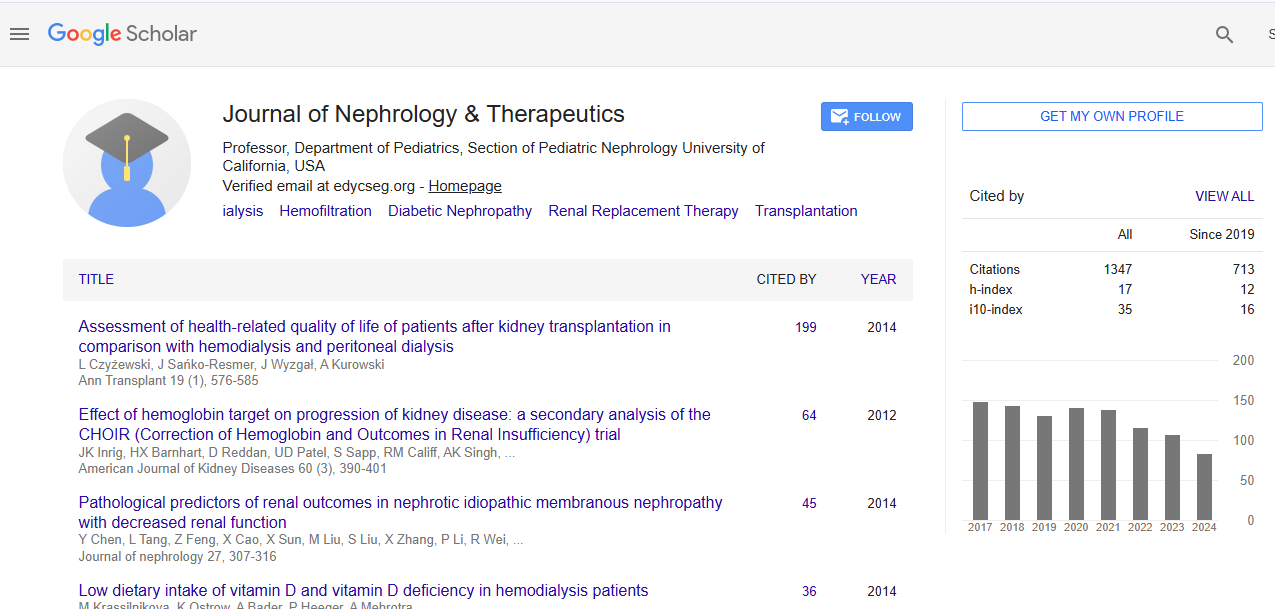
Journal of Nephrology & Therapeutics received 784 citations as per Google Scholar report