Perspective - (2025) Volume 16, Issue 5
Received: 01-Sep-2025, Manuscript No. jpm-26-179460;
Editor assigned: 03-Sep-2025, Pre QC No. P-179460;
Reviewed: 17-Sep-2025, QC No. Q-179460;
Revised: 22-Sep-2025, Manuscript No. R-179460;
Published:
29-Sep-2025
, DOI: 10.37421/2090-0902.2025.16.558
Citation: Petrov, Ivan. ”Nonlinear Control: Diverse Scientific and Engineering Frontiers.” J Phys Math 16 (2025):558.
Copyright: © 2025 Petrov I. This is an open-access article distributed under the terms of the Creative Commons Attribution License, which permits unrestricted use, distribution and reproduction in any medium, provided the original author and source are credited.
The application of nonlinear control theory to complex physical systems is a rapidly advancing field, offering unprecedented precision and adaptability in managing phenomena that defy linear approximations. This approach is crucial for tackling systems exhibiting chaotic behavior, bifurcations, and multistability, which are prevalent in disciplines such as fluid dynamics, plasma physics, and biomechanics. Techniques like feedback linearization, sliding mode control, and Lyapunov-based methods are instrumental in achieving desired system responses and ensuring stability under uncertainty. The realm of energy harvesting systems operating under unpredictable environmental conditions also benefits significantly from advanced nonlinear control techniques. Adaptive nonlinear controllers have demonstrated the ability to substantially improve energy extraction efficiency and system reliability, surpassing the limitations of traditional linear controllers. Acknowledging system nonlinearities and uncertainties is paramount for designing effective and robust controllers, with direct implications for the advancement of renewable energy technologies. Furthermore, the integration of machine learning with nonlinear control theory is opening new avenues for enhanced precision in manipulating quantum systems. Data-driven approaches, when complementing traditional analytical methods, yield controllers that adapt more effectively to the subtle dynamics of quantum states. These advancements are critical for the progress of quantum computing and quantum sensing, where precise control is a fundamental requirement. In the domain of microfluidic devices, robust nonlinear control strategies are essential for addressing challenges related to surface forces and fluid instabilities. A well-established framework ensures accurate droplet manipulation and mixing, even amidst significant parameter variations. This research holds vital importance for the development of microfluidics-based diagnostics and lab-on-a-chip technologies. Observer design for nonlinear systems suffering from significant parameter uncertainty, a common predicament in fields like robotics and aerospace, is another area of active research. Novel adaptive observers have been proposed that accurately estimate unmeasured states, thereby facilitating more effective feedback control. Such contributions are crucial for enhancing the performance and safety of systems operating within dynamic and uncertain environments. The stabilization of nonlinear mechanical systems characterized by underactuation and friction presents unique control challenges. A prominent methodology employs nonlinear feedback to achieve stable trajectories, a critical aspect for robotic manipulators and legged locomotion. This work addresses the inherent difficulties in controlling systems where direct actuation of all degrees of freedom is not possible, paving the way for new possibilities in locomotion and manipulation. Nonlinear model predictive control (NMPC) is being effectively applied to optimize power generation within complex renewable energy systems. NMPC demonstrates a strong capability to handle nonlinear dynamics and constraints, leading to enhanced efficiency and improved grid integration. This research provides practical solutions for the dynamic management of large-scale systems like wind farms and solar power plants. Nonlinear filtering techniques are being explored for state estimation in systems prone to multiplicative noise, a characteristic frequently encountered in chemical process control and biological modeling. Novel filters have been introduced that surpass standard approaches in terms of estimation accuracy and robustness. This work is vital for improving the reliability of monitoring and control in environments where noise is a significant factor. Control of nonlinear systems with time delays, a common and challenging scenario in networked physical systems and industrial processes, is also a subject of intense study. New methods are being developed for designing stabilizing controllers that exhibit robustness to variations in delay. These advancements offer improved performance and stability guarantees for systems affected by communication or transport lags. Finally, the application of chaos control techniques to enhance mixing and reaction rates in chemical reactors represents a significant area of innovation. Nonlinear control strategies are being employed to synchronize chaotic dynamics, thereby improving product yield and overall process efficiency. This research has substantial implications for the optimization of chemical processes and the design of advanced reactor systems.
Complex physical systems often exhibit behaviors that cannot be adequately described or managed by linear approximations. Nonlinear control theory provides the necessary tools to address these challenges, enabling more precise and adaptive management of phenomena like chaos, bifurcations, and multistability. This is particularly relevant in fields such as fluid dynamics, plasma physics, and biomechanics, where advanced techniques including feedback linearization, sliding mode control, and Lyapunov-based methods are essential for achieving robust stability and desired system responses. In the context of energy harvesting, unpredictable environmental conditions necessitate sophisticated control strategies. Nonlinear control techniques, especially adaptive ones, have proven effective in maximizing energy extraction efficiency and ensuring the reliability of these systems. By accounting for inherent nonlinearities and uncertainties, these controllers offer superior performance compared to conventional linear methods, with significant benefits for renewable energy technologies. The synergy between machine learning and nonlinear control theory is revolutionizing the precise manipulation of quantum systems. Data-driven approaches empower controllers to adapt dynamically to the subtle nuances of quantum states, complementing analytical methods. This integration is paramount for the advancement of quantum computing and quantum sensing, where exacting control is indispensable. Microfluidic devices present unique control challenges due to surface forces and fluid instabilities. Robust nonlinear control strategies are being developed to ensure accurate manipulation of droplets and efficient mixing, even when system parameters vary significantly. This area of research is crucial for the progress of microfluidics in diagnostics and lab-on-a-chip applications. Accurate state estimation in nonlinear systems with substantial parameter uncertainty is a persistent issue in robotics and aerospace. Innovative adaptive observer designs are emerging that can reliably estimate unmeasured states. This capability is fundamental for the implementation of effective feedback control, thereby enhancing the performance and safety of systems operating in complex, dynamic environments. Controlling underactuated mechanical systems, especially those involving friction, requires specialized nonlinear feedback approaches. Methodologies are being developed to achieve stable trajectories, which are critical for applications such as robotic manipulators and legged locomotion. These advancements address the inherent difficulties in controlling systems where direct actuation is limited, opening new frontiers in motion control. Nonlinear Model Predictive Control (NMPC) is proving to be a powerful tool for optimizing the performance of renewable energy systems, such as wind farms and solar power plants. NMPC's ability to effectively manage nonlinear dynamics and operational constraints leads to improved energy generation efficiency and better grid integration, offering practical solutions for complex energy management challenges. Systems characterized by multiplicative noise, common in chemical processes and biological models, require advanced filtering techniques for accurate state estimation. New nonlinear filters are being designed to offer enhanced accuracy and robustness over traditional methods. This is vital for ensuring reliable monitoring and control in noisy operational settings. The control of nonlinear systems incorporating time delays is a critical concern for networked physical systems and industrial automation. Innovative methods are being developed to design stabilizing controllers that are resilient to variations in these delays. This contributes to improved performance and greater stability guarantees for systems susceptible to communication or transport lags. Chaos control techniques are being applied to enhance fundamental processes in chemical reactors, specifically mixing and reaction rates. By synchronizing chaotic dynamics through nonlinear control strategies, researchers aim to improve product yield and process efficiency. This work holds significant promise for optimizing chemical manufacturing and developing next-generation reactor designs.
This collection of research highlights the critical role of nonlinear control theory across diverse scientific and engineering domains. Advances in controlling chaotic and complex physical systems, from plasma physics to biomechanics, are driven by techniques like feedback linearization and sliding mode control. Energy harvesting systems benefit from adaptive nonlinear controllers that enhance efficiency under uncertain conditions. In quantum systems, the integration of machine learning with nonlinear control promises greater precision. Microfluidics research addresses challenges with robust nonlinear strategies, while robotics and aerospace benefit from advanced adaptive observer designs for uncertain systems. The stabilization of underactuated mechanical systems and the optimization of renewable energy through Nonlinear Model Predictive Control (NMPC) are also key areas. Furthermore, nonlinear filtering improves state estimation in noisy environments, and new methods are addressing control challenges in systems with time delays. Finally, chaos control is being leveraged to optimize chemical reactions and mixing.
None
None
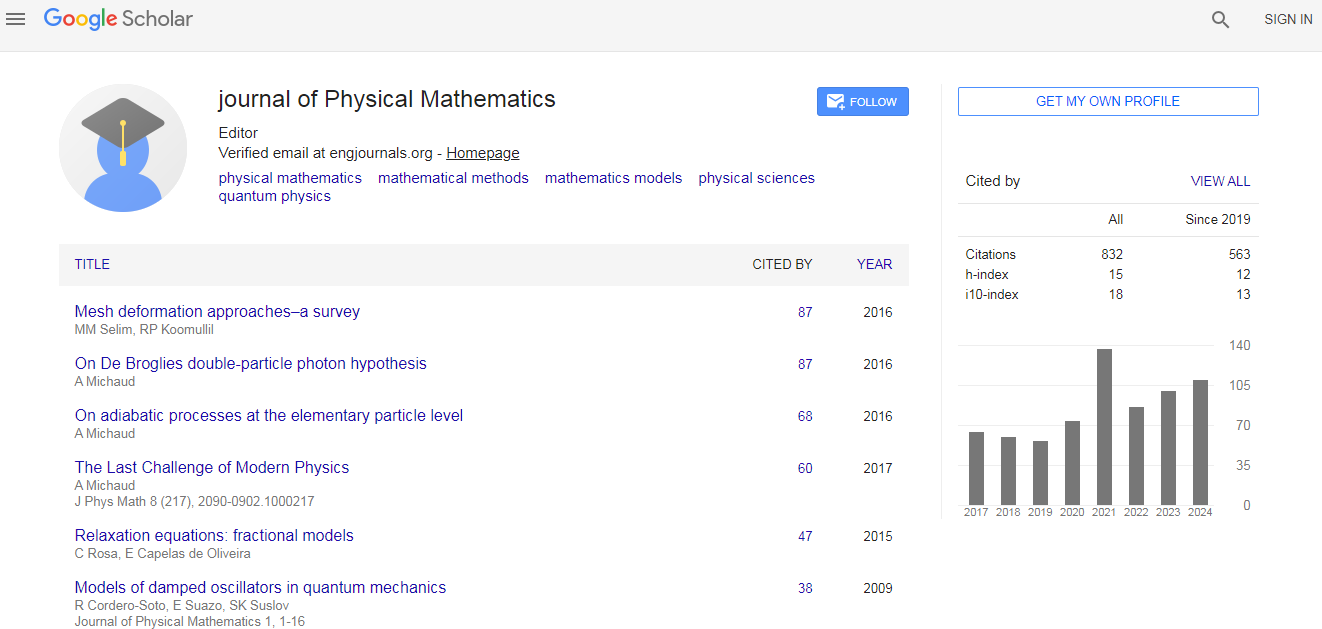
Physical Mathematics received 686 citations as per Google Scholar report