Commentary - (2025) Volume 14, Issue 5
Received: 01-Sep-2025, Manuscript No. jmmd-26-184702;
Editor assigned: 03-Sep-2025, Pre QC No. P-184702;
Reviewed: 17-Sep-2025, QC No. Q-184702;
Revised: 22-Sep-2025, Manuscript No. R-184702;
Published:
29-Sep-2025
, DOI: 10.37421/2161-0703.2025.14.546
Citation: Kulkarni, Rajesh. ”Navigating Novel Viral Diagnostics: Challenges and Solutions.” J Med Microb Diagn 14 (2025):546.
Copyright: © 2025 Kulkarni R. This is an open-access article distributed under the terms of the Creative Commons Attribution License, which permits unrestricted use, distribution and reproduction in any medium, provided the original author and source are credited.
Emerging viral infections present substantial diagnostic challenges, stemming from the novelty of pathogens and their propensity for rapid evolution. This necessitates the swift development of sensitive and specific diagnostic assays, requiring readily available reagents and equipment, particularly for detecting viruses with low viral loads or in diverse biological samples. Timely and accurate diagnosis is paramount for effective outbreak response, patient management, and public health interventions, underscoring the critical need for robust diagnostic capabilities [1].
The advancement and implementation of molecular diagnostic tools, such as RT-PCR, are fundamental to the rapid identification of novel viral agents. However, these methods face challenges related to the need for specific primers and probes, the potential for cross-reactivity with other viruses, and the requirement for specialized laboratory infrastructure and trained personnel. Point-of-care testing (POCT) offers a promising pathway for decentralized diagnostics but introduces its own set of validation and quality control issues [2].
Serological assays play a crucial role in understanding the epidemiological spread of emerging viral infections and assessing population immunity. Nevertheless, interpreting serological results can be complicated by cross-reactivity with related viruses, a time lag between infection and antibody detection, and variations in antibody persistence. Ensuring the specificity and sensitivity of these assays, especially in the early stages of an outbreak, remains a significant diagnostic hurdle [3].
The rapid identification of unknown pathogens during outbreaks relies heavily on a combination of sophisticated genomic sequencing technologies and thorough bioinformatics analysis. Key challenges include obtaining high-quality nucleic acid from diverse clinical samples, the significant computational demands of processing large datasets, and the interpretation of novel genomic sequences. The ability to quickly characterize the genetic makeup of a new virus is essential for developing targeted diagnostic tools and understanding its transmission dynamics [4].
The global nature of emerging viral infections mandates robust international collaboration in diagnostics. This encompasses the sharing of genomic data, reference materials, and best practices for assay development and validation. Harmonizing diagnostic criteria and ensuring equitable access to advanced diagnostic technologies across different regions are vital for a coordinated global response to viral threats [5].
The emergence of zoonotic viruses presents a unique diagnostic challenge, often requiring the development of assays capable of detecting viruses in both human and animal hosts. This necessitates a deep understanding of the animal reservoir, potential cross-species transmission events, and the development of multiplex diagnostics that can identify a range of potential zoonotic agents [6].
Antigen detection assays, while typically less sensitive than molecular methods, provide rapid turnaround times and can be valuable for initial sample screening. The development of highly specific monoclonal antibodies is critical for the performance of these assays. Their utility in identifying viral presence during the acute phase of infection makes them important tools, especially in resource-limited settings [7].
The diagnostic utility of viral culture, though historically significant, is often constrained by slow turnaround times and the need for specialized biosafety containment. Despite these limitations, viral culture remains the gold standard for confirming viral viability and is essential for drug susceptibility testing and isolating novel strains for further research and vaccine development [8].
Biosecurity and biosafety considerations are of utmost importance in the handling and diagnosis of emerging viral infections. Laboratories must adhere to stringent protocols to prevent laboratory-acquired infections and the accidental release of infectious agents. A thorough risk assessment for diagnostic procedures involving novel and potentially highly pathogenic viruses is a critical, yet often overlooked, aspect of diagnostic preparedness [9].
The interpretation of diagnostic results for emerging viral infections is frequently complicated by a lack of established reference ranges, limited clinical experience with the pathogen, and the potential for co-infections. Close collaboration between clinicians and laboratory professionals is essential to integrate diagnostic findings with clinical presentations for effective patient management [10].
Emerging viral infections pose considerable diagnostic difficulties, driven by novel pathogens, limited prior knowledge, and rapid viral evolution. This necessitates the rapid development of sensitive and specific diagnostic assays, alongside the availability of reagents and equipment, crucial for detecting viruses with low viral loads or within diverse biological samples. The prompt and accurate diagnosis is indispensable for effective outbreak response, patient care, and public health initiatives, highlighting the critical role of advanced diagnostic strategies [1].
Molecular diagnostic tools, such as RT-PCR, are central to the rapid identification of new viral agents. However, challenges persist concerning the requirement for sequence-specific primers and probes, the potential for cross-reactivity with other viruses, and the need for specialized laboratory infrastructure and trained personnel. Point-of-care testing (POCT) presents a promising solution for decentralized diagnostics, though it faces validation and quality control complexities [2].
Serological assays are vital for understanding the epidemiological spread of emerging viral infections and assessing population immunity. The interpretation of serological results can be complicated by cross-reactivity among related viruses, the time lag between infection and antibody detection, and variability in antibody persistence. Ensuring the specificity and sensitivity of these assays, particularly during the initial phases of an outbreak, remains a key diagnostic challenge [3].
Genomic sequencing technologies coupled with bioinformatics analysis are indispensable for the rapid identification of unknown pathogens during outbreaks. Obstacles include acquiring high-quality nucleic acid from various clinical samples, the substantial computational resources needed for data processing, and the interpretation of novel genomic sequences. The ability to quickly characterize the genetic makeup of a new virus is fundamental for developing targeted diagnostics and understanding its transmission patterns [4].
The global character of emerging viral infections underscores the importance of international collaboration in diagnostics. This involves the exchange of genomic data, reference materials, and best practices for assay development and validation. Harmonizing diagnostic criteria and ensuring equitable access to advanced diagnostic technologies globally are critical for a coordinated response to viral threats [5].
Zoonotic viruses present a unique diagnostic challenge, often demanding assays that can detect viruses in both human and animal hosts. This requires an understanding of animal reservoirs, potential cross-species transmission events, and the development of multiplex diagnostics capable of identifying a spectrum of potential zoonotic agents [6].
Antigen detection assays, while generally less sensitive than molecular methods, offer rapid turnaround times and are useful for initial screening. The development of highly specific monoclonal antibodies is crucial for assay performance. Their capability to identify viral presence during the acute phase of infection makes them valuable tools, particularly in resource-limited settings [7].
Viral culture, a historically important diagnostic method, is often limited by slow turnaround times and the requirement for specialized biosafety containment. Nevertheless, it remains the gold standard for confirming viral viability and is essential for drug susceptibility testing and isolating novel strains for research and vaccine development [8].
Biosecurity and biosafety are paramount when handling and diagnosing emerging viral infections. Laboratories must implement rigorous protocols to prevent laboratory-acquired infections and accidental release of infectious agents. Risk assessment for diagnostic procedures involving novel and potentially highly pathogenic viruses is a critical aspect of diagnostic preparedness [9].
Interpreting diagnostic results for emerging viral infections is often complicated by the absence of established reference ranges, limited clinical experience with the pathogen, and the possibility of co-infections. Effective patient management relies on close collaboration between clinicians and laboratory professionals to integrate diagnostic findings with clinical presentations [10].
Emerging viral infections pose significant diagnostic challenges due to novel pathogens, limited knowledge, and rapid evolution, necessitating rapid development of sensitive and specific assays. Molecular diagnostics like RT-PCR are crucial but require specialized infrastructure and expertise. Serological assays help understand epidemiology but face interpretation issues. Genomic sequencing and bioinformatics are vital for pathogen identification, while international collaboration and data sharing are essential for global responses. Zoonotic viruses require assays for both human and animal hosts. Antigen detection offers rapid screening, and viral culture, though slow, remains a gold standard for viability and research. Biosafety and biosecurity are critical in handling infectious agents. Interpretation of results is complex, requiring close collaboration between clinicians and lab professionals.
None
None
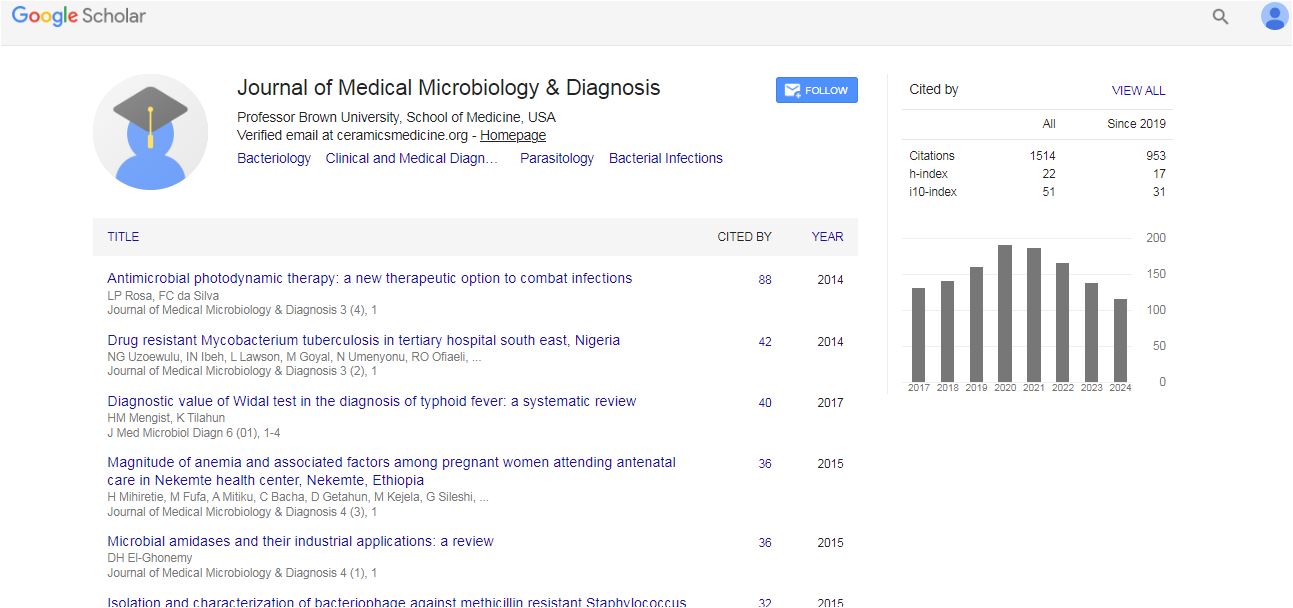
Medical Microbiology & Diagnosis received 14 citations as per Google Scholar report