Brief Report - (2025) Volume 16, Issue 5
Received: 01-Sep-2025, Manuscript No. bej-26-182489;
Editor assigned: 03-Sep-2025, Pre QC No. P-182489;
Reviewed: 17-Sep-2025, QC No. Q-182489;
Revised: 22-Sep-2025, Manuscript No. R-182489;
Published:
29-Sep-2025
, DOI: 10.37421/2161-6219.2025.16.572
Citation: Becker, Maximilien. ”Navigating Global Shifts: Data,
Agility, Sustainability, Innovation.” Bus Econ J 16 (2025):572.
Copyright: © 2025 Becker M. This is an open-access article distributed under the terms of the Creative Commons Attribution License, which permits unrestricted use,
distribution and reproduction in any medium, provided the original author and source are credited.
The contemporary business landscape is undergoing a profound transformation, driven by the relentless march of digitalization and the dynamic shifts in the global economy. Businesses are compelled to re-evaluate their strategic frameworks and operational models to remain competitive and resilient in this ever-evolving environment. This necessitates a deep understanding of emerging trends and their potential impacts on organizational structures and market positioning. The increasing integration of digital technologies across all facets of business operations is fundamentally altering how companies function and interact with their stakeholders. From customer engagement to internal processes, digitalization is a critical enabler of efficiency, innovation, and growth. The strategic adoption of these technologies is no longer optional but a prerequisite for survival and success in the modern era [1].
Emerging markets, in particular, present a unique set of challenges and opportunities for businesses. The interplay between economic policy, technological innovation, and firm performance in these regions is complex and multifaceted. Supportive government initiatives and robust investment in research and development are crucial for fostering economic growth and ensuring business prosperity within these dynamic economies [2].
Globalization, while offering avenues for market expansion and economic integration, also brings about significant societal and economic consequences. Its impact on labor markets and income inequality within developed economies is a subject of ongoing debate and concern. The potential for wage stagnation among certain worker demographics and the widening of the income gap are critical issues that require careful consideration and policy intervention [3].
The digital marketplace has introduced new paradigms for understanding consumer behavior. Behavioral economics provides valuable insights into how psychological biases influence purchasing decisions in online environments. Marketers and businesses must acknowledge and integrate these cognitive tendencies into their strategies to effectively engage consumers and optimize marketing campaigns [4].
The concept of the circular economy is gaining traction as a viable model for sustainable business practices. By focusing on waste reduction, resource efficiency, and the creation of new value streams, companies can navigate the complexities of resource scarcity and environmental concerns. This model requires systemic change and collaborative efforts across entire value chains [5].
Artificial intelligence (AI) stands as a transformative force with the potential to revolutionize productivity across numerous industries. However, its widespread adoption also raises concerns about job displacement and the future of work. Proactive strategies for workforce development and reskilling are essential to mitigate the negative consequences and harness the full potential of AI [6].
Entrepreneurship continues to be a vital engine of economic activity, particularly in times of global economic uncertainty. The ability of entrepreneurs to adapt, secure funding, and leverage supportive networks are key determinants of success. The growing prominence of social entrepreneurship also highlights the sector's role in addressing pressing societal challenges [7].
Sustainable finance and the integration of Environmental, Social, and Governance (ESG) factors are increasingly influencing corporate performance and investment decisions. A strong correlation between robust ESG performance and improved financial outcomes is becoming evident, attracting greater investor interest and emphasizing the strategic importance of sustainability [8].
Geopolitical instability and trade disputes pose significant risks to global supply chains, exposing their inherent vulnerabilities. The strategic imperative for businesses is to build resilience and diversify their supply chain networks. Agility and robustness are paramount in navigating these complex and often unpredictable global dynamics [9].
The rapid advancement of digitalization, coupled with significant shifts in the global economic landscape, is fundamentally reshaping business strategies and economic models. Companies are increasingly recognizing the critical importance of data analytics, agile management techniques, and the adoption of sustainable practices. These elements are crucial for gaining a competitive advantage and effectively navigating the inherent volatility of contemporary markets. Furthermore, businesses must remain attuned to evolving consumer behaviors and the dynamic regulatory environments to ensure their long-term viability and success [1].
In the context of emerging economies, the complex interplay between economic policies, technological advancements, and the performance of firms is a critical area of study. Research indicates that supportive governmental policies, in conjunction with substantial investments in research and development (R&D), are pivotal drivers for fostering economic growth and achieving business success in these regions. However, challenges such as infrastructure limitations and shortages of skilled talent must also be addressed to fully realize this potential [2].
The pervasive influence of globalization on labor markets and the distribution of income within developed nations warrants close examination. While globalization can contribute to enhanced economic efficiency and reduced consumer prices, it may also lead to wage stagnation for low-skilled workers and exacerbate income inequality. Consequently, the implementation of targeted policy interventions becomes essential to mitigate these adverse effects and promote more equitable outcomes [3].
Behavioral economics offers a powerful lens through which to understand consumer decision-making, particularly within the context of the digital marketplace. The study of psychological biases reveals their significant influence on online purchasing patterns and the effectiveness of marketing strategies. This underscores the necessity for businesses to design user interfaces and marketing campaigns that are cognizant of and responsive to these cognitive tendencies [4].
The emerging concept of the circular economy presents both significant challenges and promising opportunities for modern businesses. Companies are increasingly exploring and adopting circular business models with the aim of minimizing waste, optimizing resource utilization, and generating novel value streams. Realizing the full potential of this paradigm necessitates systemic shifts and robust collaboration across entire value chains [5].
The pervasive integration of artificial intelligence (AI) across various industries is having a profound impact on productivity levels and employment dynamics. While AI possesses the capacity to substantially enhance productivity, it also introduces the potential risk of job displacement for specific occupational roles. Therefore, the proactive development of workforce skills and the implementation of reskilling initiatives are of paramount importance [6].
Entrepreneurship continues to play a crucial role in navigating the complexities of a volatile global economy. Identifying and leveraging key factors such as access to funding, the cultivation of supportive networks, and the capacity for adaptability are essential for entrepreneurial success. The growing recognition and practice of social entrepreneurship also highlight the sector's commitment to addressing pressing societal challenges [7].
The burgeoning influence of sustainable finance and the integration of Environmental, Social, and Governance (ESG) factors into business operations are increasingly correlated with corporate performance and investment strategies. A discernible link exists between strong ESG performance and improved financial outcomes, alongside amplified investor interest. This trend emphasizes the strategic imperative for integrating sustainability into core business strategies [8].
Geopolitical instability and the prevalence of trade wars have exposed significant vulnerabilities within global supply chains. This has led to a strategic recalibration towards enhancing supply chain resilience and diversification. Businesses are increasingly recognizing the need to develop more agile and robust supply chain networks to mitigate risks associated with global disruptions [9].
Innovation is recognized as a primary catalyst for economic competitiveness, especially in the post-pandemic era. Fostering an organizational culture that prioritizes innovation and committing resources to research and development are crucial for maintaining a competitive edge. Continuous innovation is identified as the cornerstone of sustained long-term economic growth [10].
Businesses are adapting to digitalization and global economic shifts by focusing on data analytics, agile management, and sustainability to gain a competitive edge. Emerging markets thrive on supportive government policies and R&D investment, despite infrastructure and talent challenges. Globalization's impact on labor markets and income inequality requires policy interventions. Behavioral economics informs online consumer engagement, while the circular economy offers sustainable business models. Artificial intelligence boosts productivity but necessitates workforce adaptation. Entrepreneurship benefits from funding and networks, with social entrepreneurship addressing societal issues. ESG factors are increasingly linked to corporate performance and investment. Geopolitical risks highlight the need for resilient supply chains, and continuous innovation is vital for economic competitiveness.
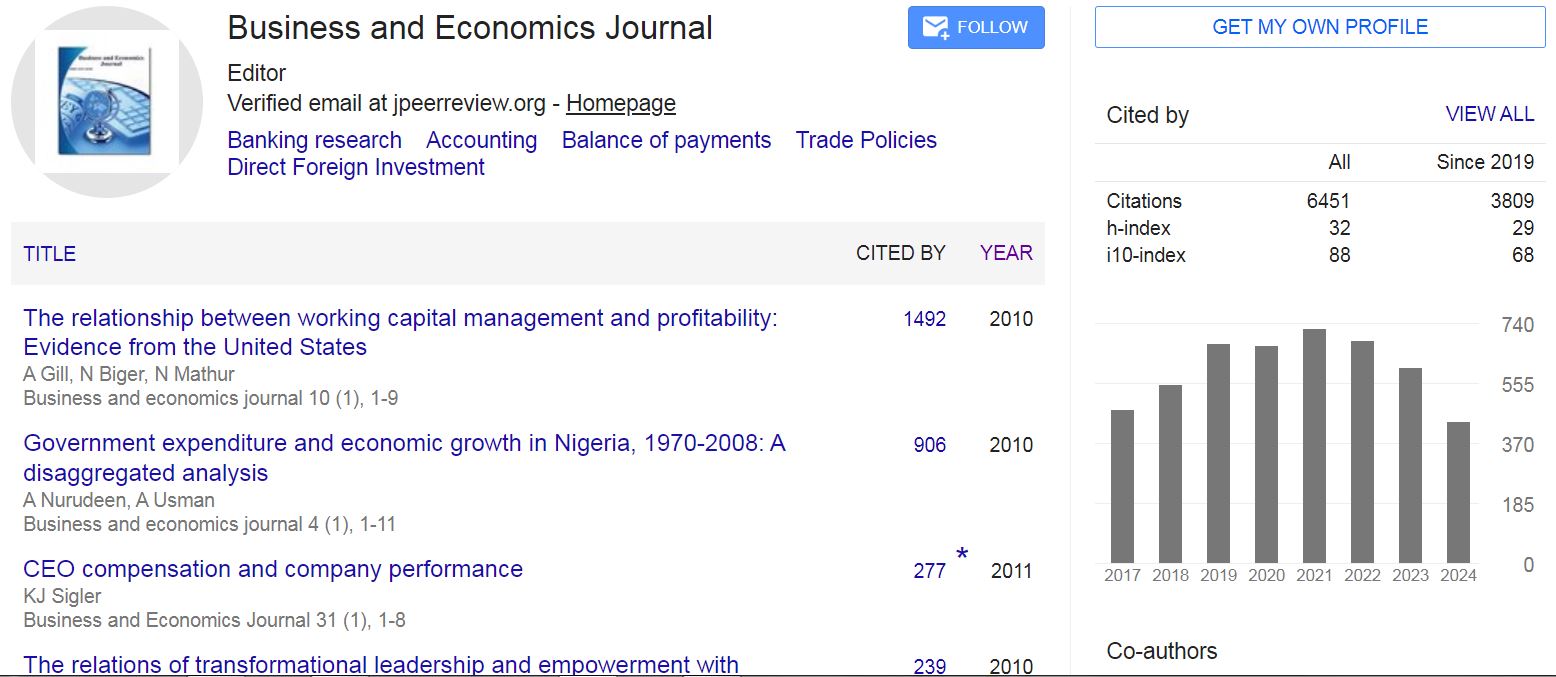
Business and Economics Journal received 6451 citations as per Google Scholar report