Commentary - (2025) Volume 13, Issue 4
Received: 01-Jul-2025, Manuscript No. economics-26-186058;
Editor assigned: 03-Jul-2025, Pre QC No. P-186058;
Reviewed: 17-Jul-2025, QC No. Q-186058;
Revised: 22-Jul-2025, Manuscript No. R-186058;
Published:
29-Jul-2025
, DOI: 10.37421/2375-4389.2025.13.534
Citation: Mokoena, Thabo. ”Navigating Global Recessions:
Causes, Recovery, and Resilience.” J Glob Econ 13 (2025):534.
Copyright: © 2025 Mokoena T. This is an open-access article distributed under the terms of the Creative Commons Attribution License, which permits unrestricted use,
distribution and reproduction in any medium, provided the original author and source are credited.
Global recessions represent a complex phenomenon with far-reaching economic consequences, necessitating a thorough understanding of their underlying causes and effective recovery strategies. Recent analyses have highlighted the evolving nature of these downturns, with contemporary events increasingly shaped by geopolitical instability and global health crises, demanding more adaptive and internationally coordinated responses than historical financial or commodity-driven recessions often required. The intricate mechanisms through which economic shocks propagate across national borders are a critical area of study, influencing the design of policies aimed at mitigating their impact and fostering resilient recoveries. Tailored fiscal and monetary policies, alongside robust structural reforms, are underscored as essential components for achieving sustainable and equitable economic growth in the aftermath of a recession. International cooperation, a vital element in navigating the complexities of global economic challenges, plays a pivotal role in synchronizing efforts and providing mutual support during periods of economic distress. The effectiveness of various fiscal stimulus measures in counteracting economic downturns has been a subject of extensive research, with findings suggesting that the optimal policy mix is highly dependent on the specific characteristics of the recession and the economic architecture of the affected nations. Direct transfers, tax reductions, and infrastructure investments are among the tools analyzed for their capacity to boost aggregate demand and support vulnerable segments of the population. Monetary policy, encompassing interest rate adjustments, quantitative easing, and forward guidance, has also been a key focus in managing recessions and stimulating recovery. The evolution of monetary tools from conventional approaches to more unconventional measures reflects the challenges posed by severe economic distress and the need for innovative solutions to inject liquidity and encourage investment. However, the long-term implications of prolonged periods of low-interest rates warrant careful consideration. The accelerating pace of digitalization and technological adoption presents a significant opportunity for economic recovery post-recession, offering pathways to enhanced productivity, new market creation, and improved public service delivery. Strategic investments in digital infrastructure and skills development are crucial for harnessing these advancements for inclusive and sustainable growth. The critical role of global governance and international collaboration in managing and recovering from recessions cannot be overstated, as coordinated policy responses and financial assistance are essential for mitigating economic shocks and promoting stability. The interconnectedness of global supply chains, while beneficial for efficiency, can also amplify the impact of disruptions, leading to shortages and inflationary pressures, thereby necessitating strategies for building resilience through diversification and improved inventory management. The differential impacts of global recessions on developed versus developing economies present unique recovery challenges, with the latter often facing greater vulnerability due to limited fiscal space and weaker institutional frameworks, underscoring the need for tailored support mechanisms. The emergence of green recovery strategies offers a dual approach, aiming to stimulate economic growth through investments in sustainable industries and renewable energy while simultaneously addressing pressing environmental concerns and building a more resilient future. Finally, the dynamics of inflation and disinflation play a crucial role in shaping recessionary trends and recovery prospects, with managing inflation expectations identified as paramount for successful economic stabilization and avoiding derailment of recovery efforts.
The multifaceted nature of global recessions, encompassing their triggers, transmission mechanisms, and recovery pathways, has been a central theme in recent economic discourse. Historical downturns, often initiated by financial crises or shifts in commodity prices, are now increasingly influenced by geopolitical events and pandemics, necessitating a paradigm shift towards more agile and internationally coordinated responses. The research highlights that while traditional remedies remain relevant, the complexity of contemporary recessions demands a nuanced approach, emphasizing the importance of bespoke fiscal and monetary policies, structural reforms, and robust international cooperation to foster recoveries that are both strong and equitable [1].
The effectiveness of fiscal stimulus measures during economic downturns is a critical area of investigation, with studies comparing the impact of direct transfers, tax cuts, and infrastructure spending. The findings suggest that the optimal mix of fiscal policies is not universal but contingent upon the specific characteristics of the recession and the economic structure of the affected countries. Well-designed, targeted fiscal interventions are recognized for their potential to significantly shorten the duration of recessions and accelerate recovery by bolstering aggregate demand and providing crucial support to vulnerable populations [2].
Monetary policy responses to global recessions, including interest rate adjustments, quantitative easing, and forward guidance, are explored for their influence on economic activity and inflation. While conventional monetary tools retain their importance, unconventional measures have become indispensable for providing liquidity and stimulating investment during severe economic distress. However, this paper also acknowledges the potential risks associated with prolonged periods of low-interest rates, underscoring the need for careful management [3].
Digitalization and technological adoption are identified as powerful catalysts for economic recovery post-recession. Embracing digital transformation can lead to enhanced productivity, the creation of new markets, and more efficient public services. The research emphasizes that investments in digital infrastructure, skills development, and supportive regulatory frameworks are crucial for ensuring that technological advancements contribute to inclusive and sustainable economic growth during recovery phases [4].
The imperative of global cooperation and effective governance in managing and recovering from global recessions is a significant focus. Coordinated policy responses, financial assistance, and information sharing among nations and international institutions are vital. A breakdown in global cooperation can exacerbate downturns and prolong recovery, while robust multilateral engagement is essential for fostering stability and shared prosperity [5].
Supply chain disruptions have a profound impact on global recessions and subsequent recovery strategies. The interconnectedness of global supply chains, while promoting efficiency, can amplify the effects of shocks, leading to shortages and inflationary pressures. Building resilience through diversification, nearshoring, and strategic inventory management is posited as critical for achieving faster and more stable economic recoveries [6].
The differential impact of global recessions on developed versus developing economies presents distinct recovery challenges. Developing countries, often possessing less fiscal space and weaker institutional capacity, are more vulnerable to external shocks and experience slower recoveries. The research highlights the necessity for tailored support mechanisms, including debt relief and targeted aid, to facilitate recovery in these economies [7].
Green recovery strategies are emerging as a promising approach to post-recession economic growth. Investing in sustainable industries, renewable energy, and climate adaptation offers a dual benefit: fostering economic expansion while simultaneously addressing environmental challenges. Green stimulus packages have the potential to create jobs, enhance energy security, and build a more resilient and sustainable economic future [8].
Inflation dynamics and disinflation processes significantly influence recessionary trends and recovery prospects. The manner in which different inflation scenarios affect consumer behavior, investment decisions, and the efficacy of monetary policy is a crucial consideration. Managing inflation expectations is paramount for achieving a smooth recovery, as high or volatile inflation can undermine economic stabilization efforts [9].
Finally, the labor market implications of global recessions and the strategies for achieving a robust and inclusive employment recovery are examined. The impact on unemployment rates, wage growth, and job quality is discussed, with an emphasis on the importance of active labor market policies, reskilling and upskilling initiatives, and social safety nets to help workers navigate economic downturns and fully participate in the subsequent recovery [10].
This collection of research analyzes global recessions, exploring their diverse causes, including geopolitical events, pandemics, and financial crises. It examines various recovery strategies, such as fiscal stimulus, monetary policy adjustments, and the role of digitalization. The studies emphasize the importance of international cooperation, resilient supply chains, and tailored approaches for developed and developing economies. Green recovery initiatives and strategies for labor market recovery are also highlighted. Key findings indicate that effective responses require tailored policies, robust international collaboration, and a focus on sustainable and inclusive growth. Managing inflation and adapting to technological advancements are crucial for navigating economic downturns and accelerating recovery. The research underscores the need for proactive measures to build resilience and foster stable economic futures. A comprehensive understanding of these factors is essential for policymakers and stakeholders aiming to mitigate the impact of recessions and promote robust global economic recovery.
None
None
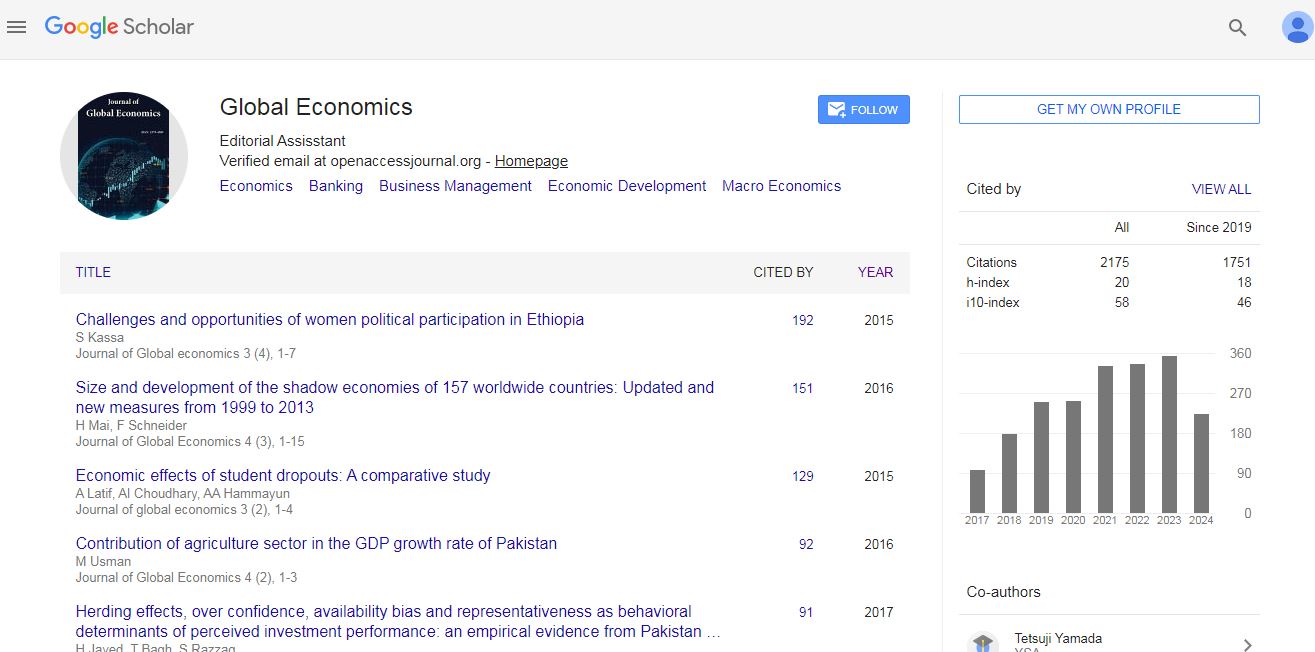
Journal of Global Economics received 2175 citations as per Google Scholar report