Short Communication - (2025) Volume 16, Issue 3
Received: 01-May-2025, Manuscript No. bej-26-182440;
Editor assigned: 05-May-2025, Pre QC No. P-182440;
Reviewed: 19-May-2025, QC No. Q-182440;
Revised: 22-May-2025, Manuscript No. R-182440;
Published:
29-May-2025
, DOI: 10.37421/2161-6219.2025.16.561
Citation: Kadir, Sami. ”Navigating Global Business: Adaptability,
Resilience, Innovation.” Bus Econ J 16 (2025):561.
Copyright: © 2025 Kadir S. This is an open-access article distributed under the terms of the Creative Commons Attribution License, which permits unrestricted use, distribution
and reproduction in any medium, provided the original author and source are credited.
Globalization profoundly reshapes business strategies, demanding adaptive models and cross-cultural understanding. Economic policies must navigate interconnected markets, addressing both opportunities in trade and challenges from global competition and inequality. This review synthesizes key insights into how businesses and economies are evolving in this dynamic global landscape, emphasizing resilience, innovation, and sustainable practices [1].
The digitalization of business operations is a defining characteristic of the globalized era. Companies leveraging digital platforms and advanced analytics gain competitive advantages, but also face increased cybersecurity risks and the need for constant technological adaptation. Understanding these digital shifts is crucial for economic competitiveness [2].
Global supply chains are under immense pressure from geopolitical events, climate change, and evolving consumer demands. Businesses must build more resilient and diversified supply networks, shifting from lean just-in-time models to strategies that prioritize flexibility and regionalization to mitigate disruptions [3].
The rise of emerging economies presents both opportunities and challenges for established global players. Understanding local market dynamics, regulatory environments, and consumer behavior is essential for successful market entry and sustained growth. Economic development in these regions also impacts global trade patterns [4].
Sustainability has moved from a niche concern to a core business imperative in a globalized world. Companies are increasingly judged on their environmental, social, and governance (ESG) performance, influencing investment decisions and consumer loyalty. Integrating sustainable practices is key to long-term economic viability [5].
The dynamics of global financial markets are increasingly complex, influenced by monetary policy shifts, geopolitical risks, and technological innovations like FinTech. Understanding these interconnections is vital for businesses and policymakers to manage capital flows and ensure financial stability [6].
Talent management in a globalized world requires attracting, developing, and retaining a diverse workforce. Companies must navigate different labor laws, cultural norms, and skill gaps to build effective global teams. The competition for skilled labor is a significant economic factor [7].
The competitive landscape is continuously shifting due to globalization, necessitating continuous innovation. Businesses that foster a culture of R&D and adapt quickly to market changes are more likely to thrive. Economic policy plays a role in incentivizing innovation and R&D investment [8].
Geopolitical tensions and trade protectionism present significant risks to global economic integration. Businesses need to develop strategies that account for fluctuating trade policies and potential disruptions to international commerce. Economic forecasting must incorporate these uncertainties [9].
The evolving nature of work, driven by automation and remote collaboration tools, is a critical aspect of globalization. Businesses must adapt their organizational structures and management practices to accommodate flexible work arrangements and the integration of AI into the workforce [10].
The global economic landscape is characterized by profound shifts driven by globalization, necessitating adaptive business strategies and a nuanced understanding of cross-cultural dynamics. Navigating interconnected markets requires careful consideration of both the opportunities presented by international trade and the inherent challenges of global competition and rising inequality. The synthesis of insights into the evolution of businesses and economies highlights the importance of resilience, innovation, and sustainable practices in this dynamic environment [1].
Digitalization serves as a cornerstone of modern business operations within the globalized era. Organizations that effectively utilize digital platforms and sophisticated analytical tools are positioned to gain significant competitive advantages. However, this digital transformation also introduces heightened cybersecurity risks and demands continuous adaptation to technological advancements, underscoring its critical role in maintaining economic competitiveness [2].
Global supply chains are currently experiencing unprecedented pressure stemming from geopolitical instability, the impacts of climate change, and the fluctuating demands of consumers. Consequently, businesses are compelled to develop more robust and diversified supply networks. This involves a strategic pivot away from purely lean, just-in-time models towards approaches that emphasize flexibility and regionalization to better withstand and mitigate potential disruptions [3].
Emerging economies represent a dual frontier of opportunity and challenge for established global enterprises. Successful market entry and sustained growth hinge on a deep comprehension of local market nuances, distinct regulatory frameworks, and specific consumer behaviors. The economic development within these regions also fundamentally influences global trade patterns and economic interactions [4].
Sustainability has transitioned from a peripheral concern to an indispensable element of global business strategy. Companies are increasingly evaluated based on their environmental, social, and governance (ESG) performance, which directly impacts investment decisions and shapes consumer loyalty. The integration of sustainable practices is therefore paramount for achieving long-term economic viability and stakeholder trust [5].
Global financial markets exhibit increasing complexity, with their dynamics significantly influenced by evolving monetary policies, pervasive geopolitical risks, and the rapid proliferation of technological innovations such as FinTech. A thorough understanding of these intricate interconnections is essential for both businesses and policymakers in effectively managing capital flows and safeguarding financial stability on a global scale [6].
Effective talent management within a globalized context necessitates the strategic attraction, development, and retention of a diverse workforce. Companies must adeptly navigate a complex web of international labor laws, diverse cultural norms, and varying skill availabilities to cultivate high-performing global teams. The intense competition for skilled professionals is a substantial economic determinant in today's interconnected world [7].
The global competitive arena is in a constant state of flux, driven by the pervasive forces of globalization, which in turn mandate continuous innovation. Enterprises that cultivate a strong culture of research and development and demonstrate agility in responding to market shifts are far more likely to achieve enduring success. Economic policy also plays a crucial role in fostering an environment that incentivizes innovation and R&D investment [8].
Geopolitical tensions and the resurgence of trade protectionism pose considerable risks to the advancement of global economic integration. Businesses are increasingly required to formulate strategies that proactively address fluctuating trade policies and potential disruptions to the flow of international commerce. Economic forecasting models must therefore evolve to accurately incorporate these inherent uncertainties [9].
The transformation of work, accelerated by automation and the widespread adoption of remote collaboration technologies, is a pivotal consequence of globalization. Businesses must critically re-evaluate and adapt their organizational structures and management methodologies to effectively support flexible work arrangements and the seamless integration of artificial intelligence into the workforce [10].
Globalization is fundamentally altering business strategies, requiring adaptability and cross-cultural insight. Digitalization offers competitive advantages but also risks, while global supply chains face disruption, pushing for resilience and diversification. Emerging markets present growth opportunities, and sustainability is now a core business imperative, influencing ESG performance and investment. Global financial markets are complex, impacted by policy and FinTech, necessitating careful management. Talent acquisition and retention in a diverse global workforce are critical, as is continuous innovation driven by R&D. Geopolitical risks and trade protectionism challenge integration, requiring strategic foresight. The nature of work is evolving with automation and remote tools, demanding organizational adaptation.
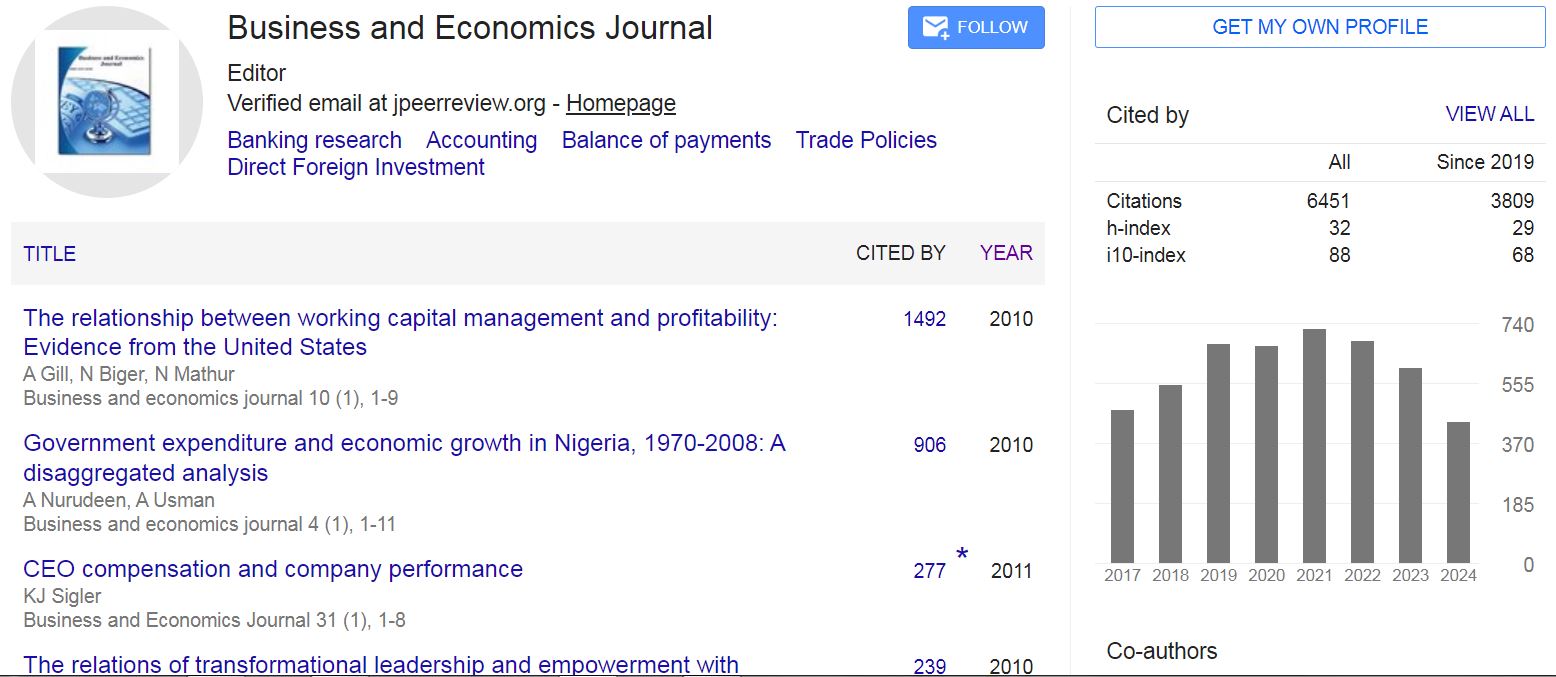
Business and Economics Journal received 6451 citations as per Google Scholar report