Perspective - (2025) Volume 9, Issue 4
Received: 01-Jul-2025, Manuscript No. fsb-26-189958;
Editor assigned: 03-Jul-2025, Pre QC No. P-189958;
Reviewed: 17-Jul-2025, QC No. Q-189958;
Revised: 22-Jul-2025, Manuscript No. R-189958;
Published:
09-Jul-2025
, DOI: 10.37421/2577-0543.2025.9.244
Citation: Kulkarni, Rajesh. ”Nanoemulsions: Advancing Drug Delivery with Enhanced Bioavailability.” J Formul Sci Bioavailab 09 (2025):244.
Copyright: © 2025 Kulkarni R. This is an open-access article distributed under the terms of the Creative Commons Attribution License, which permits unrestricted use, distribution and reproduction in any medium, provided the original author and source are credited.
Nanoemulsion-based drug delivery systems represent a significant leap forward in therapeutic interventions, primarily attributed to their enhanced bioavailability, improved solubility of challenging drug compounds, and sophisticated targeted delivery capabilities. These advanced systems are characterized by their exceptionally small droplet sizes, typically within the nanometer range. This nanoscale dimension is instrumental in facilitating a more efficient absorption of poorly soluble drugs, which consequently leads to enhanced therapeutic efficacy and allows for a reduction in the frequency of drug administration. The inherent tunability of their physicochemical properties further empowers researchers and formulators to customize these systems for specific drug molecules and diverse administration routes, establishing them as remarkably versatile tools in the ongoing development of novel pharmaceuticals [1].
The intricate formulation of nanoemulsions for effective drug delivery necessitates a highly meticulous and systematic process. This involves the judicious selection of key components, including surfactants, co-surfactants, oils, and water, all of which are critical for achieving the desired droplet size and ensuring the long-term stability of the emulsion. For the preparation of these nanoemulsions, both high-energy methodologies, such as high-pressure homogenization, and low-energy techniques, like spontaneous emulsification, are frequently employed. The stability of these nanoemulsions is of paramount importance, as they must withstand various environmental factors including temperature fluctuations, pH changes, and variations in ionic strength, to guarantee their efficacy throughout their shelf-life and during in vivo performance [2].
Nanoemulsions have demonstrated considerable promise in significantly improving the oral bioavailability of drugs that are inherently poorly soluble in water. The remarkably small droplet size characteristic of nanoemulsions, coupled with their expansive surface area, serves to augment the solubilization and subsequent absorption of drugs within the gastrointestinal tract. Moreover, these systems possess the capability to shield therapeutic agents from enzymatic degradation and mitigate the effects of first-pass metabolism, thereby leading to higher systemic drug concentrations and ultimately, more favorable therapeutic outcomes [3].
The application of nanoemulsions in targeted drug delivery presents a compelling strategy for minimizing systemic drug exposure and concurrently reducing the incidence of off-target side effects. This is often achieved through surface modification of the nanoemulsion droplets with specific ligands, antibodies, or peptides, which then enable precise targeting to disease sites, such as tumor tissues or areas of inflammation. This localized delivery mechanism significantly enhances the drug concentration at the intended target site, thereby improving therapeutic efficacy while simultaneously minimizing systemic toxicity [4].
Nanoemulsions are also finding extensive application in parenteral drug delivery, offering distinct advantages that include enhanced drug solubility and improved stability for injectable formulations. They can effectively facilitate the intravenous delivery of hydrophobic drugs, diminishing the reliance on organic solvents and potentially contributing to improved patient safety. Furthermore, the inherent controlled-release characteristics exhibited by certain nanoemulsion formulations can be leveraged to prolong the duration of drug action, providing sustained therapeutic benefits [5].
For topical and transdermal drug delivery applications, nanoemulsions possess the capability to significantly enhance the penetration of active pharmaceutical ingredients into the skin, thereby improving both local and systemic absorption. The minute droplet size of these systems, along with their capacity to interact favorably with the stratum corneum, facilitates the efficient transport of drugs across the skin barrier. This attribute makes them particularly well-suited for the delivery of drugs intended for various dermatological conditions and for achieving desired systemic drug levels through non-invasive routes [6].
The utilization of nanoemulsions in ocular drug delivery is emerging as a promising approach to overcome critical challenges such as poor drug bioavailability and rapid clearance from the ocular surface. These systems have shown potential in improving drug penetration into ocular tissues and extending the retention time of therapeutic agents. Their inherent mucoadhesive properties can further enhance the drug's residence time on the ocular surface, leading to sustained drug release and improved therapeutic outcomes for prevalent conditions like glaucoma and dry eye disease [7].
Inhalation-based delivery of therapeutic agents using nanoemulsions is actively being explored as a novel strategy for managing respiratory diseases. This approach aims to achieve enhanced lung deposition and improved absorption of drugs directly into the pulmonary tissues. Such a method could prove particularly beneficial for delivering medications to treat chronic conditions like asthma and COPD, as well as lung infections, potentially leading to a reduction in the systemic side effects often associated with conventional administration routes [8].
The nanoemulsion formulation strategy proves particularly advantageous for the delivery of sensitive biomolecules, including peptides, proteins, and nucleic acids, which are often plagued by inherent instability and limited bioavailability. Nanoemulsions offer a protective environment for these fragile molecules, shielding them from degradation and facilitating their transport across biological barriers. This capability opens new avenues for the development of more effective therapies involving biologics that were previously challenging to deliver effectively [9].
The regulatory framework governing nanoemulsion-based drug delivery systems is currently undergoing significant evolution, with an increasing focus placed on rigorous characterization, comprehensive safety assessments, and robust efficacy evaluations. A thorough understanding of the potential long-term effects and the biocompatibility of the constituent components of nanoemulsions is absolutely critical for their successful translation into clinical practice. Ongoing research efforts are largely directed towards developing standardized methodologies for characterization and establishing reliable preclinical and clinical evaluation strategies to meet these evolving regulatory demands [10].
Nanoemulsion-based drug delivery systems represent a significant leap forward in therapeutic interventions, primarily attributed to their enhanced bioavailability, improved solubility of challenging drug compounds, and sophisticated targeted delivery capabilities. These advanced systems are characterized by their exceptionally small droplet sizes, typically within the nanometer range. This nanoscale dimension is instrumental in facilitating a more efficient absorption of poorly soluble drugs, which consequently leads to enhanced therapeutic efficacy and allows for a reduction in the frequency of drug administration. The inherent tunability of their physicochemical properties further empowers researchers and formulators to customize these systems for specific drug molecules and diverse administration routes, establishing them as remarkably versatile tools in the ongoing development of novel pharmaceuticals [1].
The intricate formulation of nanoemulsions for effective drug delivery necessitates a highly meticulous and systematic process. This involves the judicious selection of key components, including surfactants, co-surfactants, oils, and water, all of which are critical for achieving the desired droplet size and ensuring the long-term stability of the emulsion. For the preparation of these nanoemulsions, both high-energy methodologies, such as high-pressure homogenization, and low-energy techniques, like spontaneous emulsification, are frequently employed. The stability of these nanoemulsions is of paramount importance, as they must withstand various environmental factors including temperature fluctuations, pH changes, and variations in ionic strength, to guarantee their efficacy throughout their shelf-life and during in vivo performance [2].
Nanoemulsions have demonstrated considerable promise in significantly improving the oral bioavailability of drugs that are inherently poorly soluble in water. The remarkably small droplet size characteristic of nanoemulsions, coupled with their expansive surface area, serves to augment the solubilization and subsequent absorption of drugs within the gastrointestinal tract. Moreover, these systems possess the capability to shield therapeutic agents from enzymatic degradation and mitigate the effects of first-pass metabolism, thereby leading to higher systemic drug concentrations and ultimately, more favorable therapeutic outcomes [3].
The application of nanoemulsions in targeted drug delivery presents a compelling strategy for minimizing systemic drug exposure and concurrently reducing the incidence of off-target side effects. This is often achieved through surface modification of the nanoemulsion droplets with specific ligands, antibodies, or peptides, which then enable precise targeting to disease sites, such as tumor tissues or areas of inflammation. This localized delivery mechanism significantly enhances the drug concentration at the intended target site, thereby improving therapeutic efficacy while simultaneously minimizing systemic toxicity [4].
Nanoemulsions are also finding extensive application in parenteral drug delivery, offering distinct advantages that include enhanced drug solubility and improved stability for injectable formulations. They can effectively facilitate the intravenous delivery of hydrophobic drugs, diminishing the reliance on organic solvents and potentially contributing to improved patient safety. Furthermore, the inherent controlled-release characteristics exhibited by certain nanoemulsion formulations can be leveraged to prolong the duration of drug action, providing sustained therapeutic benefits [5].
For topical and transdermal drug delivery applications, nanoemulsions possess the capability to significantly enhance the penetration of active pharmaceutical ingredients into the skin, thereby improving both local and systemic absorption. The minute droplet size of these systems, along with their capacity to interact favorably with the stratum corneum, facilitates the efficient transport of drugs across the skin barrier. This attribute makes them particularly well-suited for the delivery of drugs intended for various dermatological conditions and for achieving desired systemic drug levels through non-invasive routes [6].
The utilization of nanoemulsions in ocular drug delivery is emerging as a promising approach to overcome critical challenges such as poor drug bioavailability and rapid clearance from the ocular surface. These systems have shown potential in improving drug penetration into ocular tissues and extending the retention time of therapeutic agents. Their inherent mucoadhesive properties can further enhance the drug's residence time on the ocular surface, leading to sustained drug release and improved therapeutic outcomes for prevalent conditions like glaucoma and dry eye disease [7].
Inhalation-based delivery of therapeutic agents using nanoemulsions is actively being explored as a novel strategy for managing respiratory diseases. This approach aims to achieve enhanced lung deposition and improved absorption of drugs directly into the pulmonary tissues. Such a method could prove particularly beneficial for delivering medications to treat chronic conditions like asthma and COPD, as well as lung infections, potentially leading to a reduction in the systemic side effects often associated with conventional administration routes [8].
The nanoemulsion formulation strategy proves particularly advantageous for the delivery of sensitive biomolecules, including peptides, proteins, and nucleic acids, which are often plagued by inherent instability and limited bioavailability. Nanoemulsions offer a protective environment for these fragile molecules, shielding them from degradation and facilitating their transport across biological barriers. This capability opens new avenues for the development of more effective therapies involving biologics that were previously challenging to deliver effectively [9].
The regulatory framework governing nanoemulsion-based drug delivery systems is currently undergoing significant evolution, with an increasing focus placed on rigorous characterization, comprehensive safety assessments, and robust efficacy evaluations. A thorough understanding of the potential long-term effects and the biocompatibility of the constituent components of nanoemulsions is absolutely critical for their successful translation into clinical practice. Ongoing research efforts are largely directed towards developing standardized methodologies for characterization and establishing reliable preclinical and clinical evaluation strategies to meet these evolving regulatory demands [10].
Nanoemulsions represent a significant advancement in drug delivery, offering enhanced bioavailability, solubility, and targeted delivery due to their nanoscale droplet size. They improve absorption of poorly soluble drugs, leading to better efficacy and reduced dosing frequency. The formulation process is meticulous, involving careful selection of components and preparation methods like homogenization or spontaneous emulsification, with stability being crucial for performance. These systems excel in enhancing oral bioavailability by increasing drug solubilization and protecting against degradation, and enable targeted delivery through surface modification to minimize side effects. They are also valuable for parenteral, topical, transdermal, ocular, and pulmonary drug delivery, improving drug penetration and efficacy across various routes. Furthermore, nanoemulsions are effective for delivering sensitive biomolecules like peptides and proteins. The regulatory landscape for these systems is evolving, emphasizing characterization, safety, and efficacy for clinical translation.
None
None
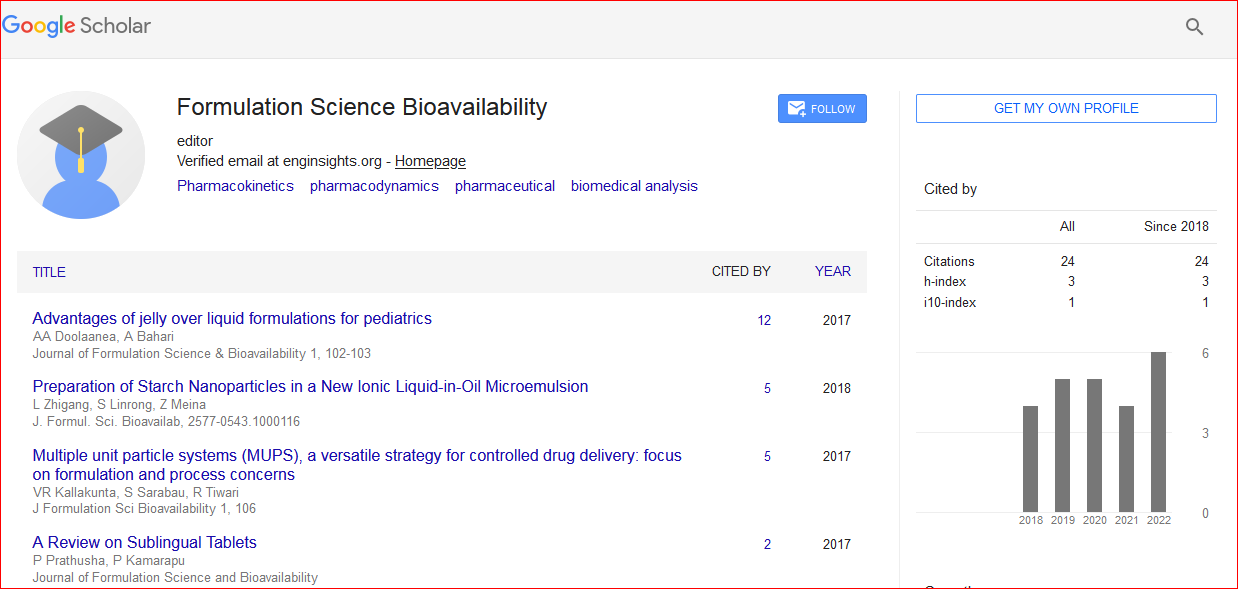
Journal of Formulation Science & Bioavailability received 23 citations as per Google Scholar report