Brief Report - (2025) Volume 12, Issue 4
Received: 01-Aug-2025, Manuscript No. jreac-26-185850;
Editor assigned: 04-Aug-2025, Pre QC No. P-185850;
Reviewed: 18-Aug-2025, QC No. Q-185850;
Revised: 22-Aug-2025, Manuscript No. R-185850;
Published:
29-Aug-2025
, DOI: 10.37421/2380-2391.2025.12.438
Citation: O’Connor, Patrick. ”Multivariate Statistics: Addressing Environmental Pollution Challenges.” J Environ Anal Chem 12 (2025):438.
Copyright: © 2025 O’Connor P. This is an open-access article distributed under the terms of the Creative Commons Attribution License, which permits unrestricted use, distribution and reproduction in any medium, provided the original author and source are credited.
The escalating challenges posed by environmental pollution necessitate sophisticated analytical techniques to understand its multifaceted nature and mitigate its adverse effects. Multivariate statistical methods have emerged as powerful tools for dissecting complex environmental datasets, offering a robust framework for identifying pollution sources, assessing spatial and temporal variations, and understanding the intricate relationships between various environmental parameters. This study explores the application of multivariate statistical methods to analyze complex environmental pollution datasets. Techniques such as Principal Component Analysis (PCA), Hierarchical Cluster Analysis (HCA), and Partial Least Squares Regression (PLSR) are detailed for identifying pollution sources, assessing spatial-temporal variations, and establishing relationships between pollutants and environmental factors. The insights gained are crucial for effective pollution management and policy development [1].
Air pollution, particularly in urban settings, presents a significant public health concern. Unraveling the dynamics of multiple air pollutants requires analytical approaches that can identify common emission sources and understand their combined impacts. Factor Analysis (FA) and Canonical Correlation Analysis (CCA) are instrumental in this regard. This research highlights the utility of Factor Analysis (FA) and Canonical Correlation Analysis (CCA) in unraveling the intricate relationships between multiple air pollutants in urban environments. The analysis helps to pinpoint common emission sources and understand the synergistic or antagonistic effects of different pollutants on public health, offering a robust framework for air quality modeling [2].
Water quality assessment is another critical area where multivariate statistics prove invaluable. Identifying distinct pollution patterns in surface water bodies can guide targeted remediation efforts and improve the management of aquatic ecosystems. The study investigates the application of Self-Organizing Maps (SOMs) for identifying distinct pollution patterns in surface water bodies. SOMs effectively group sampling sites with similar pollution characteristics, aiding in the identification of pollution hotspots and the assessment of water quality heterogeneity. This pattern recognition capability is vital for targeted remediation efforts [3].
Soil contamination poses a significant threat to land resources and human health. Accurate classification and source identification of contaminated sites are essential for effective risk assessment and land use planning. This paper demonstrates the effectiveness of Discriminant Analysis (DA) in classifying contaminated sites based on a suite of soil pollutant concentrations. DA helps in distinguishing between different contamination sources or levels, providing a statistical basis for risk assessment and land use planning in polluted areas [4].
Industrial activities often lead to the discharge of wastewater, impacting the quality of receiving water bodies. Understanding the relationship between discharge characteristics and water quality is crucial for environmental protection. The study applies Canonical Variate Analysis (CVA) to investigate the relationships between industrial wastewater discharge characteristics and receiving water body quality. CVA is employed to identify linear combinations of variables that best explain the differences between groups of sampling sites affected by varying levels of discharge, offering a multivariate approach to impact assessment [5].
Environmental noise pollution, often overlooked, can have detrimental effects on human well-being and wildlife. Source separation of complex noise signals is a prerequisite for effective noise management strategies. This paper introduces the application of Independent Component Analysis (ICA) for source separation of complex environmental noise signals. ICA is used to disentangle mixed signals from different noise sources, enabling a clearer understanding of individual pollution contributions and their spatial distribution in urban soundscapes [6].
Heavy metal pollution in marine environments, particularly in coastal sediments, requires comprehensive analysis to understand its distribution and sources. The research examines the spatio-temporal variability of heavy metal pollution in coastal sediments using geostatistical methods combined with multivariate analysis (e.g., PCA). This integrated approach helps in understanding the underlying processes controlling metal distribution and identifying potential pollution sources affecting marine ecosystems [7].
Freshwater ecosystems are susceptible to various pollution gradients, which can significantly alter microbial community structures. This study applies Non-metric Multidimensional Scaling (NMDS) to explore patterns of microbial community structure in response to different pollution gradients in freshwater ecosystems. NMDS provides a visual representation of community similarity, facilitating the identification of pollution-sensitive and pollution-tolerant microbial indicators [8].
Urban air quality is heavily influenced by anthropogenic activities, with vehicular emissions being a major contributor. The research utilizes Multiple Linear Regression (MLR) to model the relationship between traffic density and roadside air pollutant concentrations. MLR is employed to quantify the contribution of vehicular emissions to air quality degradation, providing essential data for traffic management and air pollution control strategies [9].
Waste management, particularly in urban areas, generates leachate that can pose a significant environmental risk if not properly managed. Understanding the composition of waste and its impact on leachate is crucial. This study applies Correspondence Analysis (CA) to analyze the association between different types of waste and their presence in urban landfill leachate. CA helps to identify characteristic patterns and co-occurrence of waste components, offering insights into waste composition and potential leachate pollution pathways [10].
Multivariate statistical methods offer a powerful lens through which to dissect the complexities of environmental pollution, providing essential insights for effective management and policy development. These techniques enable researchers to move beyond simple univariate analyses and explore the interrelationships among numerous variables, thereby uncovering deeper patterns and drivers of pollution. This study explores the application of multivariate statistical methods to analyze complex environmental pollution datasets. Techniques such as Principal Component Analysis (PCA), Hierarchical Cluster Analysis (HCA), and Partial Least Squares Regression (PLSR) are detailed for identifying pollution sources, assessing spatial-temporal variations, and establishing relationships between pollutants and environmental factors. The insights gained are crucial for effective pollution management and policy development [1].
In urban environments, the interplay of multiple air pollutants demands analytical tools capable of identifying common emission sources and characterizing their synergistic or antagonistic effects. Factor Analysis and Canonical Correlation Analysis provide a robust framework for such investigations. This research highlights the utility of Factor Analysis (FA) and Canonical Correlation Analysis (CCA) in unraveling the intricate relationships between multiple air pollutants in urban environments. The analysis helps to pinpoint common emission sources and understand the synergistic or antagonistic effects of different pollutants on public health, offering a robust framework for air quality modeling [2].
Assessing the health of surface water bodies relies on identifying distinct patterns of pollution across various sampling sites. Self-Organizing Maps offer an effective method for achieving this, facilitating the localization of pollution hotspots. The study investigates the application of Self-Organizing Maps (SOMs) for identifying distinct pollution patterns in surface water bodies. SOMs effectively group sampling sites with similar pollution characteristics, aiding in the identification of pollution hotspots and the assessment of water quality heterogeneity. This pattern recognition capability is vital for targeted remediation efforts [3].
Soil contamination presents a complex challenge, requiring methods that can accurately classify sites based on pollutant profiles and pinpoint the origin of contamination. Discriminant Analysis is well-suited for this task. This paper demonstrates the effectiveness of Discriminant Analysis (DA) in classifying contaminated sites based on a suite of soil pollutant concentrations. DA helps in distinguishing between different contamination sources or levels, providing a statistical basis for risk assessment and land use planning in polluted areas [4].
The environmental impact of industrial activities is often assessed by examining the relationship between wastewater discharge characteristics and the quality of receiving waters. Canonical Variate Analysis provides a multivariate approach to quantify these relationships. The study applies Canonical Variate Analysis (CVA) to investigate the relationships between industrial wastewater discharge characteristics and receiving water body quality. CVA is employed to identify linear combinations of variables that best explain the differences between groups of sampling sites affected by varying levels of discharge, offering a multivariate approach to impact assessment [5].
Environmental noise pollution, a pervasive issue in urban soundscapes, requires methods capable of disentangling mixed signals from various sources to understand individual contributions. This paper introduces the application of Independent Component Analysis (ICA) for source separation of complex environmental noise signals. ICA is used to disentangle mixed signals from different noise sources, enabling a clearer understanding of individual pollution contributions and their spatial distribution in urban soundscapes [6].
Investigating the distribution and origins of heavy metals in coastal sediments is crucial for marine ecosystem health. A combination of geostatistical and multivariate approaches offers a comprehensive perspective. The research examines the spatio-temporal variability of heavy metal pollution in coastal sediments using geostatistical methods combined with multivariate analysis (e.g., PCA). This integrated approach helps in understanding the underlying processes controlling metal distribution and identifying potential pollution sources affecting marine ecosystems [7].
Freshwater ecosystems are sensitive indicators of pollution, and understanding how microbial communities respond to different pollution gradients is vital for ecological monitoring. This study applies Non-metric Multidimensional Scaling (NMDS) to explore patterns of microbial community structure in response to different pollution gradients in freshwater ecosystems. NMDS provides a visual representation of community similarity, facilitating the identification of pollution-sensitive and pollution-tolerant microbial indicators [8].
Urban air quality is significantly impacted by traffic, and quantifying the contribution of vehicular emissions is essential for effective control strategies. The research utilizes Multiple Linear Regression (MLR) to model the relationship between traffic density and roadside air pollutant concentrations. MLR is employed to quantify the contribution of vehicular emissions to air quality degradation, providing essential data for traffic management and air pollution control strategies [9].
Understanding the composition of urban waste and its influence on landfill leachate is fundamental to sustainable waste management. This study applies Correspondence Analysis (CA) to analyze the association between different types of waste and their presence in urban landfill leachate. CA helps to identify characteristic patterns and co-occurrence of waste components, offering insights into waste composition and potential leachate pollution pathways [10].
This collection of studies highlights the indispensable role of multivariate statistical methods in addressing diverse environmental pollution challenges. From analyzing complex pollution datasets to understanding air quality dynamics, assessing water and soil contamination, and investigating noise and heavy metal pollution, these techniques offer powerful analytical capabilities. Methods such as PCA, HCA, PLSR, FA, CCA, SOMs, DA, CVA, ICA, NMDS, MLR, and CA are employed to identify pollution sources, assess spatial-temporal variations, establish relationships between pollutants and environmental factors, and classify contaminated sites. The insights derived are critical for informed pollution management, effective remediation strategies, public health protection, and the development of robust environmental policies. The research underscores the utility of these statistical approaches in providing a deeper, more comprehensive understanding of environmental degradation and its underlying causes, paving the way for more targeted and effective interventions.
None
None
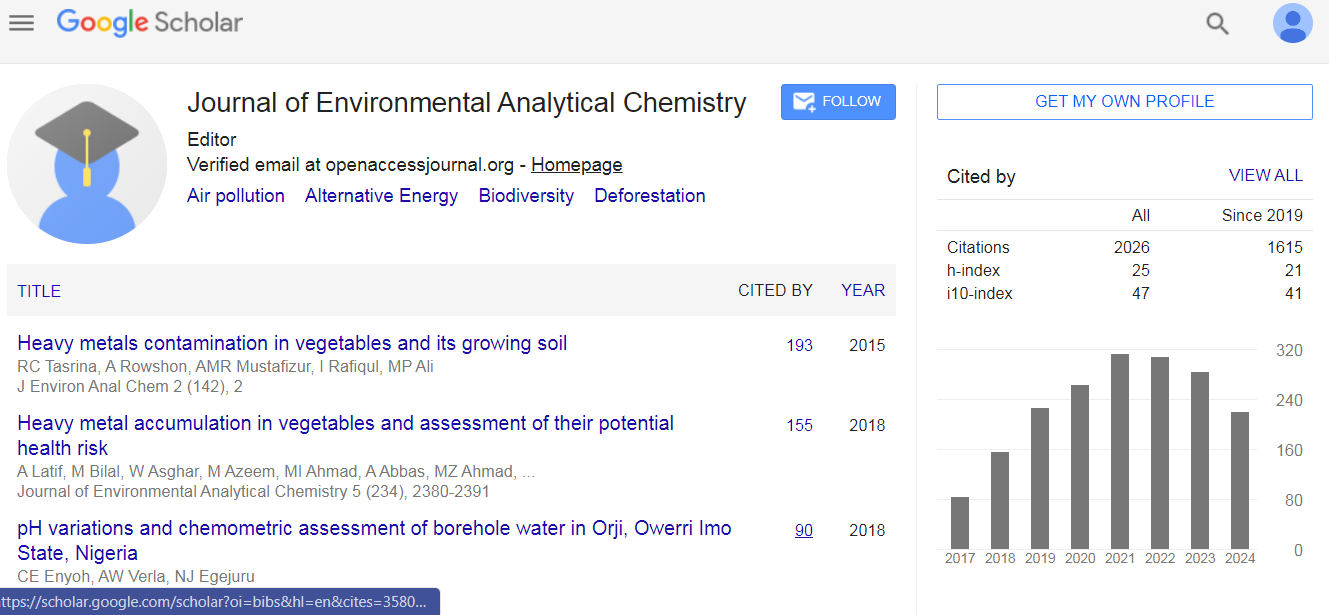
Journal of Environmental Analytical Chemistry received 1781 citations as per Google Scholar report