Brief Report - (2025) Volume 19, Issue 5
Received: 01-Oct-2025, Manuscript No. jmgm-26-188380;
Editor assigned: 03-Oct-2025, Pre QC No. P-188380;
Reviewed: 17-Oct-2025, QC No. Q-188380;
Revised: 22-Oct-2025, Manuscript No. R-188380;
Published:
29-Oct-2025
, DOI: 10.37421/1747-0862.2025.19.744
Citation: Minh, Le Thi. ”Multi-Omics: Revolutionizing Cancer Diagnosis and Treatment.” J Mol Genet Med 19 (2025):744.
Copyright: © 2025 Minh T. Le This is an open-access article distributed under the terms of the Creative Commons Attribution License, which permits unrestricted use, distribution and reproduction in any medium, provided the original author and source are credited.
Multi-omics approaches are fundamentally transforming the landscape of cancer diagnosis and prognosis by intricately integrating diverse datasets. These include genomic, transcriptomic, proteomic, and metabolomic information, offering a holistic view of tumor biology. This comprehensive analysis delves deeper into tumor heterogeneity, a known challenge in effective cancer treatment, and identifies novel biomarkers that are critical for early detection. Furthermore, these integrated strategies are proving invaluable in predicting treatment response with greater accuracy, a key factor in optimizing patient care. Integrating these layers of biological information enables the development of highly personalized medicine strategies tailored to the unique molecular profile of each patient's cancer. By understanding the intricate interplay of different molecular levels, clinicians can make more informed decisions regarding treatment selection and sequencing. Ultimately, this precision oncology paradigm aims to significantly improve patient outcomes and survival rates. The integration of multi-omics data, encompassing genomics, epigenomics, and transcriptomics, is paramount for deciphering the intricate molecular architecture of cancer. This advanced analytical framework is essential for uncovering subtle genomic and transcriptomic alterations that drive tumorigenesis and disease progression. The ability to identify these minute changes allows for the development of more specific and sensitive diagnostic markers and prognostic indicators. Such integrated analyses are indispensable for advancing our fundamental understanding of cancer biology and for the rational design of targeted therapeutic interventions. By piecing together the complex puzzle of cancer at multiple molecular levels, researchers can identify vulnerabilities and develop drugs that specifically target these weaknesses, minimizing off-target effects and maximizing efficacy. Proteomics and metabolomics provide complementary and essential insights into cancer biology that extend beyond the study of genomic alterations alone. By meticulously analyzing protein expression levels and metabolic profiles, researchers can illuminate the functional pathways that are perturbed by cancer. This granular understanding allows for the identification of biomarkers that accurately reflect the active biological state of the tumor. Combining proteomic and metabolomic data with other omics layers offers a more holistic and comprehensive view of cellular processes within the tumor microenvironment. This multi-dimensional approach is crucial for refining diagnostic models, improving prognostic accuracy, and identifying novel therapeutic targets that are relevant to the functional status of the cancer. The application of sophisticated machine learning and artificial intelligence algorithms is indispensable for navigating and analyzing the vast and exceedingly complex datasets generated by multi-omics studies in cancer research. These powerful computational tools are adept at identifying subtle yet significant patterns within the data that may be undetectable by traditional analytical methods. These advanced computational tools can effectively predict patient outcomes, stratify patients into distinct groups based on their unique molecular profiles, and guide the development of more precise diagnostic and prognostic strategies. The ability to leverage AI for data interpretation accelerates the pace of discovery and translation of multi-omics findings into clinical practice. Liquid biopsies, which analyze circulating tumor DNA, RNA, and proteins found in bodily fluids, represent a groundbreaking, non-invasive approach for cancer detection, monitoring, and prognosis. The multi-omics analysis of these readily accessible liquid biopsy samples offers real-time insights into tumor evolution, the development of drug resistance, and the patient's response to therapy. These dynamic insights derived from liquid biopsies offer significant advantages over traditional, invasive tissue biopsies, particularly for serial prognostic assessment and treatment monitoring. The ability to track tumor changes non-invasively allows for timely adjustments to treatment plans, thereby improving therapeutic efficacy and patient management throughout the course of the disease.
Multi-omics approaches are revolutionizing cancer diagnosis and prognosis by integrating data from genomics, transcriptomics, proteomics, and metabolomics. This comprehensive analysis provides a deeper understanding of tumor heterogeneity, identifies novel biomarkers for early detection, and predicts treatment response more accurately. Integrating these layers of biological information allows for the development of personalized medicine strategies, ultimately improving patient outcomes [1].
The integration of multi-omics data, including genomics, epigenomics, and transcriptomics, is crucial for deciphering the complex molecular landscape of cancer. This approach can uncover subtle alterations that drive tumorigenesis and progression, leading to the identification of more specific diagnostic and prognostic markers. Such integrated analyses are essential for advancing our understanding of disease mechanisms and developing targeted therapies [2].
Proteomics and metabolomics offer complementary insights into cancer biology beyond genomic alterations. By analyzing protein expression and metabolic profiles, researchers can identify functional pathways affected by cancer and discover biomarkers reflecting the active biological state of the tumor. Combining these with other omics layers provides a more holistic view for improved diagnostic and prognostic models [3].
The application of machine learning and artificial intelligence is essential for analyzing the vast and complex datasets generated by multi-omics studies in cancer. These computational tools can identify patterns, predict outcomes, and stratify patients based on their molecular profiles, paving the way for more precise diagnostic and prognostic strategies [4].
Liquid biopsies, utilizing circulating tumor DNA, RNA, and proteins, represent a promising non-invasive approach for cancer diagnosis and monitoring. Multi-omics analysis of liquid biopsy samples can provide real-time insights into tumor evolution and treatment response, offering significant advantages over traditional tissue biopsies for prognostic assessment [5].
Single-cell multi-omics technologies enable the interrogation of cellular heterogeneity within tumors at an unprecedented resolution. By profiling individual cells across multiple molecular layers, these methods can identify distinct cell populations driving cancer progression and resistance, providing critical information for prognosis and therapeutic targeting [6].
The microbiome plays an increasingly recognized role in cancer development, progression, and response to therapy. Multi-omics approaches that incorporate microbial data alongside host genomics and transcriptomics are vital for understanding these complex interactions and developing microbiome-targeted diagnostic and prognostic strategies [7].
Epigenetic modifications, such as DNA methylation and histone modifications, are critical regulators of gene expression in cancer. Multi-omics profiling that includes epigenomic data can reveal aberrant epigenetic landscapes associated with tumor initiation and progression, offering valuable diagnostic and prognostic biomarkers [8].
The integration of metabolomics with other omics data provides a functional readout of cellular states in cancer. Metabolic profiling can identify alterations in pathways that support tumor growth and survival, leading to the discovery of novel diagnostic markers and potential therapeutic targets for improved prognosis [9].
Translational applications of multi-omics data in clinical settings are crucial for improving cancer diagnosis and prognosis. This involves developing robust analytical pipelines and clinical decision support tools that can effectively translate complex molecular insights into actionable information for oncologists and patients, leading to personalized treatment strategies [10].
Multi-omics approaches are revolutionizing cancer diagnosis and prognosis by integrating genomic, transcriptomic, proteomic, and metabolomic data. This comprehensive analysis enhances understanding of tumor heterogeneity, identifies novel biomarkers for early detection, and improves prediction of treatment response. Integrating these layers enables personalized medicine, leading to better patient outcomes. Machine learning and AI are crucial for analyzing these complex datasets, while liquid biopsies offer non-invasive prognostic assessment. Single-cell multi-omics provides high-resolution insights into cellular heterogeneity. The microbiome's role is increasingly recognized, and epigenomic data reveals aberrant landscapes. Metabolomics provides functional insights into cellular states. Translational applications are key for clinical impact, facilitating personalized treatment strategies.
None
None
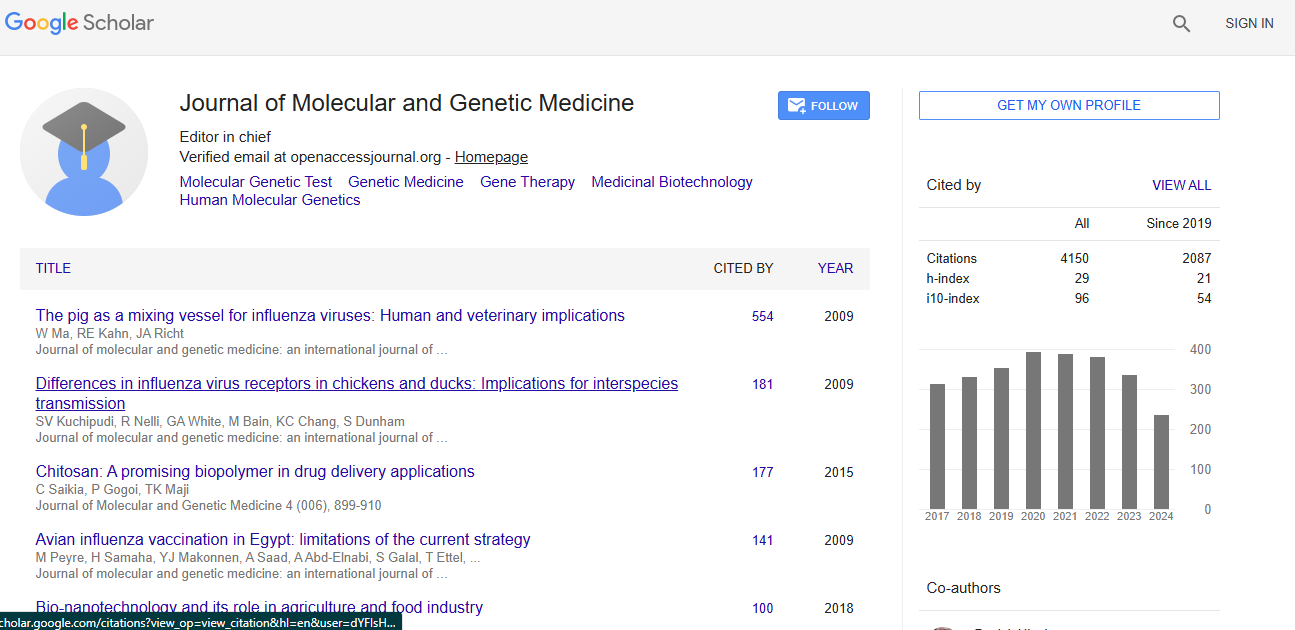
Molecular and Genetic Medicine received 3919 citations as per Google Scholar report