Short Communication - (2025) Volume 16, Issue 5
Received: 01-Sep-2025, Manuscript No. hycr-25-175007;
Editor assigned: 03-Sep-2025, Pre QC No. P-175007;
Reviewed: 17-Sep-2025, QC No. Q-175007;
Revised: 22-Sep-2025, Manuscript No. R-175007;
Published:
29-Sep-2025
, DOI: 10.37421/2157-7587.2025.16.623
Citation: Tremblay, Sophie. ”Multifaceted Water Balance: Climate, Health, Adaptation.” Hydrol Current Res 16 (2025):623.
Copyright: © 2025 Tremblay S. This is an open-access article distributed under the terms of the Creative Commons Attribution License, which permits unrestricted use,
distribution and reproduction in any medium, provided the original author and source are credited.
This article reviews the current understanding of how the human body manages fluid balance and maintains hydration. It highlights the intricate physiological mechanisms involved, emphasizing their importance for overall health, physical performance, and response to various environmental stressors. Understanding these processes helps in preventing dehydration and managing fluid-related disorders [1].
This global synthesis explores how climate change affects the water balance in land-based ecosystems. It points out significant shifts in precipitation patterns, evapotranspiration rates, and runoff, which contribute to increased drought frequency in some areas and severe flooding in others. Ultimately, this alters ecosystem function and water availability on a fundamental level [2].
This review examines current methods for assessing urban water balance and proposes effective management strategies, especially under the growing pressures of climate change. It outlines how cities can optimize the management of precipitation, runoff, and water supply to build greater resilience and move towards more sustainable urban water systems [3].
This comprehensive synthesis investigates how plants maintain their water balance and hydraulic properties when faced with drought conditions globally. It sheds light on the specific physiological adaptations plants use to cope with water scarcity, offering crucial insights for developing drought-resistant crops and managing ecosystems effectively in a changing climate [4].
This study offers a new assessment of the global water balance, utilizing advanced satellite data and model reanalysis to provide a more precise understanding of how water storage changes across continents and oceans. It highlights significant trends in groundwater depletion, ice sheet melt, and shifts in terrestrial water storage, which are vital for climate science and water resource planning [5].
This research focuses on modeling regional water balance, carefully considering the complex interactions between changing climate and evolving land use patterns. It demonstrates how these models can accurately predict future water availability and guide adaptive management strategies for specific river basins or regions, which is essential for sustainable resource planning [6].
This review addresses the critical challenges of agricultural water management in arid regions, with a keen focus on strategies to improve water balance and irrigation efficiency. It delves into advanced techniques like precision irrigation, smart sensing technologies, and sustainable agricultural practices, all essential for maximizing crop yield while minimizing water consumption [7].
Drawing on data from a global network, this study provides valuable insights into the long-term soil water balance within temperate forest ecosystems. It clarifies how factors such as precipitation, evapotranspiration, and inherent soil properties dictate water availability, ultimately impacting forest health and overall productivity, especially in the context of changing climate conditions [8].
This review synthesizes the latest progress in understanding how the global hydrological cycle is changing due to climate change, directly affecting regional and global water balances. It covers shifts in precipitation patterns, increases in atmospheric water vapor, and altered runoff, emphasizing the urgent need for robust monitoring and sophisticated modeling approaches [9].
This article explores how various diseases can significantly disrupt the body's water balance, examining the underlying pathophysiological mechanisms and their clinical ramifications. It covers conditions like heart failure, kidney disease, and endocrine disorders, providing a thorough view of water imbalance as a critical element in disease progression and patient management [10].
Research extensively explores the delicate balance of fluid within the human body, emphasizing its critical role in maintaining overall health, optimizing physical performance, and facilitating an effective response to environmental stressors [1]. Understanding these intricate physiological mechanisms is key to preventing dehydration and effectively managing fluid-related medical conditions. Furthermore, the body's water balance can be significantly disrupted by various diseases, necessitating a deeper look into the underlying pathophysiological mechanisms and their clinical implications. Conditions such as heart failure, kidney disease, and endocrine disorders often involve complex water imbalances, which are crucial factors in disease progression and patient management [10].
Focus shifts to the broader environmental context, where climate change profoundly impacts the water balance in land-based ecosystems. Significant shifts in precipitation patterns, evapotranspiration rates, and runoff contribute to an increased frequency of droughts and severe flooding, fundamentally altering ecosystem function and water availability globally [2]. In a comprehensive synthesis, new assessments of the global water balance utilize advanced satellite data and model reanalysis to offer a more precise understanding of water storage dynamics across continents and oceans. These studies reveal vital trends in groundwater depletion, ice sheet melt, and changes in terrestrial water storage, informing climate science and crucial water resource planning [5]. The evolving global hydrological cycle, under the influence of climate change, directly impacts regional and global water balances. This includes documented shifts in precipitation, increases in atmospheric water vapor, and altered runoff, highlighting the urgent need for robust monitoring and sophisticated modeling to address these changes effectively [9].
Urban areas face unique challenges in water management, especially considering the escalating pressures from climate change. Current reviews examine effective strategies for assessing urban water balance, proposing methods for cities to optimize precipitation, runoff, and water supply management. The goal is to build greater resilience and foster more sustainable urban water systems [3]. On a regional scale, advanced modeling techniques are crucial for understanding water balance, taking into account the complex interplay between changing climate conditions and evolving land use patterns. These models are instrumental in predicting future water availability and guiding adaptive management strategies for specific river basins or regions, ensuring sustainable resource planning [6]. Furthermore, agricultural water management, particularly in arid regions, presents critical challenges. Studies focus on improving water balance and irrigation efficiency through advanced techniques like precision irrigation, smart sensing technologies, and sustainable agricultural practices, all designed to maximize crop yield while minimizing water consumption [7].
Plants exhibit remarkable physiological adaptations to maintain their water balance and hydraulic properties when confronted with global drought conditions. This comprehensive synthesis offers crucial insights for developing drought-resistant crops and managing ecosystems more effectively in a changing climate [4]. Complementing this, research into long-term soil water balance within temperate forest ecosystems provides valuable understanding. Drawing on data from a global network, studies clarify how factors such as precipitation, evapotranspiration, and inherent soil properties govern water availability, ultimately impacting forest health and overall productivity, especially in the context of evolving climate conditions [8].
The collected research highlights the multifaceted concept of water balance across diverse domains, from human physiology to global ecosystems. It emphasizes the critical role of fluid balance in human health and performance, detailing physiological mechanisms and the impact of diseases on this balance [1, 10]. A significant portion addresses the profound effects of climate change on water balance, exploring shifts in precipitation, evapotranspiration, and runoff that lead to increased droughts and floods in terrestrial, urban, and global contexts [2, 3, 5, 9]. Studies leverage advanced satellite data and modeling to assess global water storage changes and predict future water availability under changing climate and land use patterns [5, 6]. Specific attention is given to the adaptive strategies of plants in maintaining water balance during drought, offering insights for crop development and ecosystem management [4]. Furthermore, the collection covers improvements in agricultural water management, particularly in arid regions, through efficient irrigation and smart technologies [7], alongside detailed analyses of long-term soil water balance in forest ecosystems [8]. Collectively, these studies underscore the urgent need for comprehensive understanding, robust monitoring, and adaptive strategies to manage water resources effectively in an era of environmental change and evolving physiological demands.
None
None
Indexed at, Google Scholar, Crossref
Indexed at, Google Scholar, Crossref
Indexed at, Google Scholar, Crossref
Indexed at, Google Scholar, Crossref
Indexed at, Google Scholar, Crossref
Indexed at, Google Scholar, Crossref
Indexed at, Google Scholar, Crossref
Indexed at, Google Scholar, Crossref
Indexed at, Google Scholar, Crossref
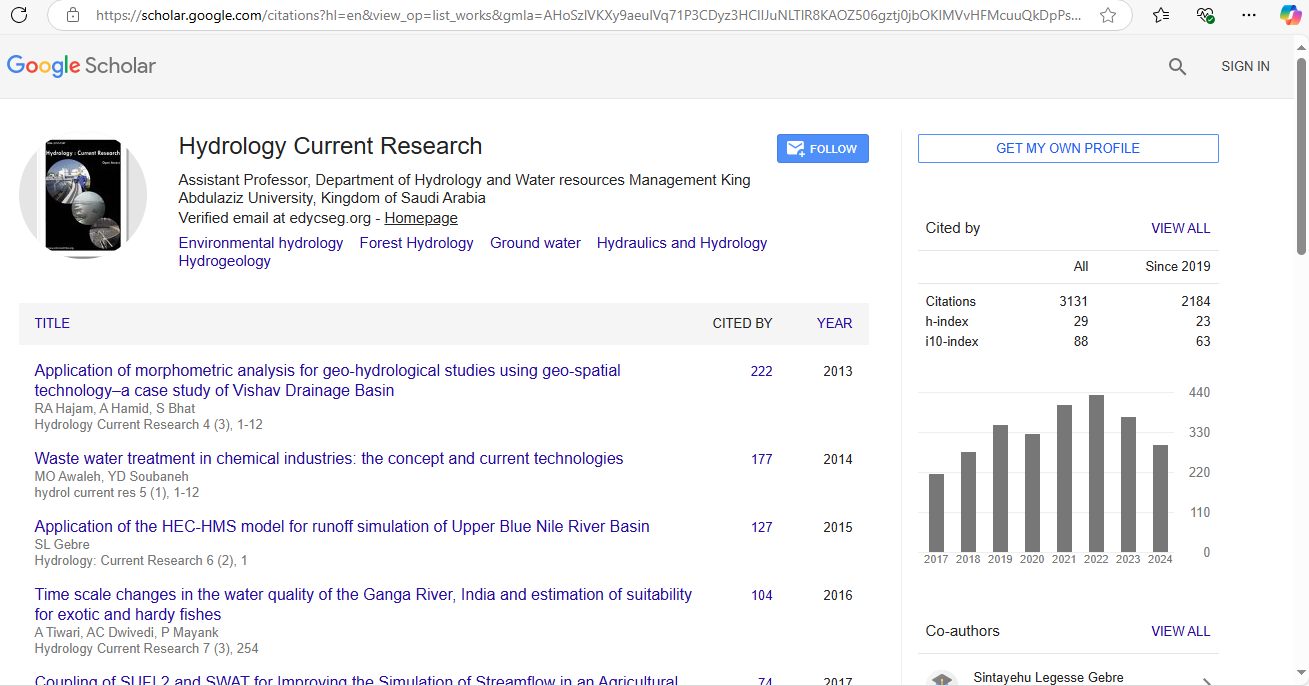
Hydrology: Current Research received 2843 citations as per Google Scholar report