Opinion - (2025) Volume 17, Issue 4
Received: 01-Aug-2025, Manuscript No. jbabm-26-182348;
Editor assigned: 03-Aug-2025, Pre QC No. P-182348;
Reviewed: 17-Aug-2025, QC No. Q-182348;
Revised: 24-Aug-2025, Manuscript No. R-182348;
Published:
31-Aug-2025
, DOI: 10.37421/1948-593X.2025.17.506
Citation: Al-Farsi, Karim. ”Monitoring Cancer Treatment: Essential Bioanalytical Tools and Approaches.” J Bioanal Biomed 17 (2025):506.
Copyright: © 2025 Al-F arsiK. This is an open-access article distributed under the terms of the Creative Commons Attribution License, which permits unrestricted use, distribution and reproduction in any medium, provided the original author and source are credited.
Monitoring therapeutic response in cancer is a critical aspect of patient care, aiming to optimize outcomes by tracking treatment effectiveness and identifying early signs of resistance or recurrence. Bioanalytical tools are instrumental in this process, providing quantitative data on drug levels, target engagement, and crucial molecular biomarkers that indicate disease progression or regression. These advanced methods pave the way for personalized medicine approaches, enabling timely and informed treatment adjustments to better suit individual patient needs and disease characteristics. Liquid biopsies, which leverage circulating tumor DNA (ctDNA) and circulating tumor cells (CTCs), present a minimally invasive strategy for observing tumor evolution and assessing treatment response. The analysis of ctDNA can reveal mutations that arise due to treatment and elucidate emerging resistance mechanisms. Furthermore, the enumeration and characterization of CTCs can correlate with disease burden and prognosis, offering valuable insights into the patient's condition. Mass spectrometry-based proteomics offers a potent platform for the identification and quantification of proteins that serve as significant biomarkers for cancer response. This technology enables the monitoring of dynamic changes in protein expression, post-translational modifications, and intricate protein-protein interactions. Such detailed insights are vital for uncovering the mechanisms of drug action and resistance, thereby supporting the development of more targeted therapies. Flow cytometry and single-cell analysis are indispensable techniques for characterizing the complex immune responses elicited by cancer therapies. These methods allow for the detailed phenotyping of immune cell populations, enabling an assessment of their activation status and the quantification of their effector functions. Monitoring shifts in immune cell infiltration and functionality within the tumor microenvironment is paramount for evaluating the efficacy of immunotherapies. Genomic profiling of tumors, encompassing whole-exome sequencing and targeted gene panels, furnishes essential information for comprehending treatment response and mechanisms of resistance. The ability to monitor tumor evolution through serial biopsies or liquid biopsies is crucial for detecting the emergence of acquired resistance mutations. This data directly guides the selection of subsequent therapeutic strategies and aids in predicting patient outcomes. Pharmacokinetic and pharmacodynamic (PK/PD) studies are fundamental to tailoring drug dosing regimens to achieve optimal therapeutic efficacy while simultaneously minimizing treatment-related toxicity. Bioanalytical methods play a key role in measuring drug concentrations within biological fluids and assessing the drug's impact on its designated target. The integration of PK/PD data facilitates personalized dosing strategies that can substantially enhance treatment response. Radiomics, a discipline focused on extracting quantitative features from medical images, is rapidly emerging as a valuable tool for the non-invasive monitoring of treatment response. Observed changes in radiomic features over time can accurately reflect tumor shrinkage, metabolic alterations, or shifts within the tumor microenvironment, thereby correlating with treatment efficacy and predicting patient outcomes. The development of novel bioanalytical assays, such as digital PCR and advanced immunoassays, is paramount for the sensitive and specific detection of minimal residual disease (MRD) in cancer patients. The early identification of MRD allows for the timely recognition of relapse and can significantly inform critical treatment decisions, including the intensification of therapy or the initiation of maintenance treatments. Integrating multi-omics data, which includes genomics, transcriptomics, proteomics, and metabolomics, provides an indispensable holistic perspective on tumor biology and its response to therapy. Bioanalytical tools are foundational for generating these diverse and comprehensive datasets. By synthesizing information from multiple molecular layers, researchers can achieve a profound understanding of treatment mechanisms. The creation of point-of-care (POC) bioanalytical devices for cancer therapy monitoring holds immense promise for revolutionizing patient management. These innovative devices facilitate rapid, on-site analysis of critical biomarkers, enabling prompt clinical decision-making and substantially reducing reliance on extensive laboratory infrastructure. POC diagnostics can significantly improve treatment accessibility.
The clinical management of cancer necessitates robust methods for monitoring therapeutic response, a process vital for optimizing patient outcomes by tracking treatment effectiveness and detecting early signs of resistance or recurrence. Bioanalytical tools are central to this endeavor, providing quantitative data on drug levels, target engagement, and essential molecular biomarkers that signal disease progression or regression. These sophisticated techniques support personalized medicine, allowing for timely therapeutic adjustments tailored to individual patient profiles. Liquid biopsies, employing circulating tumor DNA (ctDNA) and circulating tumor cells (CTCs), offer a minimally invasive avenue for tracking tumor evolution and treatment response. Analysis of ctDNA can uncover treatment-induced mutations and identify resistance mechanisms. The enumeration and characterization of CTCs can be correlated with disease burden and prognosis, providing critical prognostic information without requiring repeated tissue biopsies. Mass spectrometry-based proteomics serves as a powerful platform for identifying and quantifying proteins that act as biomarkers of cancer response. This approach allows for the monitoring of alterations in protein expression, post-translational modifications, and protein-protein interactions. Such detailed molecular insights are crucial for understanding drug action and resistance mechanisms, thereby aiding in the development of more targeted and personalized treatment strategies. Flow cytometry and single-cell analysis are key techniques for characterizing immune responses to cancer therapies. These methods enable detailed phenotyping of immune cell populations, assessment of their activation status, and quantification of effector functions. Monitoring changes in immune cell infiltration and function within the tumor microenvironment is essential for evaluating immunotherapy efficacy and informing combination strategies. Genomic profiling of tumors, including whole-exome sequencing and targeted gene panels, provides critical information for understanding treatment response and resistance. Serial monitoring of tumor evolution via biopsies or liquid biopsies can reveal the emergence of acquired resistance mutations. This genomic data is instrumental in guiding the selection of subsequent therapies and predicting patient outcomes. Pharmacokinetic and pharmacodynamic (PK/PD) studies are indispensable for tailoring drug dosing to achieve optimal therapeutic efficacy while minimizing toxicity. Bioanalytical methods are employed to measure drug concentrations in biological fluids and assess the drug's impact on its target. Integrating PK/PD data enables personalized dosing regimens that can significantly improve treatment response. Radiomics, which involves extracting quantitative features from medical images, is emerging as a valuable tool for monitoring treatment response. Changes in radiomic features over time can indicate tumor shrinkage, metabolic alterations, or modifications in the tumor microenvironment, correlating with treatment efficacy and predicting outcomes. This non-invasive modality complements other bioanalytical approaches. The development of novel bioanalytical assays, such as digital PCR and advanced immunoassays, is critical for the sensitive and specific detection of minimal residual disease (MRD). Detecting MRD allows for early identification of relapse and can inform treatment decisions, such as intensifying therapy or initiating maintenance treatments, ultimately aiming to improve long-term survival. Integration of multi-omics data, encompassing genomics, transcriptomics, proteomics, and metabolomics, offers a holistic view of tumor biology and response to therapy. Bioanalytical tools are vital for generating these diverse datasets. By combining information from different molecular layers, a deeper understanding of treatment mechanisms can be achieved. The development of point-of-care (POC) bioanalytical devices for cancer therapy monitoring holds significant promise for improving patient management. These devices enable rapid, on-site biomarker analysis, facilitating timely clinical decisions and reducing the need for complex laboratory infrastructure. POC diagnostics can enhance treatment accessibility and efficiency.
Monitoring cancer treatment response is crucial for optimizing patient care and outcomes. Bioanalytical tools, including liquid biopsies, mass spectrometry-based proteomics, flow cytometry, genomic profiling, and radiomics, are essential for tracking tumor evolution, treatment effectiveness, and resistance mechanisms. Pharmacokinetic and pharmacodynamic studies help tailor drug dosing for efficacy and safety. Novel assays like digital PCR aid in detecting minimal residual disease, while multi-omics integration provides a comprehensive understanding of tumor biology. The development of point-of-care devices promises to enhance accessibility and efficiency in cancer monitoring and management.
None
None
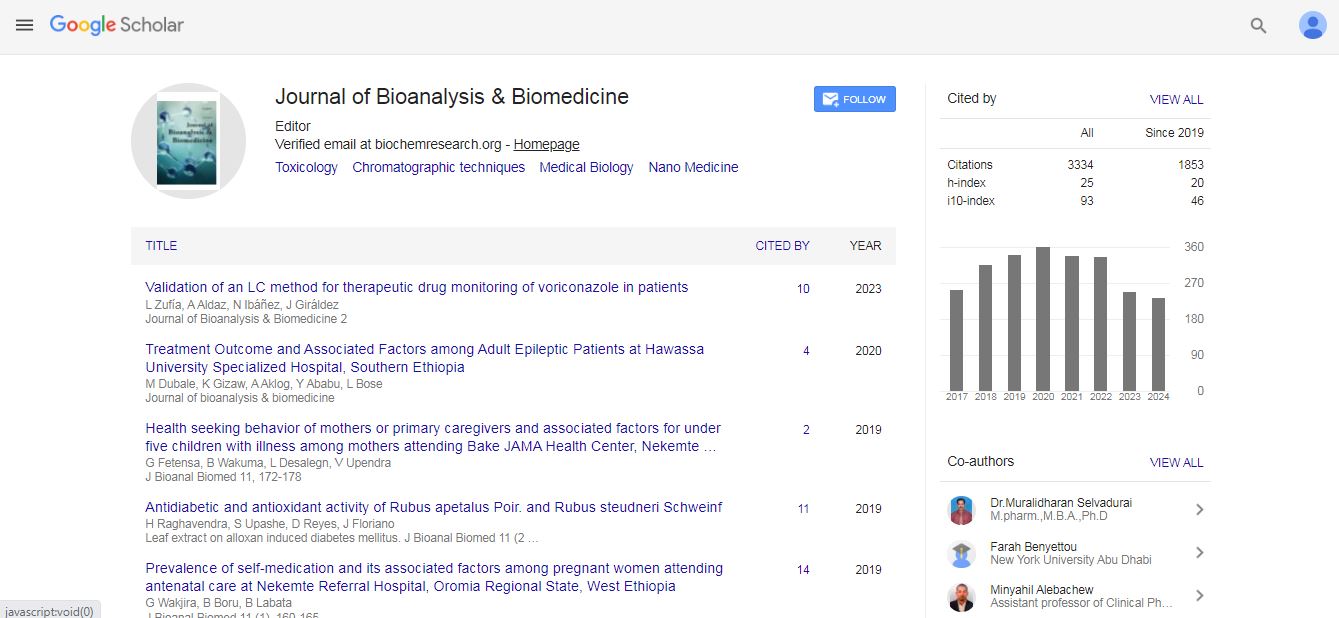
Journal of Bioanalysis & Biomedicine received 3099 citations as per Google Scholar report