Brief Report - (2025) Volume 14, Issue 2
Received: 01-Apr-2025, Manuscript No. jsp-26-182231;
Editor assigned: 03-Apr-2025, Pre QC No. P-182231;
Reviewed: 17-Apr-2025, QC No. Q-182231;
Revised: 22-Apr-2025, Manuscript No. R-182231;
Published:
29-Apr-2025
, DOI: 10.37421/2165-7939.2025.14.710
Citation: Sharma, Arjun R.. ”Molecular Mechanisms Driving Spinal Degeneration.” J Spine 14 (2025):710.
Copyright: © 2025 Sharma R. Arjun This is an open-access article distributed under the terms of the Creative Commons Attribution License, which permits unrestricted use, distribution and reproduction in any medium, provided the original author and source are credited.
Degenerative disorders of the spine represent a significant and escalating clinical concern, affecting a vast number of individuals worldwide. Recent breakthroughs in comprehending the intricate molecular underpinnings of conditions such as osteoarthritis and disc degeneration are paving the way for novel therapeutic interventions [1].
Crucially, understanding the genetic predispositions and epigenetic modifications that play a role in degenerative spine disease is paramount. Research is actively identifying specific gene variants that confer an increased susceptibility to ailments like lumbar spinal stenosis [2].
The pervasive influence of inflammation in the progression of spinal degeneration is becoming increasingly apparent. Cytokines, including IL-1ÃÂ?² and TNF-ÃÂ?±, are recognized as key contributors to the degradation of cartilage and the extracellular matrix within the intervertebral disc [3].
Cellular senescence, characterized by an irreversible cessation of cell division, contributes significantly to the aging and subsequent degeneration of spinal tissues. Senescent cells actively release a pro-inflammatory secretome that amplifies tissue damage [4].
Matrix metalloproteinases (MMPs) are integral to the dynamic process of extracellular matrix remodeling, and their aberrant activity is a substantial factor in the pathogenesis of disc degeneration. The precise modulation of specific MMPs involved in matrix breakdown, while preserving their beneficial functions, presents a complex therapeutic challenge [5].
Emerging as highly promising modalities for the treatment of degenerative spinal conditions are stem cell therapy and regenerative medicine. The inherent capacity of mesenchymal stem cells to differentiate into chondrocytes, coupled with their potent immunomodulatory effects, offers substantial potential for tissue repair and functional recovery [6].
Biomechanical factors, including the effects of repetitive loading and suboptimal posture, are critical drivers of mechanical stress that initiate and perpetuate the cycle of spinal degeneration. A thorough comprehension of these forces at both cellular and tissue levels is indispensable for the development of effective preventive and therapeutic strategies [7].
The role of oxidative stress in the degenerative cascade within the spine is also gaining significant recognition. Reactive oxygen species have the capacity to inflict damage upon cellular components and, in turn, foster inflammatory responses, thereby accelerating the rate of tissue breakdown [8].
Advancements in diagnostic imaging technologies are enabling a more refined evaluation of spinal degeneration, thereby facilitating earlier detection and the formulation of personalized treatment plans. Furthermore, molecular imaging probes designed to specifically target degenerative processes are currently under development [9].
An emerging frontier in spinal degeneration research involves elucidating the influence of the gut microbiome on systemic inflammation, which can subsequently impact spinal health. Imbalances within the gut microbial community, or dysbiosis, may contribute to inflammatory pathways that exacerbate the degeneration of intervertebral discs and facet joints [10].
Degenerative disorders of the spine represent a growing clinical challenge, impacting millions globally. Recent advancements in understanding the molecular mechanisms underlying conditions like osteoarthritis and disc degeneration are opening new avenues for treatment. This research highlights the role of inflammatory pathways, matrix metalloproteinases, and cellular senescence in driving spinal degeneration. Targeting these pathways holds promise for novel therapeutic strategies [1].
Understanding the genetic predispositions and epigenetic modifications involved in degenerative spine disease is crucial. Studies are identifying specific gene variants associated with an increased risk of conditions like lumbar spinal stenosis. The interplay between genetic factors and environmental influences, such as lifestyle and occupational stressors, is a key area of investigation for personalized medicine approaches [2].
The role of inflammation in driving spinal degeneration is increasingly recognized. Cytokines like IL-1ÃÂ?² and TNF-ÃÂ?± are implicated in the breakdown of cartilage and intervertebral disc matrix. Modulating these inflammatory pathways, perhaps through targeted biologic therapies, represents a promising strategy to slow disease progression and alleviate pain [3].
Cellular senescence, a state of irreversible cell cycle arrest, contributes to the aging and degeneration of spinal tissues. Senescent cells release a pro-inflammatory secretome that exacerbates tissue damage. Eliminating senescent cells or inhibiting their harmful secretions could be a therapeutic target for age-related spinal conditions [4].
Matrix metalloproteinases (MMPs) play a critical role in extracellular matrix remodeling, and their dysregulation contributes significantly to disc degeneration. Inhibiting specific MMPs involved in matrix degradation, while preserving beneficial MMP activity, presents a complex but potentially effective therapeutic strategy [5].
Stem cell therapy and regenerative medicine are emerging as promising approaches for treating degenerative spine conditions. The ability of mesenchymal stem cells to differentiate into chondrocytes and their immunomodulatory properties offer potential for tissue repair and functional restoration [6].
Biomechanical factors, such as repetitive loading and poor posture, contribute to the mechanical stress that initiates and perpetuates spinal degeneration. Understanding these forces at a cellular and tissue level is essential for developing preventive and therapeutic interventions [7].
The role of oxidative stress in spinal degeneration is increasingly evident. Reactive oxygen species can damage cellular components and promote inflammatory responses, accelerating tissue breakdown. Antioxidant strategies may offer a protective benefit [8].
Advances in imaging techniques allow for more precise assessment of spinal degeneration, aiding in early diagnosis and personalized treatment planning. Molecular imaging probes that target specific degenerative processes are under development [9].
The gut microbiome's influence on systemic inflammation and, consequently, spinal degeneration is an emerging area of research. Dysbiosis may contribute to inflammatory processes that exacerbate disc and facet joint degeneration [10].
Degenerative spine disorders are a growing global health concern, with recent research focusing on molecular mechanisms like inflammation, matrix metalloproteinases, and cellular senescence as key drivers. Genetic predispositions and epigenetic factors are also implicated, with ongoing studies identifying risk variants for conditions like lumbar spinal stenosis and exploring the interplay of genetics and environmental influences. Inflammation, mediated by cytokines, plays a significant role in matrix breakdown, suggesting therapeutic avenues in modulating these pathways. Cellular senescence contributes to age-related spinal degeneration through pro-inflammatory secretomes, and targeting senescent cells offers potential treatment. Matrix metalloproteinases are crucial in extracellular matrix remodeling, and their dysregulation contributes to degeneration, necessitating precise therapeutic inhibition strategies. Regenerative medicine, particularly mesenchymal stem cell therapy, shows promise for tissue repair and functional restoration. Biomechanical factors like repetitive loading and poor posture initiate and perpetuate degeneration, requiring a deeper understanding of forces at cellular and tissue levels. Oxidative stress also accelerates spinal tissue breakdown by damaging cellular components and promoting inflammation, pointing to antioxidant strategies. Advanced imaging techniques are improving early diagnosis and personalized treatment, with molecular imaging probes in development. The gut microbiome's impact on systemic inflammation and spinal degeneration is an emerging research area, suggesting dysbiosis may worsen disc and facet joint degeneration.
None
None
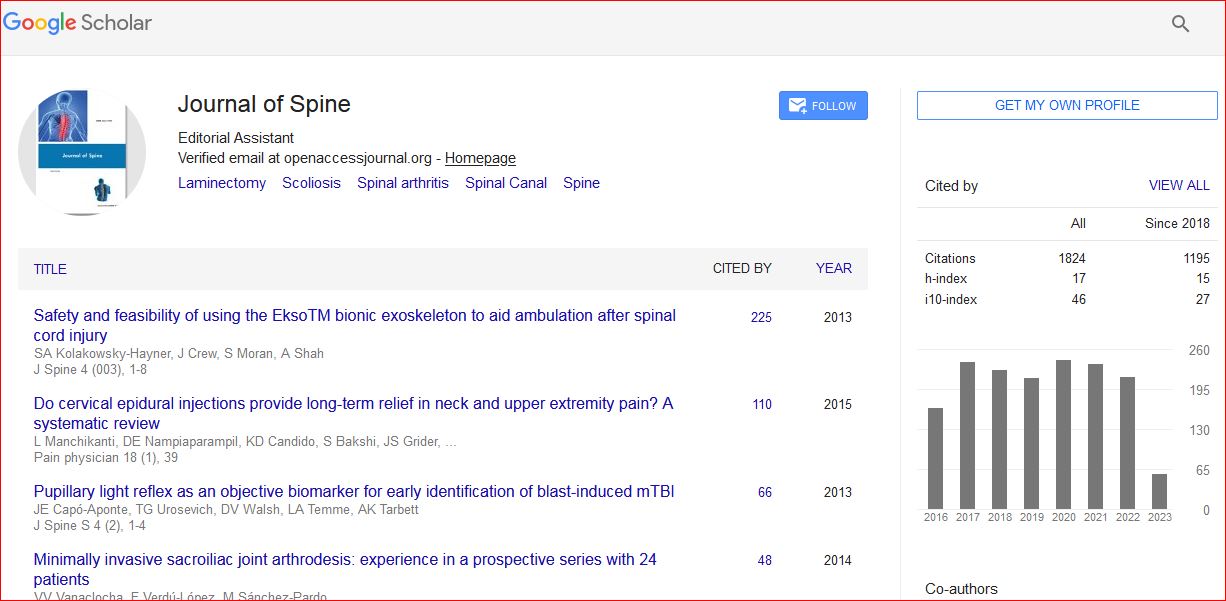
Journal of Spine received 2022 citations as per Google Scholar report