Opinion - (2025) Volume 9, Issue 6
Received: 01-Dec-2025, Manuscript No. ahbs-26-182569;
Editor assigned: 03-Dec-2025, Pre QC No. P-182569;
Reviewed: 17-Dec-2025, QC No. Q-182569;
Revised: 22-Dec-2025, Manuscript No. R-182569;
Published:
29-Dec-2025
, DOI: 10.37421/2952-8097.2025.9.347
Citation: Ahmed, Yasmin. ”Neuroendocrine Mechanisms of
Stress and Behavior.” J Anim Health Behav Sci 09 (2025):347.
Copyright: © 2025 Ahmed Y. This is an open-access article distributed under the terms of the Creative Commons Attribution License, which permits unrestricted use,
distribution and reproduction in any medium, provided the original author and source are credited.
The complex interplay of neuroendocrine pathways governs the multifaceted stress responses observed across the animal kingdom. These intricate systems are crucial for adapting to a variety of environmental challenges, ranging from acute threats to prolonged periods of adversity. Understanding these mechanisms provides profound insights into animal physiology and behavior. The hypothalamic-pituitary-adrenal (HPA) axis and the sympathetic-adrenal-medullary (SAM) system represent two principal neuroendocrine cascades that orchestrate the body's reaction to stressors. Their coordinated actions modulate not only physiological parameters but also significant behavioral adaptations, enabling animals to cope with diverse pressures [1].
Investigating the enduring consequences of adverse experiences during early life stages is paramount. Research has shown that early life stress can profoundly impact the HPA axis, leading to long-term dysregulation and persistent alterations in stress hormone levels, with significant implications for social and emotional behaviors in adulthood [2].
Beyond the well-studied mammalian systems, the role of specific neuropeptides in stress modulation extends to other species. The oxytocin system, for instance, has emerged as a key player in buffering stress and anxiety-like behaviors, particularly in companion animals, suggesting potential therapeutic avenues [3].
The neurobiological underpinnings of fear, a fundamental adaptive response, are closely linked to neuroendocrine function. The amygdala, in conjunction with the HPA axis, plays a critical role in the acquisition, consolidation, and extinction of fear memories, highlighting the brain's complex architecture for threat detection and processing [4].
The gut-brain axis represents a sophisticated bidirectional communication network, where stress profoundly influences gastrointestinal function and vice versa. Chronic stress can disrupt this axis, leading to alterations in gut microbiota and inflammation, which in turn impact mood and anxiety-related behaviors through neuroendocrine signaling [5].
Social dynamics are intrinsically tied to stress physiology. Social isolation, for example, can significantly alter HPA axis reactivity and lead to elevated stress hormone levels, contributing to behavioral changes such as increased territorial aggression in male rodents [6].
Environmental factors, even those not directly posing an immediate threat, can act as chronic stressors. Noise pollution, for instance, has been shown to negatively impact the neuroendocrine and behavioral responses of farm animals, affecting their welfare and physiological state [7].
Parental care significantly shapes an offspring's stress coping strategies through enduring epigenetic modifications. Variations in maternal behavior can lead to lasting alterations in HPA axis sensitivity and stress-related behaviors, demonstrating the profound influence of early life environment on stress resilience [8].
In prey animals, the evolutionary adaptations for survival in high-risk environments involve sophisticated neuroendocrine mechanisms that mediate fear responses to predators. The HPA axis and associated fear circuitry are activated by predator cues, triggering rapid stress responses and avoidance behaviors essential for survival [9].
The exploration of neuroendocrine pathways reveals their central role in orchestrating animal stress responses. These systems, including the HPA axis and SAM system, are fundamental in modulating behavioral adaptations to both acute and chronic stressors. Hormones like cortisol and adrenaline are key mediators, influencing anxiety, fear, and coping mechanisms, with individual differences shaped by genetic and environmental factors [1].
Studies focusing on the long-term effects of early life stress have illuminated the profound impact on adult social and emotional behaviors in rodents. These investigations demonstrate that adverse early experiences can lead to persistent dysregulation of the HPA axis, manifesting as altered stress hormone levels and behavioral deficits such as increased aggression and reduced social interaction, underscoring the plasticity and vulnerability of the neuroendocrine system [2].
The significance of the oxytocin system in modulating stress and anxiety is increasingly recognized, particularly in non-rodent species. Research on dogs suggests that oxytocin can buffer stress effects by promoting social bonding and reducing HPA axis activity, indicating its potential as a target for interventions aimed at managing stress-related behaviors in companion animals [3].
Examining the neurobiological mechanisms of fear conditioning and extinction highlights the intricate connection between the amygdala and neuroendocrine systems. The interaction between fear stimuli and the HPA axis is crucial for the formation and retrieval of fear memories. Furthermore, the research explores how neuroendocrine modulation can enhance fear extinction processes [4].
The gut-brain axis represents a critical interface in stress response, with chronic unpredictable stress significantly disrupting its normal functioning in rats. This disruption involves alterations in gut microbiota and inflammatory markers, which subsequently influence mood and anxiety-like behaviors via neuroendocrine signaling pathways, emphasizing the bidirectional communication between the gut and the brain [5].
The influence of social environment on stress physiology is substantial. Research on male mice subjected to social isolation reveals altered HPA axis reactivity and elevated corticosterone levels, which are associated with increased territorial aggression. This study emphasizes the vital role of social interaction in regulating neuroendocrine stress responses [6].
Environmental stressors, such as chronic noise pollution, have measurable impacts on the neuroendocrine and behavioral responses of farm animals like cattle. Sustained exposure to noise leads to elevated cortisol levels and behavioral changes, including reduced rumination and altered feeding patterns, highlighting the importance of environmental management for animal welfare [7].
Epigenetic modifications play a crucial role in how maternal care influences offspring's stress coping strategies. Variations in maternal behavior can induce enduring changes in the offspring's HPA axis sensitivity and stress-related behaviors by altering gene expression, rather than the underlying DNA sequence [8].
Predator-induced fear in prey animals is mediated by specific neuroendocrine mechanisms. In rodents, the HPA axis and fear circuitry interact to produce a potent stress response upon exposure to predator cues, resulting in freezing and avoidance behaviors, which are critical evolutionary adaptations for survival [9].
Aggression in animals is a complex behavior influenced by a range of neuroendocrine factors. Testosterone, cortisol, and neuropeptides such as vasopressin and oxytocin interact with neural circuits to regulate aggressive responses to social challenges and stressors, offering insights into managing aggression across different species [10].
This collection of research explores the intricate neuroendocrine mechanisms underlying stress responses and related behaviors in diverse animal species. Studies highlight the critical roles of the hypothalamic-pituitary-adrenal (HPA) axis and sympathetic-adrenal-medullary (SAM) system in modulating adaptations to acute and chronic stressors. The long-term impacts of early life stress on neuroendocrine regulation and subsequent social and emotional behaviors are examined, alongside the influence of neuropeptides like oxytocin in stress buffering. Research also delves into the neurobiology of fear conditioning, the gut-brain axis's response to stress, and the effects of social isolation and environmental factors such as noise pollution. Furthermore, the role of maternal care in shaping stress coping strategies through epigenetic modifications and the neuroendocrine correlates of predator-induced fear are investigated. Finally, a review synthesizes the hormonal and neuropeptide influences on aggression. Collectively, these studies underscore the pervasive impact of neuroendocrine signaling on animal physiology and behavior, with implications for welfare, health, and survival.
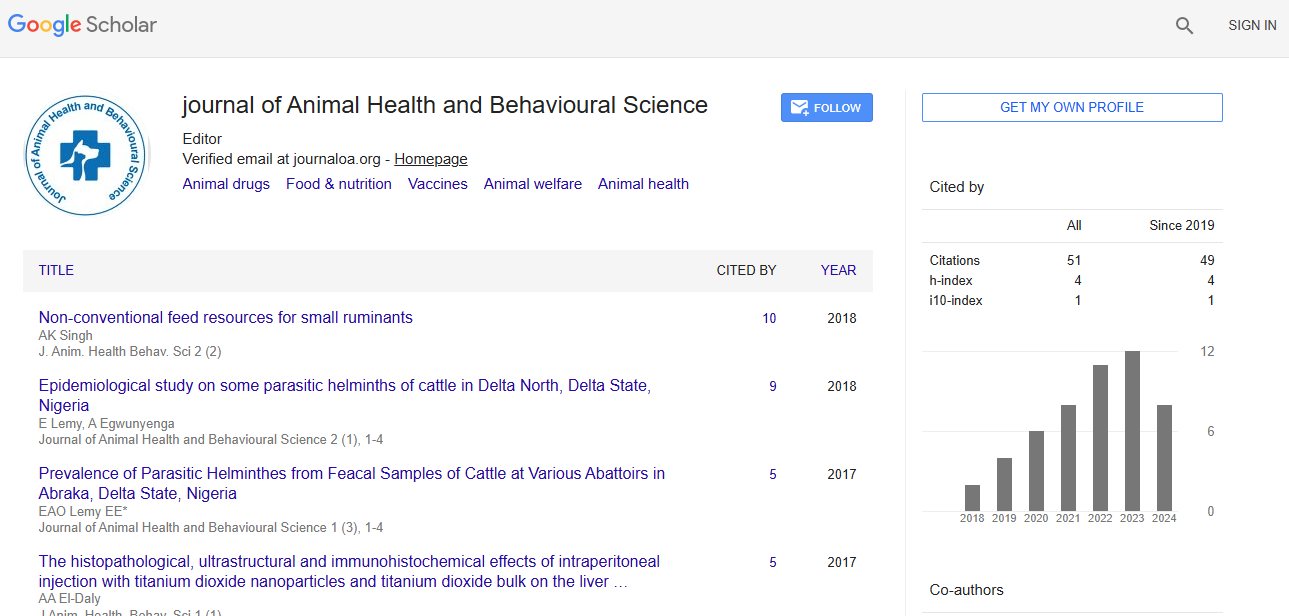
Journal of Animal Health and Behavioural Science received 38 citations as per Google Scholar report