Commentary - (2025) Volume 16, Issue 6
Received: 01-Dec-2025, Manuscript No. jmbd-26-179551;
Editor assigned: 03-Dec-2025, Pre QC No. P-179551;
Reviewed: 15-Dec-2025, QC No. Q-179551;
Revised: 22-Dec-2025, Manuscript No. R-179551;
Published:
29-Dec-2025
, DOI: 10.37421/2155-9929.2025.16.735
Citation: Rojas, Pablo. ”Molecular Diagnostics: Revolutionizing Precision Healthcare.” J Mol Biomark Diagn 16 (2025):735.
Copyright: © 2025 Rojas P. This is an open-access article distributed under the terms of the Creative Commons Attribution License, which permits unrestricted use, distribution
and reproduction in any medium, provided the original author and source are credited.
Biomarker-based molecular diagnostics represent a transformative force in clinical decision-making, fundamentally altering how diseases are identified and managed. By pinpointing specific molecular signatures within biological samples, these advanced diagnostic tools facilitate earlier and more accurate detection of a wide range of conditions. This precision in identification is crucial for enabling timely and effective interventions, ultimately leading to improved patient outcomes and a more proactive approach to healthcare. The ability to discern subtle molecular changes allows clinicians to move beyond generalized treatment approaches and towards strategies tailored to the unique biological profile of each patient. Furthermore, molecular diagnostics are instrumental in the precise stratification of patients, a critical step in the era of targeted therapies. This allows for the identification of individuals most likely to benefit from specific drug regimens, thereby maximizing therapeutic efficacy and minimizing exposure to treatments that may be ineffective or cause undue side effects. This patient-centric approach ensures that valuable healthcare resources are utilized efficiently, focusing on treatments that offer the greatest potential for positive impact. The ongoing development and refinement of these diagnostic capabilities are central to advancing precision medicine. Monitoring treatment response is another key area revolutionized by biomarker-based diagnostics. These tools provide objective measures to track the effectiveness of therapeutic interventions, allowing for dynamic adjustments to treatment plans as needed. This continuous feedback loop enables clinicians to optimize care, ensuring that patients receive the most appropriate and effective treatment throughout their disease journey. Such dynamic monitoring is essential for managing chronic conditions and adapting to the evolving landscape of disease progression. The cumulative impact of these advancements is a significant improvement in patient outcomes. By enabling earlier diagnosis, more precise treatment selection, and effective monitoring, molecular diagnostics contribute to better disease control, reduced morbidity, and enhanced quality of life. This holistic improvement across the entire patient care pathway underscores the profound influence of these technologies. The shift towards more personalized and effective medical interventions is directly attributable to the insights provided by molecular diagnostics. Beyond direct patient benefits, the increased efficiency and efficacy brought about by molecular diagnostics also translate into reduced healthcare costs. By avoiding ineffective treatments, minimizing complications, and shortening treatment durations where possible, these diagnostics help to alleviate the economic burden on healthcare systems. This economic advantage is a vital consideration in the widespread adoption and integration of these advanced technologies into routine clinical practice. The long-term sustainability of healthcare systems is bolstered by the cost-effectiveness of precision diagnostics. Personalized medicine, an overarching goal of modern healthcare, is deeply intertwined with the progress in molecular diagnostics. The ability to understand the individual molecular underpinnings of disease allows for the development of treatments and preventive strategies tailored to each person's unique genetic makeup and disease profile. This individualized approach promises to redefine the standard of care across numerous medical specialties. The foundation of personalized medicine rests firmly on the capabilities offered by advanced molecular diagnostics. Liquid biopsies, a particularly promising area within molecular diagnostics, offer a non-invasive means of accessing crucial molecular information. By analyzing circulating tumor DNA (ctDNA) and other biomarkers in bodily fluids, these techniques provide a window into disease status without the need for invasive procedures. This convenience and reduced risk factor make liquid biopsies highly attractive for routine screening, monitoring, and treatment selection. Their potential to democratize access to sophisticated diagnostic information is immense. Artificial intelligence (AI) is playing an increasingly vital role in unlocking the full potential of molecular diagnostics. AI algorithms are capable of analyzing vast and complex datasets, such as those generated by omics technologies, to identify novel biomarkers and predict disease trajectories. This synergy between AI and molecular data accelerates the discovery process and enhances the predictive and prognostic capabilities of diagnostic tools, leading to more informed clinical decisions. The computational power of AI amplifies the insights derived from molecular data. Genomic profiling has emerged as an indispensable tool in oncology, enabling the identification of specific mutations that can be targeted with precision therapies. This approach ensures that treatments are directed at the molecular drivers of cancer, maximizing effectiveness and minimizing off-target toxicity. The ability to match patients to therapies based on their tumor's molecular landscape represents a significant leap forward in cancer care. This targeted approach minimizes collateral damage to healthy cells, a common challenge with traditional chemotherapies. The rigorous validation and regulatory oversight of these diagnostic tools are paramount to their successful clinical integration. Ensuring the reliability, accuracy, and clinical utility of novel biomarkers and assays is a complex but essential process. This systematic approach guarantees that diagnostic innovations translate into tangible benefits for patients and contribute positively to the overall healthcare landscape. Patient safety and the integrity of clinical practice hinge on robust validation frameworks.
Molecular diagnostics, characterized by their reliance on biomarker identification, are ushering in a new era of clinical decision-making. By elucidating specific molecular signatures, these diagnostics empower earlier and more precise disease detection, facilitate accurate patient stratification for targeted therapies, and enable effective monitoring of treatment response. This multifaceted approach leads to substantial improvements in patient outcomes, significant reductions in healthcare expenditures, and propels the advancement of personalized medicine across various disease areas. The precise identification of molecular signatures is crucial for stratifying patients, a vital step in the application of targeted therapies. This process ensures that individuals are matched with treatments most likely to be effective, thereby optimizing therapeutic benefits and minimizing adverse events. The capability to discern these subtle differences at a molecular level allows for a highly individualized approach to patient care, moving away from one-size-fits-all treatment models. This precision is central to the concept of precision medicine. Treatment response monitoring is another domain profoundly impacted by molecular diagnostics. These tools provide objective and quantifiable measures of a patient's reaction to therapy, allowing for timely adjustments to treatment regimens. This continuous oversight ensures that patients receive the most effective care throughout their illness, adapting to changes in disease status and therapeutic efficacy. Such dynamic management is essential for achieving optimal health outcomes, especially in complex or chronic conditions. The overarching result of these diagnostic and therapeutic advancements is a marked improvement in patient outcomes. The synergistic effect of earlier detection, tailored treatments, and vigilant monitoring contributes to better disease control, reduced suffering, and an enhanced quality of life for individuals. These improvements are not merely incremental but represent a fundamental shift in how diseases are managed and how patient well-being is prioritized. The collective impact on patient well-being is undeniable. Beyond the direct benefits to patients, the increased efficiency and precision offered by molecular diagnostics also yield significant economic advantages. By curtailing the use of ineffective treatments and preventing costly complications, these technologies contribute to a more sustainable healthcare system. The reduction in overall healthcare spending, while maintaining or improving quality of care, highlights the economic prudence of investing in these advanced diagnostic capabilities. Cost-effectiveness is a key driver for adoption. Personalized medicine, a paradigm shift towards individualized healthcare, is critically dependent on the insights provided by molecular diagnostics. The ability to understand the unique molecular profile of a patient's disease allows for the development of bespoke treatment and prevention strategies. This tailored approach promises to redefine the standard of care, moving towards a future where medical interventions are as unique as the individuals they serve. The realization of personalized medicine is intrinsically linked to diagnostic innovation. Liquid biopsies represent a cutting-edge development within molecular diagnostics, offering a non-invasive method for extracting critical molecular information. By analyzing biomarkers such as circulating tumor DNA (ctDNA) in blood or other bodily fluids, these techniques provide valuable insights into disease status, progression, and treatment response with minimal patient discomfort. This accessibility broadens their applicability in screening, monitoring, and therapeutic guidance. The non-invasive nature enhances patient compliance and accessibility. The integration of artificial intelligence (AI) with molecular diagnostics is accelerating discovery and application. AI algorithms excel at analyzing complex biological data, such as genomic and proteomic information, to identify novel biomarkers, predict disease risk, and forecast treatment outcomes. This computational power enhances the diagnostic yield and clinical utility of molecular data, paving the way for more sophisticated and predictive diagnostic tools. The synergy of AI and molecular data unlocks new diagnostic frontiers. In oncology, genomic profiling has become a cornerstone of modern treatment paradigms. This approach allows for the identification of specific genetic alterations within tumors that can be targeted by specialized therapies. By matching patients to drugs that specifically address their tumor's molecular profile, treatment efficacy is significantly enhanced, and the risk of toxicity is reduced. This targeted strategy represents a significant advancement in cancer care. The precision in targeting cancer at its molecular roots is revolutionary. The clinical adoption of novel biomarkers and diagnostic assays hinges on rigorous validation and adherence to regulatory pathways. Comprehensive scientific evaluation ensures the reliability, accuracy, and clinical relevance of these tools, which is essential for their integration into standard medical practice. This meticulous process safeguards patient safety and ensures that diagnostic innovations provide genuine clinical benefits, thereby fostering trust and confidence in their use. The integrity of diagnostic testing relies on robust validation.
Biomarker-based molecular diagnostics are revolutionizing healthcare by enabling earlier and more accurate disease detection, precise patient stratification for targeted therapies, and effective monitoring of treatment response. This leads to improved patient outcomes and reduced healthcare costs, driving the advancement of personalized medicine. Liquid biopsies offer a non-invasive approach for cancer management, while artificial intelligence accelerates the discovery and application of molecular diagnostics. Genomic profiling is crucial in oncology for guiding targeted therapy selection. Biomarkers are also vital for early disease detection and risk assessment in cardiovascular diseases. Companion diagnostics ensure optimal drug-patient matching. Multiplex assays provide comprehensive molecular profiles, and epigenetic biomarkers are gaining traction for neurological disorders. Point-of-care diagnostics are essential for timely intervention, especially in infectious diseases. Rigorous validation and regulatory approval are critical for the clinical adoption of these transformative tools.
None
None
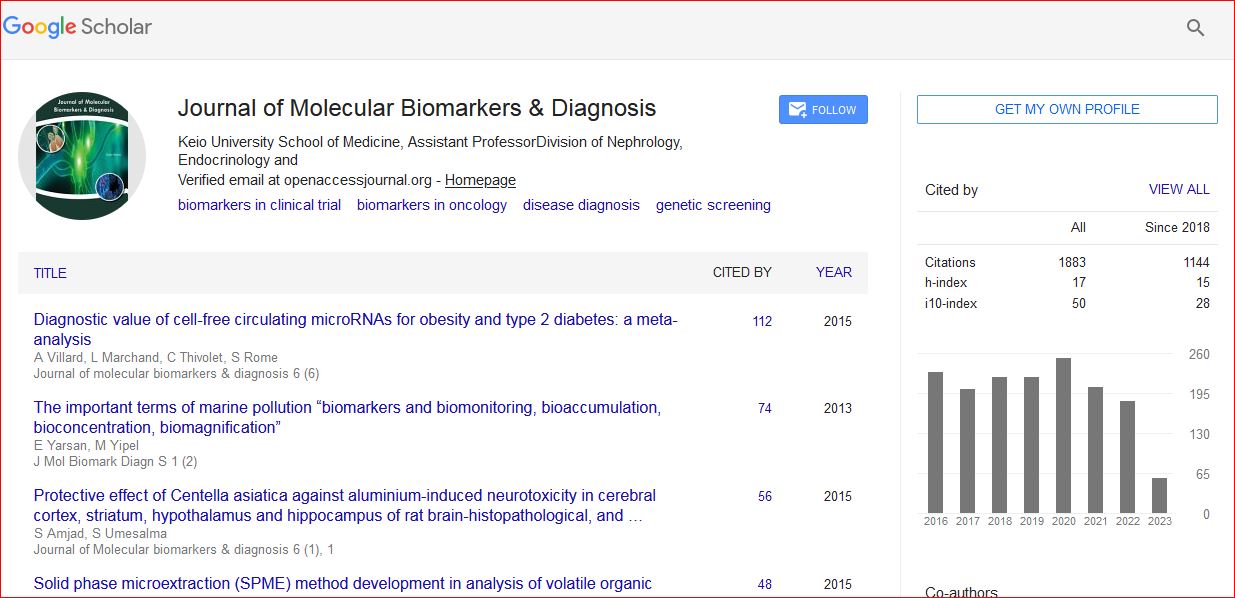
Journal of Molecular Biomarkers & Diagnosis received 2054 citations as per Google Scholar report