Short Communication - (2025) Volume 14, Issue 3
Received: 04-Mar-2025, Manuscript No. mcce-25-172343;
Editor assigned: 06-Mar-2025, Pre QC No. P-172343;
Reviewed: 20-Mar-2025, QC No. Q-172343;
Revised: 25-Mar-2025, Manuscript No. R-172343;
Published:
31-Mar-2025
, DOI: 10.37421/2470-6965.2025.14.398
Citation: Kirmani, Peter. âMolecular Diagnostics: Advancing Precision Medicine.â Malar Contr Elimination 14 (2025):398.
Copyright: © 2025 Kirmani P. This is an open-access article distributed under the terms of the Creative Commons Attribution License, which permits unrestricted use,
distribution and reproduction in any medium, provided the original author and source are credited.
Next-generation sequencing (NGS) is a transformative force in oncology molecular diagnostics. It encompasses applications like germline variant detection, somatic mutation analysis, minimal residual disease monitoring, and non-invasive prenatal testing. NGSâ??s comprehensive genomic profiling capability is crucial for personalized cancer therapy, prognostic assessment, and early detection [1].
Significant progress is evident in molecular diagnostics for infectious diseases, emphasizing their crucial role in rapid, accurate pathogen identification. Techniques from traditional Polymerase Chain Reaction (PCR)-based methods to advanced NGS and CRISPR-based systems have impacted disease surveillance, outbreak control, and antimicrobial resistance management [2].
The burgeoning field of CRISPR-based molecular diagnostics showcases potential for rapid, sensitive, and specific detection of various targets, including pathogens and genetic mutations. These technologies are transitioning from research laboratories to Point-of-Care (POC) and high-throughput applications, profoundly influencing public health and clinical diagnostics [3].
Liquid biopsy stands out as a groundbreaking non-invasive approach for molecular diagnostics in cancer. It involves detecting circulating tumor Deoxyribonucleic Acid (DNA) (ctDNA), circulating tumor cells (CTCs), and other biomarkers from bodily fluids. This utility is apparent in early cancer detection, monitoring treatment response, and identifying resistance mechanisms, thus advancing personalized oncology [4].
An overview of NGS in molecular diagnostics highlights its rapid advancements and profound impact across clinical fields. Despite challenges in data analysis, cost, and standardization, future prospects involve integrating NGS into routine clinical practice for improved patient care [5].
Recent progress in Point-of-Care (POC) molecular diagnostics for infectious diseases emphasizes the development of rapid, portable, and user-friendly devices. Technologies like isothermal amplification and microfluidics enable decentralized testing, which is critical for timely diagnosis, disease surveillance, and managing outbreaks in resource-limited settings [6].
Molecular diagnostics play an expanding role in neurodegenerative diseases, detailing methods for identifying genetic predispositions, biomarkers for early detection, and monitoring disease progression. Advancements in genomic sequencing and protein analysis are enhancing diagnostic accuracy, paving the way for targeted therapeutic interventions in conditions like Alzheimerâ??s and Parkinsonâ??s [7].
The latest advancements in molecular diagnostics for pathogen detection offer high sensitivity and specificity for identifying infectious agents. Methodologies span from nucleic acid amplification tests to biosensor-based platforms, improving public health responses, epidemiological surveillance, and clinical management of infectious diseases [8].
Microfluidic technologies are increasingly integrated into molecular diagnostics for infectious diseases. Their miniaturization, automation, and rapid analysis capabilities enable highly sensitive and portable diagnostic platforms, which are critical for Point-of-Care testing and managing global health challenges more effectively [9].
Molecular diagnostics serve a pivotal role in advancing precision medicine. Personalized genetic information, derived from molecular tests, guides tailored treatment strategies, drug selection, and disease prevention. This highlights the current landscape and future directions for integrating these diagnostics into routine clinical care for optimized patient outcomes [10].
Molecular diagnostics are at the forefront of modern medicine, providing essential tools for precise disease identification, monitoring, and treatment guidance. The field encompasses a wide array of advanced technologies and applications, fundamentally reshaping approaches to healthcare. For instance, next-generation sequencing (NGS) has emerged as a transformative technology in oncology, offering comprehensive genomic profiling critical for personalized cancer therapy, prognostic assessment, and early detection [1]. NGS applications include the detection of germline variants, somatic mutations, and minimal residual disease monitoring. This technology is also vital for non-invasive prenatal testing and continues to be integrated into clinical practice for improved patient care, despite existing challenges in data analysis, cost, and standardization [5]. Another groundbreaking, non-invasive approach for cancer diagnostics is liquid biopsy, which involves detecting circulating tumor Deoxyribonucleic Acid (DNA) (ctDNA), circulating tumor cells (CTCs), and other biomarkers from bodily fluids. This method proves highly useful for early cancer detection, monitoring treatment responses, and identifying mechanisms of drug resistance, thereby significantly advancing personalized oncology [4].
Infectious diseases have also seen remarkable progress through molecular diagnostics, which are crucial for rapid and accurate pathogen identification. Traditional Polymerase Chain Reaction (PCR)-based methods have been complemented by more advanced techniques, including next-generation sequencing and CRISPR-based systems. These advancements are instrumental in enhancing disease surveillance, controlling outbreaks, and managing antimicrobial resistance effectively [2]. Recent progress in Point-of-Care (POC) molecular diagnostics for infectious diseases focuses on developing rapid, portable, and user-friendly devices. Technologies such as isothermal amplification and microfluidics enable decentralized testing, which is indispensable for timely diagnoses, robust disease surveillance, and managing outbreaks, especially in resource-limited settings [6]. Furthermore, advancements specifically in molecular diagnostics for pathogen detection provide high sensitivity and specificity for identifying infectious agents, utilizing methodologies from nucleic acid amplification tests to biosensor-based platforms to improve public health responses and clinical management [8].
The integration of microfluidic technologies into molecular diagnostics for infectious diseases further exemplifies innovation. The miniaturization, automation, and rapid analysis capabilities of microfluidic devices are enabling highly sensitive and portable diagnostic platforms. These platforms are critical for effective Point-of-Care testing and for managing global health challenges more efficiently [9]. Similarly, the burgeoning field of CRISPR-based molecular diagnostics showcases immense potential for the rapid, sensitive, and specific detection of various targets, including pathogens and genetic mutations. These technologies are increasingly transitioning from research laboratories to both Point-of-Care and high-throughput applications, making a significant impact on public health and clinical diagnostics [3].
Beyond infectious diseases and oncology, molecular diagnostics are expanding their reach into other complex areas like neurodegenerative diseases. This involves developing precise methods for identifying genetic predispositions, discovering reliable biomarkers for early disease detection, and continually monitoring disease progression. Breakthroughs in genomic sequencing and protein analysis are actively enhancing diagnostic accuracy, paving the way for more targeted therapeutic interventions in challenging conditions such as Alzheimerâ??s and Parkinsonâ??s diseases [7]. These diverse applications highlight the pervasive influence of molecular diagnostics in modern healthcare.
Ultimately, molecular diagnostics play a pivotal role in advancing precision medicine. By providing personalized genetic information derived from sophisticated molecular tests, these diagnostics guide tailored treatment strategies, optimize drug selection, and support proactive disease prevention initiatives. This underscores the current robust landscape and charts future directions for integrating these powerful diagnostics into routine clinical care to achieve optimized patient outcomes and truly personalize healthcare [10].
Molecular diagnostics have significantly advanced across various medical fields, driving personalized treatment strategies and improving public health. Next-generation sequencing (NGS) plays a crucial role, particularly in oncology, by enabling comprehensive genomic profiling for germline variants, somatic mutations, minimal residual disease, and non-invasive prenatal testing. NGS is fundamental for personalized cancer therapy, prognostic assessment, and early detection, despite facing challenges in data analysis, cost, and standardization. Beyond oncology, molecular diagnostics have transformed the management of infectious diseases. Techniques ranging from traditional PCR to advanced NGS and CRISPR-based systems are vital for rapid and accurate pathogen identification, disease surveillance, outbreak control, and antimicrobial resistance management. Point-of-Care (POC) diagnostics, utilizing technologies like isothermal amplification and microfluidics, offer rapid, portable, and user-friendly solutions for decentralized testing, especially in resource-limited settings. Microfluidic devices, with their miniaturization and automation, are particularly enabling sensitive and portable diagnostic platforms for global health challenges. The field also sees innovation in liquid biopsy, a non-invasive approach for cancer diagnostics that detects circulating tumor DNA (ctDNA) and circulating tumor cells (CTCs), and other biomarkers from bodily fluids. This method is valuable for early cancer detection, monitoring treatment response, and identifying resistance mechanisms. Furthermore, CRISPR-based molecular diagnostics show immense potential for rapid and sensitive detection of pathogens and genetic mutations, transitioning from labs to high-throughput applications. Molecular diagnostics also extend to neurodegenerative diseases, providing methods for identifying genetic predispositions and biomarkers for early detection and monitoring disease progression, informing targeted therapeutic interventions. Overall, the integration of these advanced molecular tools is central to advancing precision medicine, guiding tailored treatment strategies and disease prevention.
None
None
1. Xu M, Zhiwei S, Xiaohong H. "Molecular diagnostics in oncology: the impact of next-generation sequencing".Signal Transduct Target Ther 8 (2023):136.
Indexed at, Google Scholar, Crossref
2. Yi P, Xuemei W, Qiaoli L. "Advances in molecular diagnostics for infectious diseases".J Zhejiang Univ Sci B 22 (2021):275-288.
Indexed at, Google Scholar, Crossref
3. Meitong Z, Huiting C, Yifan C. "CRISPR-based molecular diagnostics: From point-of-care to high-throughput applications".Biosens Bioelectron 197 (2022):113642.
Indexed at, Google Scholar, Crossref
4. Sreepurna M, Purnima B, Arka G. "Liquid biopsy: a promising tool for molecular diagnostics in cancer".Curr Opin Oncol 35 (2023):517-526.
Indexed at, Google Scholar, Crossref
5. Sajid K, Muhammad A, Muhammad Z. "Next-generation sequencing in molecular diagnostics: advancements, challenges, and future prospects".Genomics 115 (2023):111718.
Indexed at, Google Scholar, Crossref
6. Xuemei L, Weijie Z, Qiaoluan S. "Recent advances in point-of-care molecular diagnostics for infectious diseases".J Med Virol 93 (2021):6554-6567.
Indexed at, Google Scholar, Crossref
7. Jorge JL, Jorge M, Adam MB. "Molecular diagnostics in neurodegenerative diseases".Semin Neurol 41 (2021):413-424.
Indexed at, Google Scholar, Crossref
8. Qi L, Qi Z, Yuxin Z. "Recent progress in molecular diagnostics for pathogen detection".Biosens Bioelectron 177 (2021):112838.
Indexed at, Google Scholar, Crossref
9. Jinwoo K, Woonggyu L, Chang-Ha L. "Microfluidic-based molecular diagnostics for infectious diseases".Lab Chip 20 (2020):2235-2252.
Indexed at, Google Scholar, Crossref
10. Zhenhuan G, Pan Z, Yifan C. "The role of molecular diagnostics in precision medicine: current landscape and future directions".Expert Rev Mol Diagn 22 (2022):801-812.
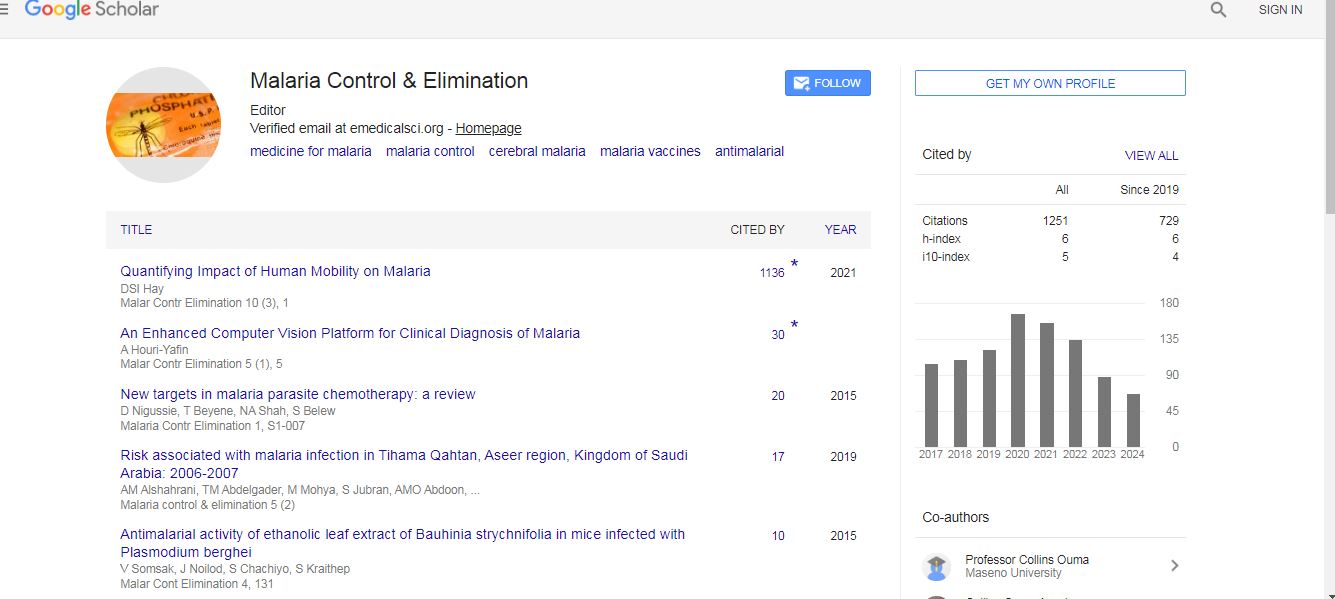
Malaria Control & Elimination received 1187 citations as per Google Scholar report