Commentary - (2025) Volume 16, Issue 4
Received: 01-Aug-2025, Manuscript No. jmbd-26-179470;
Editor assigned: 04-Aug-2025, Pre QC No. P-179470;
Reviewed: 14-Aug-2025, QC No. Q-179470;
Revised: 21-Aug-2025, Manuscript No. R-179470;
Published:
28-Aug-2025
, DOI: 10.37421/2155-9929.2025.16.712
Citation: Svensson, Ingrid. ”Molecular Biomarkers: Revolutionizing Personalized Medicine.” J Mol Biomark Diagn 16 (2025):712.
Copyright: © 2025 Svensson I. This is an open-access article distributed under the terms of the Creative Commons Attribution License, which permits unrestricted use, distribution and reproduction in any medium, provided the original author and source are credited.
Molecular biomarkers are profoundly transforming the landscape of disease diagnosis and treatment, ushering in an era of precision medicine. Their ability to facilitate earlier and more accurate diagnoses, stratify patient risk, and guide therapeutic interventions is paramount to improving patient outcomes by ensuring the right treatment is administered to the right patient at the right time. The integration of molecular data into clinical practice is essential for realizing the full potential of these tools in disease prognosis and management. Precision oncology, in particular, leverages molecular biomarkers extensively to identify actionable mutations and predict treatment responses. This paradigm shift moves away from a generalized approach, advocating for targeted therapies that offer enhanced efficacy and reduced toxicity. The ongoing discovery and validation of novel biomarkers are critical for extending the reach of personalized cancer care and significantly improving survival rates. The advent of circulating tumor DNA (ctDNA) analysis has opened significant new avenues for non-invasive cancer monitoring. ctDNA can function as a prognostic marker, enabling the detection of minimal residual disease and predicting the likelihood of relapse. Its utility in guiding treatment decisions and assessing therapeutic response is rapidly expanding, providing a dynamic perspective on tumor evolution and progression. In the realm of cardiovascular diseases, specific molecular biomarkers play a crucial role in risk assessment and early detection. These markers are instrumental in identifying individuals at elevated risk for future cardiac events, thereby enabling timely interventions and preventive strategies. Furthermore, they are valuable in monitoring disease progression and evaluating the effectiveness of ongoing therapeutic interventions. Neurological disorders pose considerable challenges for accurate diagnosis and prognostication. Molecular biomarkers show significant promise in identifying specific disease subtypes, predicting disease trajectories, and monitoring therapeutic responses in conditions such as Alzheimer's and Parkinson's disease. The development of reliable and validated biomarkers is consequently key to advancing patient care in this complex field. The integration of multi-omics approaches, encompassing genomics, transcriptomics, proteomics, and metabolomics, is substantially enhancing our capacity to dissect the intricacies of complex diseases. By offering a comprehensive view of biological processes, these integrated datasets yield more powerful prognostic and predictive biomarkers, paving the way for increasingly sophisticated disease management strategies. The development and validation of robust molecular biomarkers necessitate rigorous methodologies and consistent standardization. Ensuring reproducibility and demonstrating clinical utility are paramount for their successful translation from laboratory research into routine patient care. Addressing these inherent challenges is crucial for fostering confidence in molecular diagnostics and prognostics within the clinical setting. Artificial intelligence (AI) and machine learning (ML) are increasingly being employed to analyze extensive molecular datasets. These advanced computational tools possess the capability to identify intricate patterns and novel biomarkers that might elude conventional methods, thereby accelerating the discovery process and enhancing the accuracy of prognostic models and diagnostic algorithms. The ethical and regulatory considerations associated with the application of molecular biomarkers are complex and multifaceted. Issues pertaining to data privacy, the acquisition of informed consent, and the equitable accessibility of biomarker-driven diagnostics and therapies demand careful attention to ensure responsible implementation and to prevent the exacerbation of existing health disparities. From an economic standpoint, molecular biomarkers present substantial potential, offering prospects for cost savings through earlier diagnoses, more effective treatments, and the reduction of unnecessary interventions. Nevertheless, the initial investment required for biomarker discovery, validation, and integration into healthcare systems necessitates thorough economic evaluation to substantiate their long-term value and impact.
Molecular biomarkers are revolutionizing disease understanding and treatment, enabling earlier, more precise diagnoses, risk stratification, and personalized therapeutic decisions. This advancement leads to better patient outcomes by matching optimal treatments to individual needs at the opportune moment. The integration of molecular data into routine clinical practice is fundamental to unlocking their full potential in disease prognosis and management [1].
Precision oncology relies heavily on molecular biomarkers to pinpoint actionable mutations and forecast treatment effectiveness. This approach transcends a uniform strategy, facilitating targeted therapies that are both more effective and less toxic. The continuous discovery and validation of new biomarkers are essential for broadening the scope of personalized cancer care and improving survival rates [2].
The identification of circulating tumor DNA (ctDNA) has unveiled new possibilities for non-invasive cancer monitoring. ctDNA serves as a prognostic marker, detects minimal residual disease, and predicts relapse. Its utility in guiding treatment decisions and assessing therapy response is rapidly growing, offering a dynamic view of tumor evolution [3].
In cardiovascular diseases, specific molecular biomarkers are critical for risk assessment and early detection. These markers help identify individuals at high risk for future cardiac events, allowing for timely intervention and preventive strategies. Their role also extends to monitoring disease progression and the efficacy of therapeutic interventions [4].
Neurological disorders present significant diagnostic and prognostication challenges. Molecular biomarkers offer promise for identifying specific disease subtypes, predicting disease trajectory, and monitoring therapeutic response in conditions like Alzheimer's and Parkinson's disease. Developing reliable biomarkers is key to advancing patient care in this domain [5].
The convergence of multi-omics approaches, integrating genomics, transcriptomics, proteomics, and metabolomics, is significantly enhancing our ability to dissect complex diseases. By providing a holistic view of biological processes, these integrated datasets yield more powerful prognostic and predictive biomarkers, paving the way for more sophisticated disease management strategies [6].
The development and validation of robust molecular biomarkers demand rigorous methodologies and standardization. Ensuring reproducibility and clinical utility is paramount for their successful translation from the laboratory to patient care. Addressing these challenges is vital for building confidence in molecular diagnostics and prognostics [7].
Artificial intelligence (AI) and machine learning (ML) are increasingly applied to analyze large-scale molecular datasets. These tools can identify complex patterns and novel biomarkers missed by traditional methods, accelerating discovery and improving the accuracy of prognostic models and diagnostic algorithms [8].
The ethical and regulatory landscapes surrounding molecular biomarkers are multifaceted. Issues of data privacy, informed consent, and equitable access to biomarker-driven diagnostics and therapies require careful consideration for responsible implementation and to avoid exacerbating health disparities [9].
The economic impact of molecular biomarkers is substantial, with potential for cost savings through earlier diagnosis, more effective treatment, and reduced unnecessary interventions. However, the initial investment in discovery, validation, and integration necessitates careful economic evaluation to demonstrate long-term value [10].
Molecular biomarkers are revolutionizing disease diagnosis and treatment, enabling personalized medicine through earlier detection, risk stratification, and targeted therapies. Precision oncology heavily relies on these markers for identifying actionable mutations and predicting treatment response, leading to more effective and less toxic interventions. Circulating tumor DNA (ctDNA) offers a non-invasive means for cancer monitoring, predicting relapse, and guiding treatment. In cardiovascular and neurological diseases, molecular biomarkers are crucial for risk assessment, early detection, and prognostication. Multi-omics approaches enhance biomarker discovery by integrating diverse biological data, while AI and ML accelerate the identification of novel markers and improve predictive models. Rigorous validation and standardization are essential for clinical translation. Ethical and economic considerations, including data privacy, equitable access, and cost-effectiveness, are paramount for the responsible and widespread adoption of molecular biomarkers in healthcare.
None
None
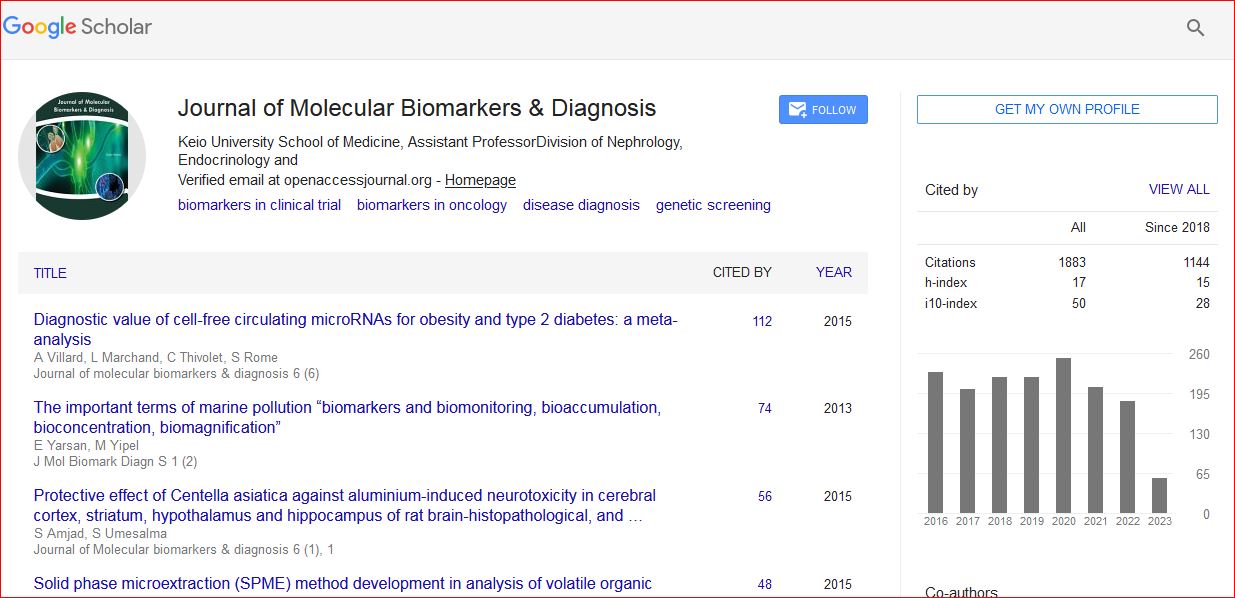
Journal of Molecular Biomarkers & Diagnosis received 2054 citations as per Google Scholar report