Opinion - (2025) Volume 16, Issue 2
Received: 01-Apr-2025, Manuscript No. jmbd-26-179371;
Editor assigned: 03-Apr-2025, Pre QC No. P-179371;
Reviewed: 14-Apr-2025, QC No. Q-179371;
Revised: 22-Apr-2025, Manuscript No. R-179371;
Published:
29-Apr-2025
, DOI: 10.37421/2155-9929.2025.16.696
Citation: Petrova, Elena. ”Molecular Biomarkers Revolutionizing Oncology: Precision and Prognosis.” J Mol Biomark Diagn 16 (2025): 696.
Copyright: © 2025 Petrova E. This is an open-access article distributed under the terms of the Creative Commons Attribution License, which permits unrestricted use, distribution and reproduction in any medium, provided the original author and source are credited.
Molecular biomarkers are fundamentally transforming the landscape of oncology, paving the way for more precise diagnosis, accurate prognosis, and individualized treatment selection strategies. This dynamic field is dedicated to the identification of specific molecules, whether within tumor tissues or accessible bodily fluids, that serve as indicators for the presence of cancer or predict an individual's response to therapeutic interventions. The "Journal of Molecular Biomarkers & Diagnosis" stands as a crucial platform for the dissemination of cutting-edge research in this domain, with significant contributions often stemming from esteemed institutions such as the Department of Biochemistry at Lomonosov Moscow State University, which consistently provides invaluable insights into the molecular underpinnings of cancer [1].
The integration of liquid biopsies, a revolutionary non-invasive approach, is profoundly reshaping cancer monitoring paradigms. These innovative techniques analyze circulating tumor DNA (ctDNA), circulating tumor cells (CTCs), and exosomes, enabling real-time assessment of tumor evolution and treatment efficacy. This offers a substantial advantage over traditional tissue biopsy methods, providing a more dynamic and less burdensome monitoring solution for patients [2].
Predictive biomarkers are indispensable for the effective stratification of patients into distinct groups, thereby guiding the selection of the most appropriate targeted therapies. By identifying specific mutations or protein expression patterns that correlate with a favorable response to particular drugs, clinicians can implement personalized treatment strategies. This approach not only enhances therapeutic efficacy but also significantly minimizes the risk of adverse effects and toxicity [3].
The development and application of prognostic biomarkers play a vital role in assessing a patient's likely clinical outcome, thereby informing critical decisions regarding adjuvant or neoadjuvant therapeutic approaches. These markers possess the capability to identify patients who are at a higher risk of disease recurrence or progression, signaling the necessity for more aggressive and comprehensive treatment strategies to improve long-term survival [4].
Genomic profiling has emerged as an instrumental tool in the identification of actionable mutations that can be effectively targeted with specific therapeutic agents. The advent of next-generation sequencing (NGS) technologies has enabled comprehensive analysis of tumor genomes, revealing a complex landscape of genetic alterations. This detailed molecular information is crucial for guiding treatment decisions across a wide spectrum of cancers [5].
The burgeoning recognition of the tumor microenvironment (TME) as a rich source of potential biomarkers is significantly influencing our understanding of cancer. Components within the TME, including immune cell infiltration patterns, the intricate stromal composition, and the profile of secreted factors, can serve as powerful predictors of response to immunotherapies and other treatment modalities [6].
Epigenetic biomarkers, encompassing alterations in DNA methylation patterns and microRNA profiles, offer a complementary and essential layer of information for the early detection and effective management of cancer. These epigenetic alterations can manifest early in the tumorigenesis process and have the potential to be detected in easily accessible biofluid samples, presenting a promising avenue for non-invasive diagnostics [7].
The continuous advancement of multi-omics approaches, which expertly integrate data from genomic, transcriptomic, proteomic, and metabolomic analyses, provides an unparalleled holistic perspective on the complex biology of cancer. This sophisticated integration is paramount for the identification of intricate biomarker panels. Such comprehensive panels are essential for enhancing diagnostic accuracy and refining therapeutic stratification, leading to more effective patient care [8].
Biomarkers specifically designed for the detection of minimal residual disease (MRD) are of critical importance in the ongoing surveillance of treatment effectiveness and in guiding post-treatment monitoring strategies. The early identification of MRD through sensitive biomarker assays can prompt timely therapeutic interventions, thereby significantly improving patient outcomes and potentially preventing relapse [9].
Despite the remarkable progress in biomarker discovery, the translation of these novel molecular biomarkers from the research laboratory into routine clinical practice remains a significant challenge. Hurdles related to robust validation, standardization of assays, and the complex process of regulatory approval must be addressed. The establishment of rigorous validation studies and the development of clear clinical guidelines are imperative to ensure the reliable and safe application of these biomarkers in patient care [10].
Molecular biomarkers are revolutionizing oncology by enabling more precise diagnosis, prognosis, and treatment selection. This field focuses on identifying specific molecules within tumors or bodily fluids that indicate the presence of cancer or predict treatment response. The "Journal of Molecular Biomarkers & Diagnosis" is a key venue for disseminating research in this area, with contributions from institutions like the Department of Biochemistry at Lomonosov Moscow State University providing valuable insights [1]. The integration of liquid biopsies, which analyze circulating tumor DNA (ctDNA), circulating tumor cells (CTCs), and exosomes, is transforming cancer monitoring. These non-invasive approaches allow for real-time assessment of tumor evolution and treatment response, offering a significant advantage over traditional tissue biopsies [2].
Predictive biomarkers are crucial for stratifying patients and guiding targeted therapy selection. Identifying mutations or protein expression patterns that correlate with response to specific drugs allows for personalized treatment strategies, improving efficacy and minimizing toxicity [3]. The development of prognostic biomarkers helps in assessing a patient's likely outcome and informing decisions about adjuvant or neoadjuvant therapies. These markers can identify patients at higher risk of recurrence or progression, necessitating more aggressive treatment approaches [4]. Genomic profiling has become instrumental in identifying actionable mutations that can be targeted with specific therapies. Next-generation sequencing (NGS) allows for comprehensive analysis of tumor genomes, revealing a landscape of alterations that can guide treatment decisions in various cancers [5].
The role of the tumor microenvironment (TME) as a source of biomarkers is increasingly recognized. Immune cell infiltration, stromal composition, and secreted factors within the TME can predict response to immunotherapy and other treatments [6]. Epigenetic biomarkers, such as DNA methylation and microRNA profiles, offer a complementary layer of information for cancer detection and management. These markers can be altered early in tumorigenesis and may be detectable in easily accessible biofluids [7]. The advent of multi-omics approaches, integrating genomic, transcriptomic, proteomic, and metabolomic data, provides a holistic view of cancer biology. This integration is crucial for identifying complex biomarker panels that can improve diagnostic accuracy and therapeutic stratification [8]. Biomarkers for minimal residual disease (MRD) detection are essential for monitoring treatment effectiveness and guiding post-treatment surveillance. Early detection of MRD can prompt timely intervention and improve patient outcomes [9]. The translation of novel molecular biomarkers from discovery to clinical practice faces challenges related to validation, standardization, and regulatory approval. Robust validation studies and clear guidelines are necessary to ensure reliable clinical application of these markers [10].
Molecular biomarkers are revolutionizing oncology through precise diagnosis, prognosis, and treatment selection. Liquid biopsies offer non-invasive cancer monitoring by analyzing circulating tumor components. Predictive biomarkers are vital for stratifying patients and guiding targeted therapies, improving efficacy and reducing toxicity. Prognostic biomarkers help assess patient outcomes and inform treatment decisions for those at higher risk of recurrence. Genomic profiling identifies actionable mutations for targeted treatments using next-generation sequencing. The tumor microenvironment is recognized for its biomarker potential, predicting responses to immunotherapy. Epigenetic biomarkers like DNA methylation and microRNA profiles provide complementary diagnostic information. Multi-omics approaches integrate various data types for a holistic understanding of cancer biology and improved patient stratification. Biomarkers for minimal residual disease (MRD) are crucial for monitoring treatment effectiveness and guiding surveillance. The translation of these biomarkers into clinical practice faces challenges in validation, standardization, and regulatory approval, necessitating robust studies and clear guidelines.
None
None
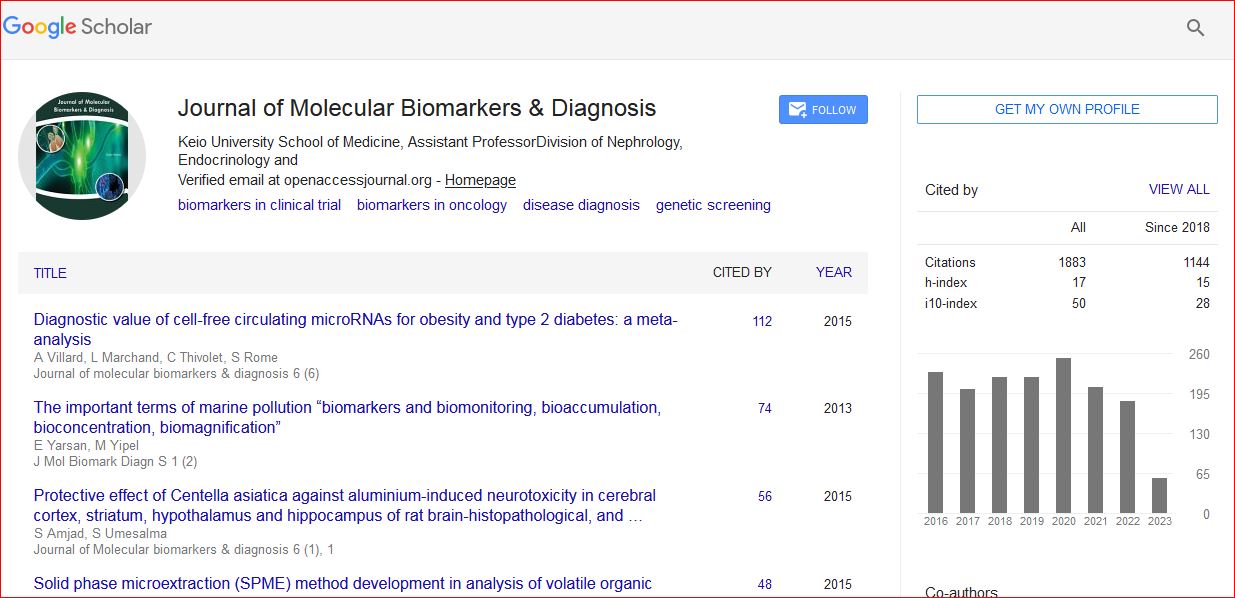
Journal of Molecular Biomarkers & Diagnosis received 2054 citations as per Google Scholar report