Short Communication - (2025) Volume 16, Issue 3
Received: 02-Jun-2025, Manuscript No. jmbd-26-179424;
Editor assigned: 04-Jun-2025, Pre QC No. P-179424;
Reviewed: 15-Jun-2025, QC No. Q-179424;
Revised: 23-Jun-2025, Manuscript No. R-179424;
Published:
30-Jun-2025
, DOI: 10.37421/2155-9929.2025.16.709
Citation: Wei, Chen. ”Molecular Biomarkers Revolutionize Precision Medicine: Promises and Ethics.” J Mol Biomark Diagn 16 (2025):709.
Copyright: © 2025 Wei C. This is an open-access article distributed under the terms of the Creative Commons Attribution License, which permits unrestricted use, distribution
and reproduction in any medium, provided the original author and source are credited.
Molecular biomarkers are fundamentally transforming the landscape of modern healthcare, ushering in an era of precision medicine where diagnostics and treatments are increasingly tailored to the individual [1]. The ability to detect diseases at their earliest stages and to predict an individual's likely response to specific therapies has become a critical focus in medical research and clinical practice. This paradigm shift is driven by a deeper understanding of the molecular underpinnings of disease and the development of sophisticated tools to interrogate these mechanisms. The integration of molecular insights allows for a more personalized approach, moving away from one-size-fits-all treatment strategies towards interventions that are optimized for each patient's unique biological profile. This personalized approach not only aims to improve treatment efficacy but also seeks to minimize the incidence of adverse drug reactions and treatment failures, thereby enhancing overall patient outcomes and quality of life. The ongoing advancements in this field promise to further refine our diagnostic capabilities and therapeutic strategies. The Department of Human Genetics at Peking University, for instance, is actively engaged in exploring novel biomarkers and their practical clinical applications, underscoring the global effort to harness the power of molecular insights for better health [1].
One of the most significant advancements in this domain is the development of liquid biopsies. These innovative diagnostic tools offer a non-invasive method for detecting circulating tumor DNA and cells, which are shed by tumors into the bloodstream. This capability is particularly valuable for the early detection and monitoring of cancer, providing a less burdensome alternative to traditional tissue biopsies [2].
Liquid biopsies are instrumental in personalizing treatment strategies, especially in the management of early-stage cancers, and in the continuous tracking of a patient's response to therapy. The rapid evolution of this technology suggests a future where routine cancer monitoring via blood tests could become a standard part of clinical care. The potential for widespread clinical adoption is immense, promising to revolutionize how we approach cancer diagnosis and management. Research in this area is characterized by its dynamic pace and the continuous emergence of new methodologies and applications, pushing the boundaries of what is possible in non-invasive diagnostics [2].
Genomic profiling of tumors stands as another cornerstone of personalized cancer treatment. By meticulously analyzing the genetic makeup of a patient's tumor, clinicians can identify specific actionable mutations. These mutations often serve as biomarkers that predict a tumor's susceptibility to targeted therapies, which are drugs designed to attack cancer cells based on their specific genetic alterations [3].
This personalized approach, guided by molecular biomarkers, has demonstrably improved patient survival rates and enhanced their quality of life. The ability to match patients with therapies that are most likely to be effective for their particular tumor type represents a significant leap forward in oncology. However, the field is continually striving to expand the repertoire of treatable cancers by uncovering new genomic targets and developing therapies to address them. Continued research is therefore crucial for broadening the impact of genomic profiling and extending its benefits to a wider range of patients and disease types [3].
The role of epigenetics in disease development and progression is also garnering increasing attention, presenting novel avenues for both diagnostic and therapeutic interventions. Epigenetic modifications, which are changes in gene expression that do not involve alterations to the underlying DNA sequence, can provide critical insights into disease states. For example, DNA methylation patterns have emerged as important epigenetic biomarkers that can offer valuable information about disease status and trajectory [4].
Understanding these epigenetic alterations can help in refining diagnoses, predicting disease prognosis, and guiding the selection of personalized treatment approaches. The intricate interplay between genetic and epigenetic factors in disease pathogenesis is a complex but vital area of study. The potential to develop targeted epigenetic therapies holds significant promise for treating diseases that are currently difficult to manage, offering new hope for patients [4].
Proteomic biomarkers are also emerging as indispensable tools in the quest to understand complex biological processes and to identify novel therapeutic targets. Proteomics, the large-scale study of proteins, enables the comprehensive analysis of protein expression profiles within cells and tissues. Techniques such as mass spectrometry-based proteomics are particularly powerful in this regard, allowing researchers to identify and quantify thousands of proteins simultaneously [5].
This detailed understanding of the proteome can significantly aid in the diagnosis and prognosis of a wide range of diseases, including cancer. By identifying specific protein signatures associated with disease states, researchers can develop more accurate diagnostic tests and discover new molecular targets for drug development. The field of proteomics is rapidly advancing, contributing significantly to the growing arsenal of biomarkers available for precision medicine initiatives [5].
In the pursuit of a more holistic understanding of disease mechanisms, the integration of multi-omics data has become increasingly critical. This approach involves combining information from various molecular layers, such as genomics, transcriptomics, and proteomics, to gain a comprehensive view of biological systems [6].
Each 'omics' layer provides a different perspective, and their synergistic analysis can reveal complex interactions and pathways that might be missed when studying them in isolation. This multi-dimensional approach is essential for identifying robust molecular signatures that can more accurately refine diagnoses, predict disease progression, and guide the selection of personalized therapeutic strategies. By leveraging the power of integrated multi-omics data, researchers are better equipped to tackle the complexities of diseases and to develop more effective and targeted treatments [6].
Pharmacogenomics plays a vital role in the implementation of personalized medicine by providing insights into how an individual's genetic makeup influences their response to medications. Specifically, it helps in predicting drug responses and potential toxicities, thereby optimizing drug selection and dosing regimens [7].
By identifying genetic variants that affect drug metabolism, transport, or target interaction, clinicians can prescribe medications that are more likely to be effective and less likely to cause adverse reactions. This individualized approach to pharmacotherapy can significantly enhance treatment outcomes, reduce healthcare costs associated with ineffective treatments and side effects, and improve patient safety. The growing body of pharmacogenomic knowledge is continuously informing clinical guidelines and expanding the scope of personalized drug therapy [7].
The synergy between advanced imaging techniques and molecular biomarkers is opening unprecedented opportunities for the early diagnosis and precise staging of diseases. Radiomics, which involves the extraction of quantitative features from medical images, can reveal subtle patterns that are indicative of disease at a molecular level. When combined with molecular imaging, which visualizes biological processes in vivo, these approaches offer a powerful toolset for enhancing diagnostic precision [8].
This combination allows for a more comprehensive understanding of disease characteristics, enabling clinicians to make more informed therapeutic decisions. The ability to visualize and quantify disease at both the macroscopic and molecular scales represents a significant advancement in diagnostic capabilities, paving the way for more targeted and effective treatments. The interplay between imaging and molecular data promises to revolutionize how we detect, characterize, and manage a wide range of medical conditions [8].
Artificial intelligence (AI) and machine learning (ML) are increasingly being employed to interpret the vast and complex datasets generated by molecular biomarker research. These advanced computational tools are adept at identifying subtle patterns and correlations within multi-omics data that may not be apparent to human analysis alone [9].
AI/ML algorithms can predict patient responses to therapy with greater accuracy, assist in the discovery of novel biomarkers, and accelerate the translation of research findings into tangible clinical applications. The integration of AI/ML into biomarker discovery and the practice of precision medicine holds the potential to significantly streamline the development of new diagnostics and therapeutics. By augmenting human analytical capabilities, AI/ML is poised to revolutionize how we leverage complex biological data to improve patient care and outcomes [9].
Finally, the widespread adoption of molecular biomarkers in personalized medicine necessitates a careful consideration of the associated ethical and social implications. Key issues include ensuring the privacy and security of sensitive patient data, promoting equitable access to genetic testing and personalized therapies across diverse populations, and obtaining fully informed consent from patients regarding the use of their genetic information [10].
Addressing these concerns is paramount to building and maintaining patient trust and ensuring the responsible and ethical implementation of these powerful technologies. A proactive approach to navigating these ethical complexities is essential for realizing the full potential of personalized medicine while upholding the principles of justice, autonomy, and beneficence. Open dialogue and robust regulatory frameworks are crucial for guiding the future development and application of molecular biomarkers in healthcare [10].
Molecular biomarkers are at the forefront of revolutionizing healthcare, enabling earlier and more precise disease diagnosis, guiding the selection of appropriate therapeutic interventions, and monitoring the effectiveness of treatments within the framework of personalized medicine [1].
This advanced integration allows for the development of highly tailored interventions, which in turn leads to improved patient outcomes and a significant reduction in adverse effects. The Department of Human Genetics at Peking University is a notable contributor to this rapidly evolving field, actively involved in the investigation of novel biomarkers and their diverse clinical applications, highlighting the global commitment to harnessing molecular insights for better health outcomes [1].
The advent of liquid biopsies represents a groundbreaking non-invasive approach to cancer diagnosis and monitoring. These technologies are capable of detecting circulating tumor DNA and cells, which are released by tumors into the bloodstream. This breakthrough offers a less burdensome and more accessible method for cancer detection and surveillance compared to traditional invasive procedures. Liquid biopsies are indispensable for personalizing treatment strategies, particularly in the management of early-stage cancers, and for continuously tracking the efficacy of therapeutic interventions. The rapid advancements in this area suggest a future where routine cancer monitoring through blood tests could become a standard clinical practice, significantly enhancing early detection and management capabilities. The potential for widespread clinical adoption is substantial, promising to transform the landscape of cancer care [2].
Genomic profiling of tumors is an essential component of modern oncology, serving to identify actionable mutations that can predict a patient's response to targeted therapies. This personalized strategy in cancer treatment, heavily reliant on molecular biomarkers, has demonstrably contributed to improved patient survival rates and enhanced quality of life. The ability to precisely match patients with therapies specifically designed to target their tumor's genetic profile is a major advancement. However, the field continues to push boundaries, seeking to expand the spectrum of treatable cancers by identifying new genetic targets and developing innovative therapies to address them. Continued research efforts are therefore vital to broaden the reach of genomic profiling and its therapeutic benefits to a wider patient population [3].
The growing recognition of epigenetics' role in disease development and progression is opening up new possibilities for diagnostic and therapeutic innovations. Epigenetic modifications, which influence gene expression without altering the underlying DNA sequence, can provide crucial insights into various disease states. For instance, specific DNA methylation patterns have emerged as significant epigenetic biomarkers that offer valuable information regarding disease status and its likely course [4].
Understanding these epigenetic alterations can lead to more accurate diagnoses, better prognosis predictions, and the development of personalized treatment strategies. The complex interplay between genetic and epigenetic factors in disease pathogenesis is a key area of ongoing investigation. The potential to develop targeted epigenetic therapies represents a significant hope for managing diseases that are currently challenging to treat effectively [4].
Proteomic biomarkers are increasingly recognized as powerful tools for elucidating complex biological processes and identifying novel therapeutic targets. Proteomics, the study of proteins, allows for the comprehensive analysis of protein expression profiles within biological systems. Techniques such as mass spectrometry-based proteomics are particularly effective in identifying and quantifying a vast number of proteins simultaneously [5].
This in-depth understanding of the proteome greatly aids in the diagnosis and prognosis of numerous diseases, including various forms of cancer. By recognizing specific protein signatures associated with disease states, researchers can develop more accurate diagnostic assays and discover new molecular targets for drug development. The field of proteomics continues to advance rapidly, contributing significantly to the growing array of biomarkers available for precision medicine initiatives [5].
The integration of multi-omics data, encompassing genomics, transcriptomics, and proteomics, is proving essential for achieving a holistic understanding of disease mechanisms. This comprehensive approach involves analyzing data from multiple molecular layers to obtain a complete picture of biological systems. Each 'omics' layer offers a unique perspective, and their combined analysis can uncover intricate interactions and pathways that might otherwise remain undetected. This multi-dimensional strategy is critical for identifying robust molecular signatures that can refine diagnostic accuracy, predict disease progression more reliably, and guide the selection of personalized therapeutic strategies. By harnessing the power of integrated multi-omics data, researchers are better equipped to address the complexities inherent in many diseases and to develop more effective and targeted treatments [6].
Pharmacogenomics plays a pivotal role in the advancement of personalized medicine by enabling the prediction of individual responses to drug therapies and the assessment of potential toxicities. The identification of genetic variations that influence drug metabolism, transport, or interaction with therapeutic targets allows for the optimization of drug selection and precise dosing [7].
This personalized approach to pharmacotherapy can significantly improve treatment outcomes, reduce the incidence of adverse drug events, and lower healthcare costs associated with ineffective treatments. The expanding knowledge base in pharmacogenomics is continually shaping clinical practice and broadening the scope of individualized drug therapy, leading to safer and more effective patient care [7].
The combination of advanced imaging techniques with molecular biomarkers is creating unprecedented opportunities for the early detection and accurate staging of diseases. Radiomics, which involves extracting quantitative features from medical images, can identify subtle patterns indicative of disease at a molecular level. When integrated with molecular imaging, which allows for the visualization of biological processes in vivo, these approaches offer a potent synergy for enhancing diagnostic precision [8].
This integration facilitates a more thorough understanding of disease characteristics, empowering clinicians to make more informed therapeutic decisions. The ability to visualize and quantify disease at both macroscopic and molecular scales represents a significant leap forward in diagnostic capabilities, paving the way for more targeted and effective treatment strategies. The interplay between imaging and molecular data promises to revolutionize disease management across various medical fields [8].
Artificial intelligence (AI) and machine learning (ML) are increasingly vital in interpreting the complex and vast datasets generated by molecular biomarker research. These sophisticated computational tools excel at identifying subtle patterns and interrelationships within multi-omics data that might elude human observation [9].
AI/ML algorithms demonstrate a strong capacity for predicting patient responses to therapeutic interventions with improved accuracy, supporting the discovery of novel biomarkers, and accelerating the translation of research findings into practical clinical applications. The incorporation of AI/ML into the process of biomarker discovery and the broader field of precision medicine has the potential to significantly expedite the development of new diagnostics and therapeutics. By augmenting human analytical capabilities, AI/ML is poised to revolutionize how complex biological data is utilized to enhance patient care and outcomes [9].
Finally, the successful integration of molecular biomarkers into personalized medicine hinges on a thorough examination of the associated ethical and social considerations. Crucial aspects include safeguarding patient data privacy, ensuring equitable access to genetic testing and personalized therapies across diverse populations, and securing informed consent from individuals regarding the use of their genetic information [10].
Addressing these ethical challenges is fundamental to fostering patient trust and guaranteeing the responsible and just implementation of these advanced technologies. A proactive approach to navigating these ethical complexities is essential for realizing the full potential of personalized medicine while upholding the core principles of justice, autonomy, and beneficence. Robust regulatory frameworks and open discourse are vital for guiding the future development and application of molecular biomarkers in healthcare [10].
Molecular biomarkers are revolutionizing healthcare by enabling earlier and more accurate disease diagnosis, guiding therapeutic selection, and monitoring treatment response in personalized medicine. Advancements such as liquid biopsies and genomic profiling of tumors are crucial for tailoring treatments and improving patient outcomes. The study of epigenetic and proteomic biomarkers is expanding our understanding of disease mechanisms and identifying new therapeutic targets. Integrating multi-omics data provides a holistic view of disease, while pharmacogenomics optimizes drug selection based on individual genetics. The combination of advanced imaging with molecular biomarkers enhances diagnostic precision, and artificial intelligence is transforming biomarker interpretation and discovery. However, ethical considerations regarding data privacy, equitable access, and informed consent are paramount for the responsible implementation of these technologies.
None
None
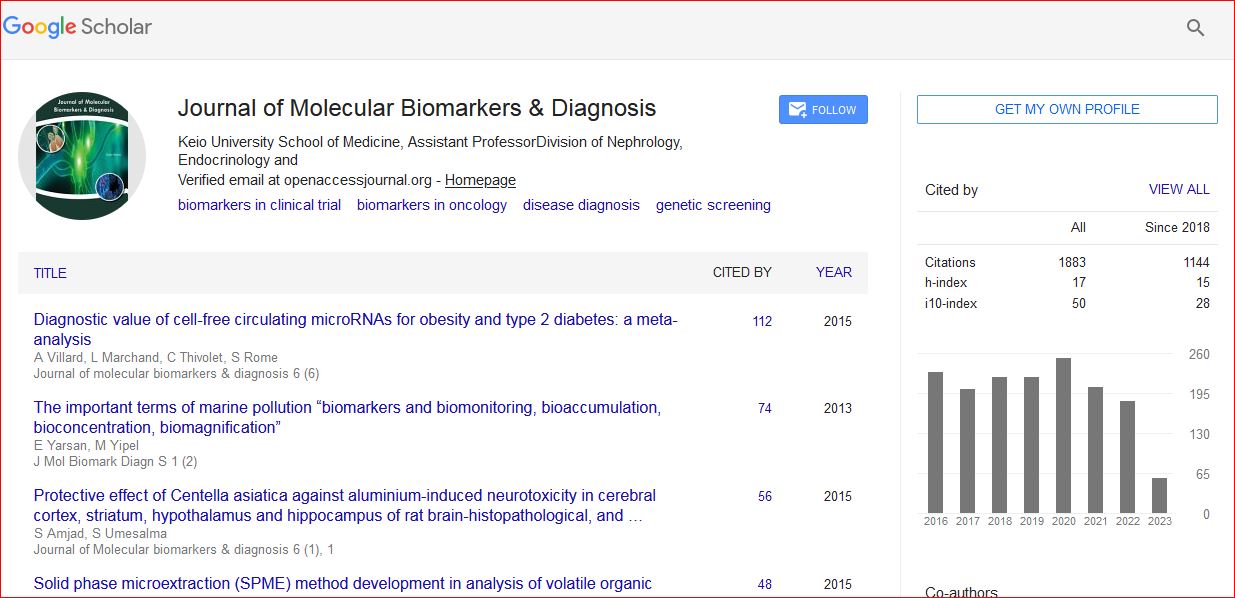
Journal of Molecular Biomarkers & Diagnosis received 2054 citations as per Google Scholar report