Perspective - (2025) Volume 16, Issue 5
Received: 01-Oct-2025, Manuscript No. jmbd-26-179571;
Editor assigned: 03-Oct-2025, Pre QC No. P-179571;
Reviewed: 15-Oct-2025, QC No. Q-179571;
Revised: 23-Oct-2025, Manuscript No. R-179571;
Published:
30-Oct-2025
, DOI: 10.37421/2155-9929.2025.16.723
Citation: Mokoena, Thabo. ”Molecular Biomarkers: Precision Medicine’s Diagnostic Revolution.” J Mol Biomark Diagn 16 (2025):723.
Copyright: © 2025 Mokoena T. This is an open-access article distributed under the terms of the Creative Commons Attribution License, which permits unrestricted use,
distribution and reproduction in any medium, provided the original author and source are credited.
Molecular biomarkers are at the forefront of transforming disease diagnosis and prognosis, offering the capability to reflect underlying biological processes for earlier detection and more precise staging [1].
This advancement is propelling us toward precision medicine, where individual molecular profiles guide therapeutic decisions to enhance patient outcomes and reduce healthcare burdens [1].
The identification and validation of novel molecular biomarkers are paramount for their successful integration into clinical practice. This necessitates the application of multi-omics approaches, rigorous statistical analysis, and comprehensive clinical validation to ensure their reliability and reproducibility [2].
Liquid biopsies, leveraging components like circulating tumor DNA (ctDNA), circulating tumor cells (CTCs), and exosomes, are emerging as powerful non-invasive tools for cancer detection, monitoring, and treatment selection [3].
Their capacity to capture tumor heterogeneity and track treatment response in real-time presents a significant advantage over traditional tissue biopsies [3].
The integration of artificial intelligence (AI) and machine learning (ML) with molecular biomarker data holds the potential to unlock deeper insights into disease progression and treatment efficacy [4].
These computational methods can identify intricate patterns and predict patient responses with enhanced accuracy, thereby accelerating the development and application of new diagnostic and prognostic tools [4].
Genomic and epigenomic alterations are fundamental drivers of numerous diseases. Their detection through molecular biomarkers provides critical diagnostic and prognostic information, enabling a more precise understanding of disease evolution and the development of targeted therapies [5].
Proteomic biomarkers play a crucial role in understanding cellular function and disease states. Technologies such as mass spectrometry and antibody-based platforms are essential for identifying and quantifying proteins, offering insights into disease mechanisms and serving as potential diagnostic and prognostic indicators [6].
Metabolic profiling offers a unique perspective into cellular health and disease, as aberrant metabolic pathways are characteristic of many conditions. Metabolites can act as sensitive biomarkers for early detection and prognosis, thereby guiding therapeutic interventions [7].
The development of robust assays for molecular biomarkers is indispensable for their successful clinical implementation. This involves advancements in technologies like PCR, sequencing, immunoassays, and biosensors to ensure the necessary sensitivity, specificity, and scalability for widespread use [8].
Pharmacogenomic biomarkers are critical for predicting drug response and guiding personalized pharmacotherapy. By analyzing genetic variations, clinicians can tailor drug selection and dosage to individual patients, optimizing efficacy and minimizing adverse drug reactions [9].
Circulating microRNAs (miRNAs) are increasingly recognized as valuable biomarkers due to their stability and tissue-specific expression. These small non-coding RNAs can reflect cellular states and disease processes, offering potential for non-invasive diagnosis and prognosis across a range of conditions [10].
Molecular biomarkers are poised to revolutionize disease diagnosis and prognosis by providing insights into underlying biological processes. This enables earlier detection, more accurate staging, and the development of personalized treatment strategies, moving us toward precision medicine where individual molecular profiles guide therapeutic decisions to improve patient outcomes and reduce healthcare burdens [1].
The translation of molecular biomarkers into clinical practice hinges on their successful identification and validation. This process requires the application of sophisticated multi-omics approaches, rigorous statistical analysis, and comprehensive clinical validation studies to guarantee their reliability and reproducibility, with ongoing efforts to overcome challenges such as biomarker heterogeneity and standardization [2].
Liquid biopsies represent a significant advancement, employing non-invasive tools like circulating tumor DNA (ctDNA), circulating tumor cells (CTCs), and exosomes for cancer detection, monitoring, and treatment selection. Their ability to capture tumor heterogeneity and dynamically track treatment response offers a distinct advantage over traditional tissue biopsies [3].
The synergy between artificial intelligence (AI), machine learning (ML), and molecular biomarker data is unlocking deeper insights into disease progression and treatment efficacy. These computational methods are instrumental in identifying complex patterns and predicting patient responses with greater accuracy, thus accelerating the development and application of novel diagnostic and prognostic tools [4].
Understanding genomic and epigenomic alterations, which are fundamental drivers of many diseases, is crucial. Molecular biomarkers facilitate the detection of these alterations, providing vital diagnostic and prognostic information that allows for targeted therapies and a more precise understanding of disease evolution [5].
Proteomic biomarkers are indispensable for elucidating cellular function and disease states. Key technologies like mass spectrometry and antibody-based platforms are employed for the identification and quantification of proteins, yielding critical insights into disease mechanisms and identifying potential diagnostic and prognostic indicators [6].
Metabolic profiling provides a unique window into cellular health and disease by examining aberrant metabolic pathways, which are characteristic of numerous conditions. Metabolites identified through such profiling can serve as sensitive biomarkers for early detection and prognosis, thereby guiding therapeutic interventions effectively [7].
The successful clinical implementation of molecular biomarkers is heavily reliant on the development of robust assays. Continuous advancements in technologies such as PCR, sequencing, immunoassays, and biosensors are essential to ensure the required sensitivity, specificity, and scalability for their widespread adoption [8].
Pharmacogenomic biomarkers are fundamental to predicting individual drug responses and guiding personalized pharmacotherapy. By analyzing genetic variations, clinicians can optimize drug selection and dosage for each patient, thereby maximizing therapeutic efficacy and minimizing the risk of adverse drug reactions [9].
Circulating microRNAs (miRNAs) are gaining prominence as biomarkers due to their inherent stability and tissue-specific expression patterns. These small non-coding RNAs can effectively reflect cellular states and disease processes, presenting significant potential for non-invasive diagnosis and prognosis across a diverse range of medical conditions [10].
Molecular biomarkers are revolutionizing disease diagnosis and prognosis by enabling earlier detection, accurate staging, and personalized treatment strategies, aligning with the principles of precision medicine. The validation of these biomarkers involves rigorous multi-omics approaches and clinical studies. Emerging non-invasive techniques like liquid biopsies offer significant advantages over traditional methods for cancer monitoring and treatment selection. Artificial intelligence and machine learning are enhancing the interpretation of biomarker data for improved predictive accuracy. Genomic, epigenomic, proteomic, and metabolic profiles provide critical information for understanding disease mechanisms and developing targeted therapies. Robust assay development is crucial for clinical application. Pharmacogenomic biomarkers personalize drug therapy, while circulating microRNAs show promise for non-invasive diagnostics. Addressing challenges like biomarker heterogeneity and standardization is key for widespread adoption.
None
None
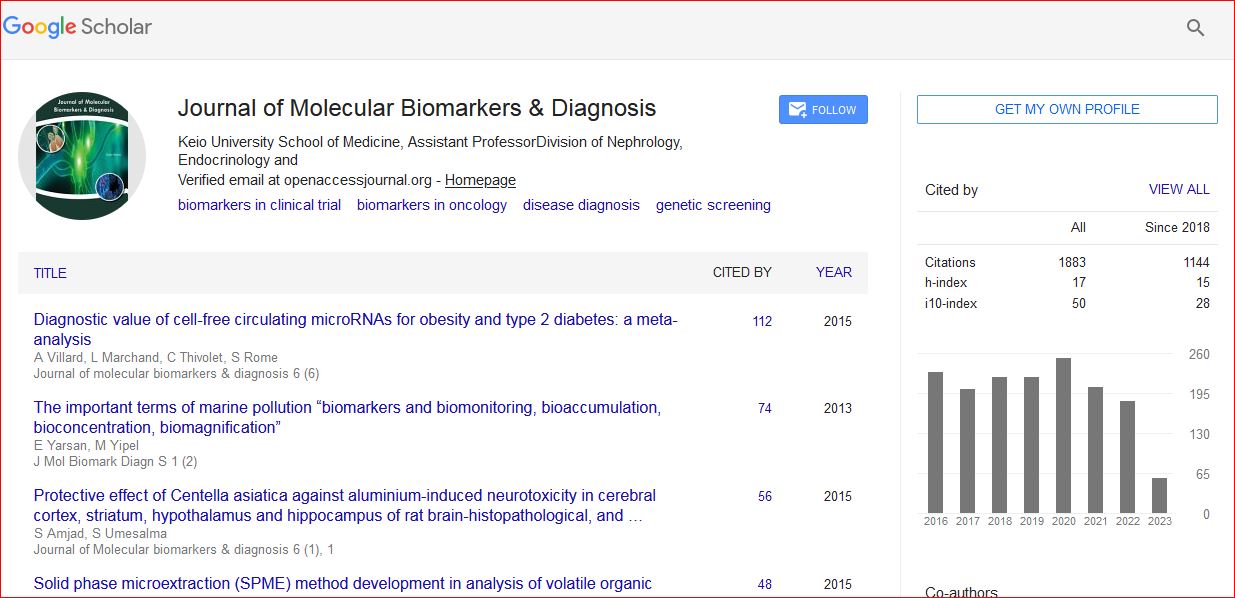
Journal of Molecular Biomarkers & Diagnosis received 2054 citations as per Google Scholar report