Commentary - (2025) Volume 14, Issue 5
Received: 01-Oct-2025, Manuscript No. idse-26-183622;
Editor assigned: 03-Oct-2025, Pre QC No. P-183622;
Reviewed: 17-Oct-2025, QC No. Q-183622;
Revised: 22-Oct-2025, Manuscript No. R-183622;
Published:
29-Oct-2025
, DOI: 10.37421/2168-9768.2025.14.509
Citation: Kowalczyk, Marek. ”Modern Irrigation and Drainage:
Smart Technologies, Sustainability, and Adaptation.” Irrigat Drainage Sys Eng
14 (2025):509.
Copyright: © 2025 Kowalczyk M. This is an open-access article distributed under the terms of the Creative Commons Attribution License, which permits unrestricted use,
distribution and reproduction in any medium, provided the original author and source are credited.
Recent advancements in irrigation and drainage systems are critically important for ensuring global food security and sustainable agricultural practices in the face of growing water scarcity and changing climatic conditions. The engineering design and management of these systems have seen significant evolution, with a strong emphasis on optimizing water use and boosting agricultural productivity. This evolving field is increasingly integrating smart technologies, such as sophisticated sensor networks and advanced data analytics, to achieve precise water application and effectively mitigate the adverse impacts of drainage [1].
The performance and design of subsurface drainage systems are vital for managing waterlogged agricultural lands, particularly in soils with poor drainage characteristics like clay. Multi-year evaluations have demonstrated the crucial role of these systems in enhancing drainage efficiency, improving crop yields, and minimizing environmental consequences, such as nutrient leaching. Proper design parameters and meticulous installation techniques are consistently highlighted as paramount for maximizing the benefits derived from subsurface drainage in agricultural contexts [2].
The application of remote sensing and Geographic Information Systems (GIS) has become indispensable for optimizing the design and operational efficiency of large-scale irrigation networks. By leveraging satellite imagery and sophisticated spatial analysis, it is possible to precisely identify areas with high water demand, pinpoint system inefficiencies, and facilitate more informed water allocation decisions. These technologies offer substantial potential for improving water use efficiency and significantly reducing operational costs within irrigation management frameworks [3].
Constructed wetlands represent an innovative and ecologically sound approach to treating agricultural drainage water. These systems have been extensively evaluated for their efficacy in removing a wide array of pollutants, including essential nutrients and harmful pesticides, while also providing considerable ecological benefits. Optimization of wetland design parameters is key to achieving effective water quality improvement and promoting sustainable land management practices [4].
Climate change poses a significant and growing threat to the availability of irrigation water, presenting complex challenges for effective system management. Adaptation strategies are therefore essential, encompassing the development of drought-resistant crop varieties, enhancement of water harvesting techniques, and precise recalibration of irrigation scheduling protocols. The development of flexible and resilient irrigation designs is crucial for maintaining food security in vulnerable regions worldwide [5].
In arid and semi-arid environments, the adoption of water-saving irrigation techniques is paramount for sustainable agriculture. Techniques such as drip irrigation and micro-sprinklers have been extensively evaluated for their water savings, crop yield improvements, and energy consumption profiles. These studies provide valuable practical guidance for farmers and irrigation managers in selecting and implementing the most suitable water-efficient technologies for their specific needs [6].
Managing the quality of agricultural drainage water is a persistent challenge in many agricultural catchments. Research into best management practices (BMPs) has shown their effectiveness in significantly reducing the loads of nutrients and sediments entering surface water bodies. An integrated catchment management framework, combining both structural and non-structural measures, is essential for achieving substantial improvements in water quality and enhancing ecosystem health [7].
The integration of artificial intelligence (AI) and machine learning (ML) is revolutionizing irrigation scheduling and water management processes. Numerous AI/ML models are being developed and applied to accurately predict crop water requirements, identify irrigation system malfunctions, and ultimately enhance overall water use efficiency. These advanced computational technologies hold transformative potential for modern irrigation engineering practices [8].
Automated surface irrigation systems are being designed and evaluated for their ability to minimize water losses and improve application uniformity. These systems often incorporate advanced technologies such as sensors, controllers, and sophisticated algorithms for real-time management and optimization of water application. A comprehensive analysis of these technological advancements is crucial for understanding their full impact on water use efficiency in surface irrigation [9].
The adoption of improved irrigation and drainage technologies in developing countries carries significant economic and social implications. Studies have assessed various factors influencing adoption, quantifying benefits such as increased crop yields and income, alongside challenges related to cost, training, and infrastructure development. Context-specific solutions and participatory approaches are vital for the successful and sustainable implementation of these technologies [10].
The engineering design and management of irrigation and drainage systems are at the forefront of efforts to enhance agricultural productivity and ensure sustainable water use, particularly in response to global challenges like climate change and water scarcity. Recent advancements highlight the integration of cutting-edge smart technologies, including sensor networks and sophisticated data analytics, which are instrumental in optimizing water application and mitigating the environmental impacts associated with drainage operations. This comprehensive approach aims to create more resilient and efficient agricultural water management systems [1].
In regions facing waterlogged conditions, especially those characterized by clay soils, the performance of subsurface drainage systems is a critical area of study. Research involving multi-year evaluations has consistently underscored the importance of these systems in managing water levels, thereby positively impacting crop yields and reducing the environmental burden of nutrient runoff. The findings emphasize that adherence to precise design specifications and diligent installation practices are fundamental to realizing the full benefits of subsurface drainage in agricultural settings [2].
The utilization of remote sensing and GIS technologies has become a cornerstone in the efficient management of extensive irrigation networks. These advanced tools enable detailed analysis of satellite imagery and spatial data, facilitating the identification of high-demand areas, detection of operational inefficiencies within the system, and more judicious allocation of water resources. Such technological integration is key to achieving significant gains in water use efficiency and driving down operational expenditures in irrigation management [3].
Constructed wetlands offer a sustainable and ecologically sound method for treating agricultural drainage water, effectively removing a range of pollutants such as nutrients and pesticides. The design of these systems is critical for maximizing their efficiency in improving water quality and contributing to broader sustainable land management goals. The ecological benefits derived from these systems further enhance their value in modern agricultural practices [4].
Climate change presents substantial challenges to the reliable availability of irrigation water, necessitating proactive adaptation strategies for effective system management. These strategies include the development of crops that are more resistant to drought, the implementation of enhanced water harvesting methods, and the continuous refinement of irrigation scheduling practices. The imperative for flexible and robust irrigation designs is clear in ensuring long-term food security, especially in regions highly susceptible to climate variability [5].
Water-saving irrigation techniques, such as drip irrigation and micro-sprinklers, are essential for agricultural sustainability in arid and semi-arid environments. Rigorous evaluations have quantified the water savings achieved, the positive effects on crop yields, and the associated energy consumption. This research provides practical insights for stakeholders to make informed decisions regarding the selection and deployment of the most suitable water-efficient technologies [6].
Addressing the quality of agricultural drainage water is a significant concern for maintaining the health of aquatic ecosystems. Research into best management practices (BMPs) has demonstrated their efficacy in curbing the release of nutrients and sediments into surface waters. The development of integrated catchment management plans, which synergize structural and non-structural interventions, is crucial for achieving significant improvements in water quality and safeguarding ecosystem integrity [7].
Artificial intelligence (AI) and machine learning (ML) are emerging as transformative forces in optimizing irrigation scheduling and overall water management. The application of various AI/ML models allows for accurate prediction of crop water needs, early detection of irrigation system malfunctions, and substantial improvements in water use efficiency. These computational advancements are poised to reshape the landscape of modern irrigation engineering [8].
The design and performance of automated surface irrigation systems are continually being refined to reduce water losses and enhance uniformity of application. This progress involves the integration of advanced sensors, intelligent controllers, and sophisticated algorithms to enable real-time management and optimization. A thorough examination of these technological advancements is vital for understanding their contribution to improved water use efficiency in surface irrigation [9].
In developing regions, the adoption of advanced irrigation and drainage technologies holds considerable economic and social promise. Assessments of these adoptions consider factors influencing uptake, the resultant increase in crop yields and income, and potential hurdles such as cost, training needs, and infrastructure requirements. The emphasis is on developing solutions tailored to local contexts and employing participatory methods for successful and sustainable implementation [10].
This collection of research explores critical aspects of modern irrigation and drainage systems. Advancements in smart technologies, such as AI and remote sensing, are enhancing efficiency and water management. Subsurface drainage systems are vital for waterlogged soils, while constructed wetlands offer sustainable water treatment. Climate change impacts necessitate adaptive strategies and water-saving techniques like drip irrigation. Best management practices are crucial for improving drainage water quality. Automated surface irrigation systems aim to minimize water loss. Finally, the economic and social impacts of adopting improved technologies in developing regions are examined, highlighting the need for context-specific solutions.
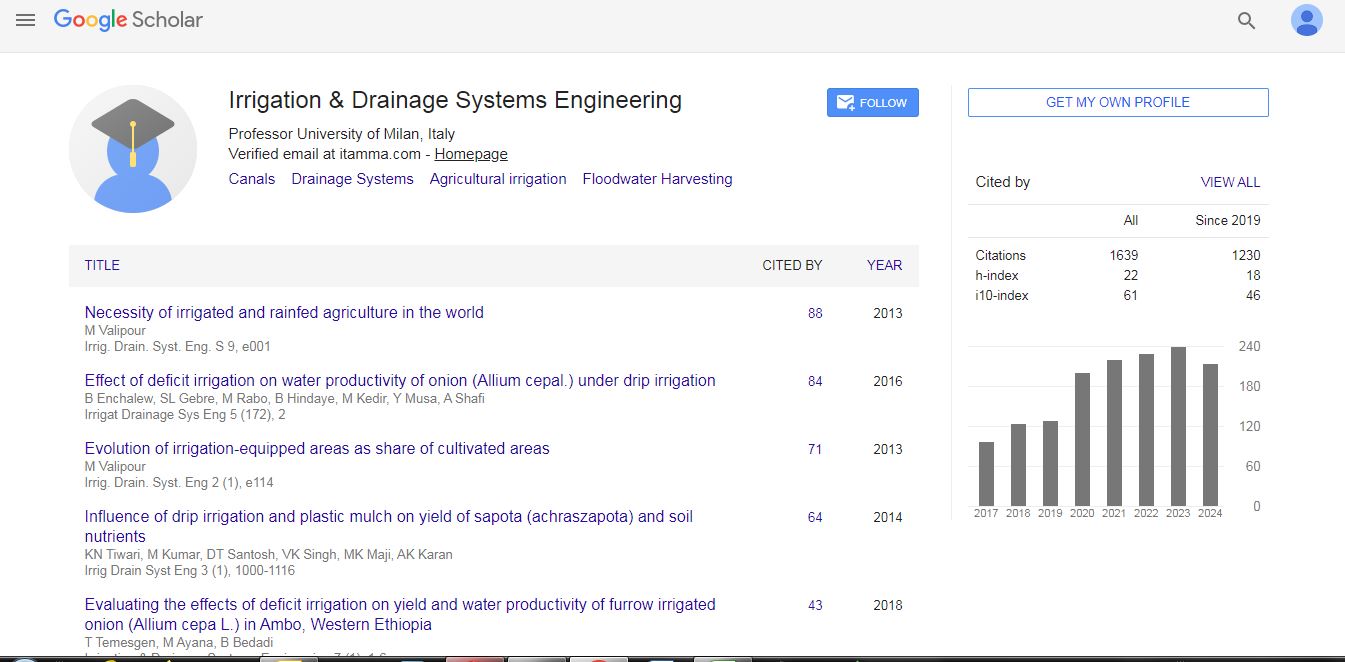
Irrigation & Drainage Systems Engineering received 835 citations as per Google Scholar report