Brief Report - (2025) Volume 16, Issue 4
Received: 01-Jul-2025, Manuscript No. jpm-26-179427;
Editor assigned: 03-Jul-2025, Pre QC No. P-179427;
Reviewed: 17-Jul-2025, QC No. Q-179427;
Revised: 22-Jul-2025, Manuscript No. R-179427;
Published:
29-Jul-2025
, DOI: 10.37421/2090-0902.2025.16.542
Citation: Torres, Miguel. ”Modeling Complex Biological and Soft Matter Systems.” J Phys Math 16 (2025):542.
Copyright: © 2025 Torres M. This is an open-access article distributed under the terms of the Creative Commons Attribution License, which permits unrestricted use, distribution and reproduction in any medium, provided the original author and source are credited.
Mathematical modeling has emerged as an indispensable tool for unraveling the intricate dynamics of biological and soft matter systems. The application of quantitative approaches allows researchers to gain deeper insights into phenomena that are often elusive through purely qualitative observation. This field leverages sophisticated mathematical frameworks to describe, predict, and understand the behavior of complex entities, ranging from individual cells to macroscopic material properties [1].
The study of cellular populations and their collective behaviors is significantly advanced through the use of differential equations and stochastic processes. These mathematical tools enable the modeling of how spatial arrangements and environmental conditions influence emergent patterns within cell communities. Such models are vital for understanding processes like tissue development and the spread of diseases [2].
Computational frameworks are crucial for simulating the mechanical characteristics of soft materials at various scales. By integrating principles from statistical and continuum mechanics, scientists can effectively analyze how the internal structure of materials like gels and elastomers dictates their macroscopic responses. This has direct implications for the design of new materials with tailored mechanical properties [3].
Active matter systems, characterized by self-propelled particles, exhibit fascinating emergent collective behaviors. Agent-based models are particularly effective in simulating how simple local interactions can give rise to complex, organized patterns observed in nature. This area of research is shedding light on fundamental principles of self-organization [4].
Fluid dynamics plays a critical role in many biological processes, and mathematical modeling provides a powerful means to investigate these phenomena. Computational fluid dynamics (CFD) is employed to analyze fluid flow in systems such as microfluidic devices and biological tissues, which is essential for applications like drug delivery and understanding physiological flows [5].
Liquid crystals, a fascinating state of matter, exhibit unique phase transitions and critical phenomena. Statistical mechanics and renormalization group techniques are employed to develop theoretical models that predict their behavior under varying conditions. This understanding is fundamental for advancements in optical devices and display technologies [6].
The integration of machine learning and data-driven approaches is revolutionizing biological modeling. Algorithms capable of learning complex relationships from vast experimental datasets can predict cellular responses and identify critical regulatory pathways, thereby bridging the gap between empirical observation and theoretical comprehension [7].
Understanding the mechanical behavior of polymer networks requires a multiscale modeling approach. By combining molecular dynamics simulations with continuum mechanics, researchers can capture phenomena across different length scales. This integrated approach is key to designing functional polymeric materials with predictable responses [8].
The mechanics of cellular processes often involve the collective behavior of active filaments. Theoretical models and numerical simulations are used to analyze the dynamics of these structures and their interactions with molecular motors, providing insights into the fundamental mechanisms of the cytoskeleton [9].
Biological tissues are dynamic entities that grow and remodel in response to various stimuli. Continuum mechanics provides a robust framework for developing mathematical models that describe tissue evolution under mechanical loads and biochemical signals. Such models are invaluable for fields like tissue engineering and wound healing [10].
Mathematical modeling serves as a cornerstone in the quantitative analysis of biological and soft matter systems. The application of theoretical frameworks, coupled with experimental data, allows for the development of predictive models that illuminate complex phenomena. This approach enables a deeper understanding of processes such as cell migration and tissue self-organization, as well as the mechanical properties of diverse materials like polymers and liquid crystals [1].
The dynamics of cellular populations and their interactions are effectively captured using differential equations and stochastic processes. These models help elucidate how spatial heterogeneity and environmental factors influence collective cell behavior, leading to emergent patterns. The predictive power of these models extends to understanding disease spread and developmental biology [2].
For soft materials, a mesoscopic computational framework is presented to simulate their mechanical properties. By applying principles from statistical and continuum mechanics, the relationship between material structure and macroscopic behavior is analyzed. This research facilitates the design of novel soft materials with tunable elasticity [3].
Active matter systems, where constituent particles are capable of self-propulsion, are key to understanding biological self-organization. Agent-based models are employed to simulate how simple local rules can generate complex emergent behaviors. This approach provides insights into phenomena observed in natural systems, such as flocking and intracellular transport [4].
Mathematical modeling of fluid dynamics is essential for biological applications. Computational fluid dynamics (CFD) is utilized to analyze molecular and cellular transport within microfluidic devices and tissues. This understanding is crucial for advancing drug delivery systems and comprehending physiological flows [5].
Liquid crystals, characterized by their unique phase transitions, are studied using statistical mechanics and renormalization group techniques. Theoretical models developed in this research predict the behavior of these fluids under varying conditions, contributing to the advancement of display and optical technologies [6].
The field of biological modeling is increasingly benefiting from machine learning and data-driven approaches. Algorithms are being developed to discern complex relationships within experimental data, enabling predictions of cellular responses and the identification of regulatory pathways. This integration bridges empirical findings with theoretical understanding [7].
Polymer networks exhibit complex behaviors influenced by both mechanical and chemical stimuli. A multiscale modeling approach, integrating molecular dynamics and continuum mechanics, is used to understand phenomena from chain entanglement to macroscopic deformation. This research aids in the design of functional polymeric materials [8].
The dynamics and mechanics of active filaments are central to cellular processes. Theoretical models and numerical simulations analyze the collective behavior of these flexible structures and their interactions with motor proteins. This work contributes to a deeper understanding of the cytoskeleton's mechanics [9].
Biological tissues undergo continuous growth and remodeling, which can be effectively modeled using continuum mechanics. Mathematical frameworks are developed to describe how tissue properties change in response to mechanical and biochemical cues. These models are validated against experimental data, supporting applications in tissue engineering and wound healing [10].
This collection of research focuses on the application of mathematical and computational modeling to understand complex phenomena in biological and soft matter systems. Key areas explored include the dynamics of cellular populations, the mechanical properties of soft materials like polymers and liquid crystals, and the emergent behaviors in active matter. Studies utilize techniques ranging from differential equations and stochastic processes to agent-based models, computational fluid dynamics, and machine learning. The research aims to provide predictive insights into processes such as cell migration, tissue morphogenesis, fluid transport, phase transitions, and tissue growth and remodeling, ultimately contributing to advancements in material design, disease understanding, and biological engineering.
None
None
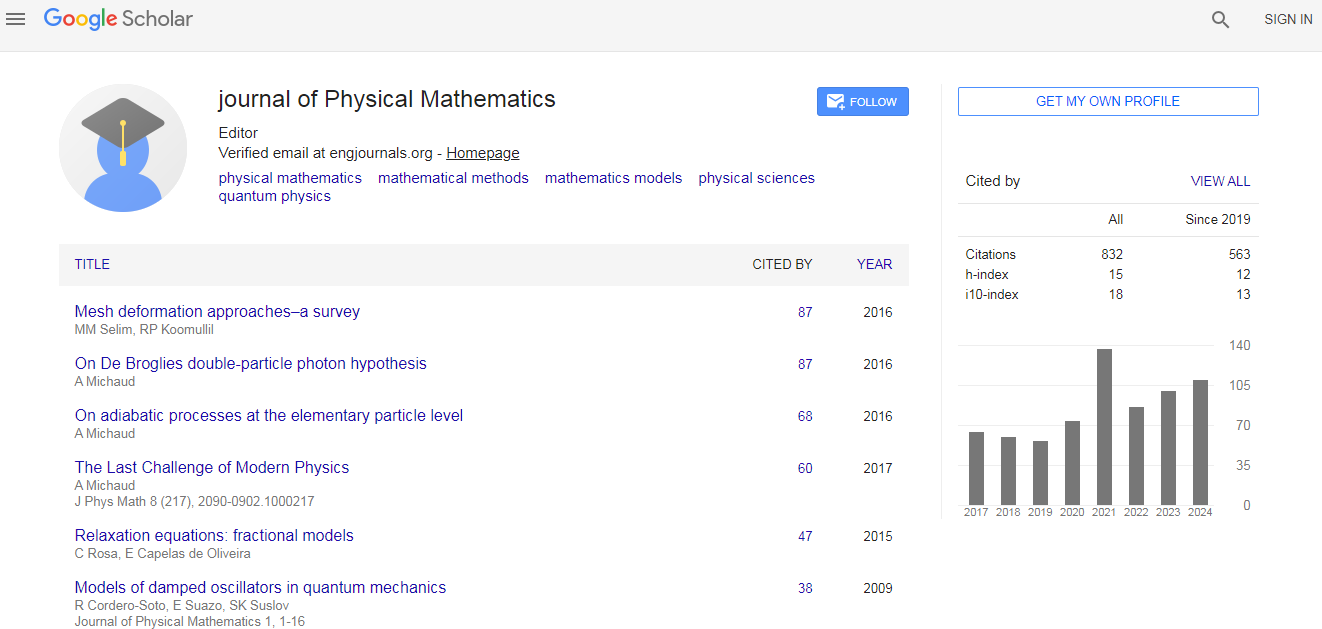
Physical Mathematics received 686 citations as per Google Scholar report