Short Communication - (2025) Volume 14, Issue 3
Received: 01-Sep-2025, Manuscript No. ara-25-175612;
Editor assigned: 03-Sep-2025, Pre QC No. P-175612;
Reviewed: 17-Sep-2025, QC No. Q-175612;
Revised: 22-Sep-2025, Manuscript No. R-175612;
Published:
29-Sep-2025
, DOI: 10.37421/2168-9695.2025.14.342
Citation: Salinas, Ricardo. ”Mobile Robots in Healthcare: Revolution, Ethics, Future.” Adv Robot Autom 14 (2025):342.
Copyright: © 2025 Salinas R. This is an open-access article distributed under the terms of the Creative Commons Attribution License, which permits unrestricted use, distribution and reproduction in any medium, provided the original author and source are credited.
Autonomous Mobile Robots (AMRs) are rapidly transforming various facets of healthcare, enhancing operational efficiency and patient care. One significant area is hospital logistics, where AMRs excel at tasks like delivering medications, supplies, and transporting lab samples, along with managing waste. This capability streamlines critical daily operations within complex hospital environments, as detailed in recent systematic reviews [1].
Beyond logistics, the interaction between humans and these advanced machines is paramount. Socially assistive mobile robots are increasingly integrated into healthcare, making Human-Robot Interaction (HRI) a vital field of study. Researchers synthesize findings on user acceptance, trust, and communication protocols among patients, staff, and visitors, pinpointing key design elements and future research directions for improving robotic assistance [2].
A fundamental challenge for AMRs operating in healthcare settings, which are often dynamic and unstructured, is effective path planning. Various algorithms and methodologies are developed to ensure safe and efficient navigation, adept at handling obstacles, real-time environmental changes, and unpredictable human movement. The ongoing discussion revolves around the trade-offs of different approaches and paving the way for more robust, adaptable navigation systems [3].
Looking at advanced robotic systems, swarm robotics presents a compelling vision for healthcare. This involves groups of simple, cooperative mobile robots working together on complex tasks such as surveillance, environmental monitoring, targeted drug delivery, and even micro-surgical procedures. This area explores the principles of swarm intelligence, examines current prototypes, and confronts significant challenges related to coordination, safety, and regulatory approval necessary for widespread clinical use [4].
Accurate positioning is indispensable for the autonomous operation of mobile robots, especially in indoor hospital environments where Global Positioning System (GPS) signals are unreliable. A crucial strategy involves fusing data from Wi-Fi signals and LiDAR sensors to achieve precise and robust localization. This approach surveys various data fusion techniques, algorithms, and system architectures, offering insights into their performance and limitations to enhance indoor autonomous navigation [5].
Public health and safety are also major beneficiaries of robotic advancements. Autonomous Mobile Robots for disinfection tasks are gaining traction in healthcare facilities. These robots employ diverse technologies, including UV-C light, hydrogen peroxide vapor, and spraying systems, to effectively reduce pathogen transmission. Evaluating their effectiveness and developing successful deployment strategies are critical steps for integrating them into standard hospital cleaning protocols, focusing on safety and operational efficiency [6].
Another transformative application involves telepresence robots, which bridge geographical distances in healthcare. Their utility spans remote consultations, extending specialized medical expertise to underserved regions, enabling virtual family visits for isolated patients, and supporting medical education. The benefits of improved communication and broader access to care are evident, yet technological, ethical, and user acceptance challenges continue to influence their wider adoption [7].
The evolution of robotics also brings sophisticated Human-Robot Collaboration (HRC), particularly with mobile manipulators that combine robot mobility with the dexterity of robotic arms. These systems facilitate joint tasks in areas like surgery, laboratory automation, and direct patient care. Research in this field focuses on diverse HRC strategies, safety protocols, and overcoming technical hurdles to create intuitive and efficient shared workspaces [8].
As robotics and Artificial Intelligence (AI) become more deeply integrated into healthcare, critical ethical considerations come to the forefront. Key dilemmas include patient autonomy, privacy concerns, accountability for potential errors, biases embedded in AI algorithms, and the broader impact on human roles in care delivery. This systematic review offers a comprehensive overview of existing ethical frameworks and proposes guidelines for the responsible development and deployment of these powerful technologies [9].
Looking ahead, the future of robotics in healthcare promises even more innovation. Emerging trends point towards miniaturization, enhanced AI integration, and increasingly sophisticated HRI capabilities, leading to specialized applications in surgery, diagnostics, and elderly care. However, substantial challenges remain, including navigating regulatory landscapes, ensuring cost-effectiveness, addressing ongoing ethical concerns, and building sustained public trust in these advanced systems [10].
Mobile robots are fundamentally reshaping healthcare operations, from mundane tasks to critical public health interventions. Autonomous mobile robots have become indispensable in hospital logistics, expertly handling the delivery of medications, supplies, and lab samples while also managing waste transportation, thereby significantly improving workflow efficiency [1]. Beyond material transport, these robots contribute directly to public health by performing disinfection tasks within healthcare facilities. They employ various advanced technologies, including UV-C light, hydrogen peroxide vapor, and spraying systems, to effectively reduce pathogen transmission. This requires careful consideration of deployment strategies and operational safety for successful integration into cleaning protocols [6].
Another crucial application involves telepresence robots, which bridge geographical distances in healthcare. Their utility spans remote consultations, extending specialized medical expertise to underserved regions, enabling virtual family visits for isolated patients, and supporting medical education. The benefits of improved communication and broader access to care are evident [7]. Crucially, the success of socially assistive mobile robots hinges on effective Human-Robot Interaction (HRI). Understanding and improving user acceptance, trust, and communication protocols among patients, staff, and visitors is a key research area, guiding the design of more effective and comfortable robotic assistance [2].
The effective deployment of mobile robots in complex healthcare environments relies heavily on sophisticated navigation capabilities. Path planning for autonomous mobile robots in dynamic and unstructured settings like hospitals requires advanced algorithms to manage obstacles, real-time environmental changes, and unpredictable human movement, with ongoing research focused on robust and adaptable solutions [3]. Complementing this, precise real-time localization is critical indoors, where Global Positioning System signals are unreliable. Data fusion techniques combining Wi-Fi signals and LiDAR sensors are surveyed as a highly effective method for accurate and robust positioning, essential for enhancing autonomous indoor navigation [5].
The field is also advancing into more complex robotic systems and collaborative models. Swarm robotics systems, for instance, envision groups of simple, cooperative mobile robots performing intricate tasks such as surveillance, environmental monitoring, targeted drug delivery, and even micro-surgical procedures. This area explores the principles of swarm intelligence and grapples with significant challenges in coordination, safety, and regulatory approval necessary for widespread clinical implementation [4]. Furthermore, Human-Robot Collaboration (HRC) with mobile manipulators represents a significant step, enabling combined mobility and dexterity for tasks like assisting in surgery, automating laboratory processes, or direct patient care. Research here addresses various HRC strategies, safety considerations, and the technical difficulties of creating intuitive and efficient shared workspaces [8].
As these technologies proliferate, critical ethical considerations surrounding robotics and Artificial Intelligence (AI) in healthcare become paramount. Dilemmas involving patient autonomy, privacy, accountability for errors, potential biases in AI algorithms, and the impact on human care roles are systematically reviewed. Establishing comprehensive ethical frameworks and guidelines is essential for the responsible development and deployment of these innovations [9]. Looking forward, the future of robotics in healthcare is marked by emerging trends like miniaturization, enhanced AI integration, and more sophisticated Human-Robot Interaction capabilities, leading to specialized applications in surgery, diagnostics, and elderly care. However, the path forward is not without challenges, including navigating regulatory hurdles, ensuring cost-effectiveness, ongoing ethical concerns, and the crucial need to build sustained public trust in these rapidly evolving systems [10].
Mobile robots are making a profound impact on healthcare by revolutionizing logistics, enhancing patient care, and improving operational efficiency. Autonomous Mobile Robots (AMRs) manage critical hospital tasks like delivering supplies, transporting samples, and waste management, significantly streamlining daily operations. These robots also play a crucial role in public health through disinfection, utilizing technologies such as UV-C light and hydrogen peroxide vapor to reduce pathogen transmission. Beyond physical tasks, the interaction between humans and robots is a central focus. Research explores Human-Robot Interaction (HRI) for socially assistive robots, focusing on user acceptance, trust, and communication to improve robotic assistance. Sophisticated navigation systems are also vital, with path planning algorithms developed for dynamic hospital environments and real-time localization enhanced by fusing Wi-Fi and LiDAR data. Advanced applications include swarm robotics for complex tasks like surveillance and targeted drug delivery, alongside Human-Robot Collaboration (HRC) with mobile manipulators for joint tasks in surgery and laboratory automation. However, the integration of these technologies brings significant ethical considerations, including patient autonomy, privacy, accountability, and AI bias. Looking ahead, the future involves miniaturization, advanced Artificial Intelligence (AI), and refined HRI, though regulatory hurdles, cost, and public trust remain key challenges. The field continues to evolve, balancing innovation with responsible deployment to maximize benefits in healthcare.
None
None
Andrea Z, Paolo R, Simone F. "Autonomous Mobile Robots for In-Hospital Logistics: A Systematic Review".Sensors (Basel) 22 (2022):9850.
Indexed at, Google Scholar, Crossref
Sarah ES, Dylan JW, Jacob AJ. "Human-Robot Interaction for Socially Assistive Mobile Robots in Healthcare: A Review".International Journal of Social Robotics 13 (2021):811-825.
Indexed at, Google Scholar, Crossref
Yonggang S, Long H, Shiqiang W. "Path Planning for Autonomous Mobile Robots in Dynamic and Unstructured Environments: A Review".Sensors (Basel) 23 (2023):3974.
Indexed at, Google Scholar, Crossref
Xiaoxuan W, Hao H, Fan W. "Swarm robotics for healthcare applications: A comprehensive review".Frontiers in Robotics and AI 10 (2023):1143851.
Indexed at, Google Scholar, Crossref
Abdullah A, Omar AA, Ahmed A. "Real-Time Localization of Mobile Robots in Indoor Environments Using Wi-Fi and LiDAR Data Fusion: A Survey".Sensors (Basel) 22 (2022):8405.
Indexed at, Google Scholar, Crossref
Ali A, Seyed HH, Seyed HM. "Autonomous Mobile Robots for Disinfection in Healthcare Facilities: A Review".International Journal of Environmental Research and Public Health 19 (2021):79.
Indexed at, Google Scholar, Crossref
Hoda E, Mahnaz M, Maryam H. "Applications of Telepresence Robots in Healthcare: A Systematic Review".Journal of Medical Systems 44 (2020):16.
Indexed at, Google Scholar, Crossref
Qixun S, Yuxing D, Xinguang L. "Human-Robot Collaboration for Mobile Manipulators: A Survey".Sensors (Basel) 23 (2023):2917.
Indexed at, Google Scholar, Crossref
Ana P, Joana S, Ricardo S. "Ethical Considerations in the Use of Robotics and Artificial Intelligence in Healthcare: A Systematic Review".International Journal of Environmental Research and Public Health 17 (2020):5346.
Indexed at, Google Scholar, Crossref
Amirhossein G, Amirhossein J, Mehran H. "The Future of Robotics in Healthcare: Emerging Trends and Challenges".Sensors (Basel) 22 (2022):3941.
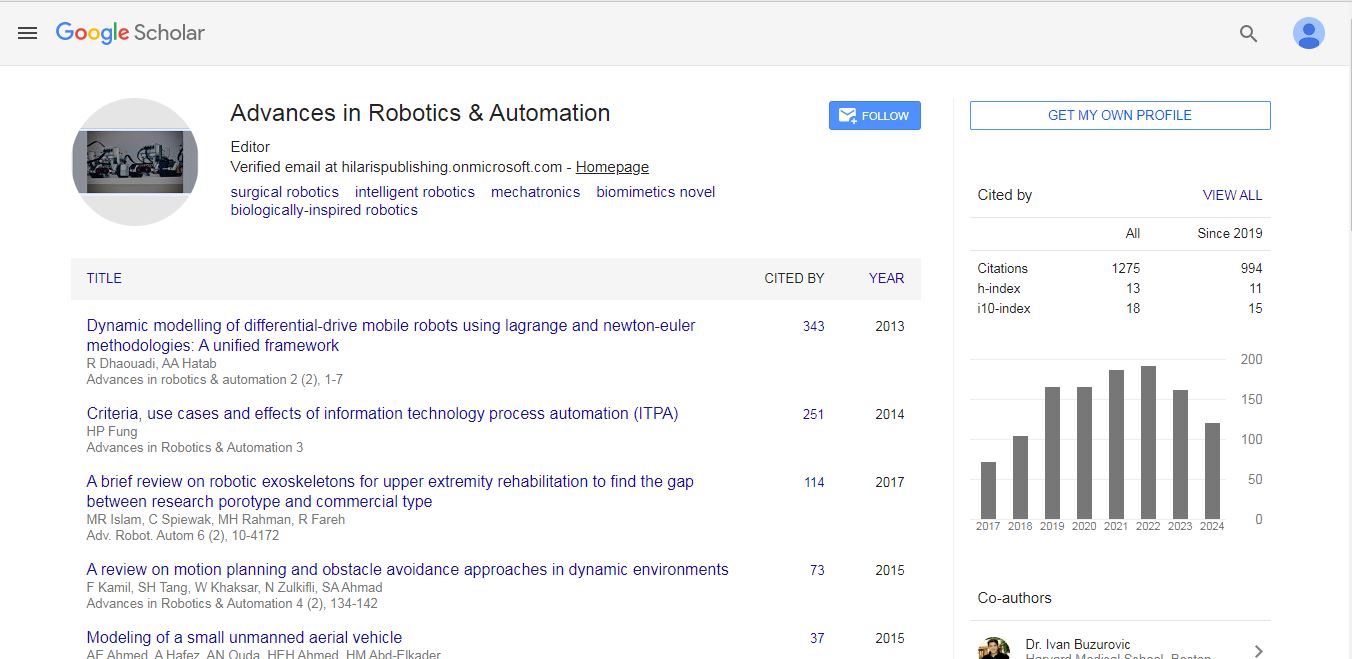
Advances in Robotics & Automation received 1275 citations as per Google Scholar report