Short Communication - (127) Volume 14, Issue 3
Received: 01-Sep-2025, Manuscript No. ara-25-175609;
Editor assigned: 03-Sep-2025, Pre QC No. P-175609;
Reviewed: 17-Sep-2025, QC No. Q-175609;
Revised: 22-Sep-2025, Manuscript No. R-175609;
Published:
29-Sep-2025
, DOI: 10.37421/2168-9695.2025.14.341
Citation: Walters, Zane. ”Mobile Robot Path Planning: DRL and Algorithms.” Adv Robot Autom 14 (2025):341.
Copyright: © 2025 W. Zane This is an open-access article distributed under the terms of the Creative Commons Attribution License, which permits unrestricted use, distribution and reproduction in any medium, provided the original author and source are credited.
Mobile robot navigation presents significant challenges, particularly in dynamic environments requiring both efficient path planning and real-time obstacle avoidance. One advanced method explores combining these crucial functionalities using Deep Reinforcement Learning (DRL). This innovative approach enables mobile robots to develop optimal navigation policies through learning, rather than relying on explicit programming for every conceivable scenario. The result is a substantial improvement in robot adaptability and overall safety when operating in complex, unpredictable settings [1].
Understanding the landscape of motion planning algorithms is essential for researchers and practitioners in robotics. A comprehensive survey systematically reviews various algorithms, categorizing them by methodology and application. This work critically discusses the strengths and weaknesses of different techniques, encompassing both traditional and contemporary learning-based methods, offering a foundational overview of the field [2].
For mobile robots operating in environments that change rapidly, real-time path planning is paramount. An enhanced A* algorithm has been introduced, specifically designed to address these dynamic conditions. Key improvements involve optimizing heuristic functions and effectively integrating environmental changes, leading to efficient and collision-free navigation. This refined algorithm demonstrates superior performance when compared to conventional A* methods in fast-changing scenarios [3].
Path planning for non-holonomic mobile robots, which have movement constraints, requires specialized solutions. A novel strategy combines sampling-based methods with Deep Reinforcement Learning to tackle this challenge. The system learns to generate smooth, collision-free trajectories that inherently respect the robot's kinematic limitations. This fusion offers a powerful solution for intricate and constrained environments, enhancing both the quality of the path and the efficiency of computation [4].
In scenarios involving multiple robots, efficient coordination and scalability are vital. A distributed reinforcement learning method has been proposed for multi-robot path planning, facilitating cooperative navigation. This decentralized learning framework allows numerous robots to collaboratively discover collision-free paths within shared spaces, making it highly effective for complex tasks involving a large number of agents [5].
Beyond just finding a path, optimal path planning for mobile robots in dynamic environments can also incorporate energy consumption as a critical optimization factor. An algorithm has been developed that thoughtfully balances path efficiency, the imperative of collision avoidance, and the overall energy usage. This holistic approach contributes to more sustainable and extended operational periods for autonomous robotic systems [6].
Operating in unknown environments necessitates robust perception and planning capabilities. A vision-based path planning system empowers autonomous mobile robots to leverage visual input from onboard cameras. This enables them to construct localized maps and subsequently plan collision-free paths in real-time, allowing for effective adaptation to unexpected obstacles and evolving environmental conditions [7].
To achieve both rapid exploration and path optimization in complex, unknown environments, a hybrid RRT*-Q-Learning algorithm has been introduced for autonomous robotic path planning. This integrated method intelligently combines the exploration strengths of RRT* with the potent optimization capabilities of Q-learning. The goal is to efficiently locate near-optimal paths, striking a valuable balance between exploring new areas and exploiting known information [8].
Meta-heuristic algorithms offer promising avenues for mobile robot path planning. For instance, an improved Whale Optimization Algorithm (WOA) has been put forth to enhance performance in this domain. These enhancements specifically target WOA's convergence speed and its ability to avoid local optima. The result is that robots can more effectively discover shorter, smoother, and collision-free paths, especially when navigating highly intricate environments [9].
Sampling-based path planning algorithms are fundamental to guiding robotic systems through complex and high-dimensional spaces. A comprehensive review provides a thorough overview of these essential algorithms, delving into their foundational concepts, popular variations such as Rapidly-exploring Random Trees (RRT) and Probabilistic Roadmaps (PRM), and their diverse practical applications. The review also sheds light on current challenges and outlines future research directions within this crucial field [10].
Mobile robot path planning is a critical area, continually seeking to improve autonomous navigation in diverse and challenging environments. A significant focus is on leveraging advanced learning techniques to handle real-time complexities. For example, methods integrating Deep Reinforcement Learning (DRL) are proving effective for combining path planning with real-time obstacle avoidance, enabling robots to learn optimal navigation policies without explicit programming. This markedly enhances adaptability and safety in complex, dynamic scenarios [1]. Furthermore, for non-holonomic mobile robots, combining sampling-based approaches with DRL allows systems to generate smooth, collision-free trajectories that respect robot kinematics, thereby optimizing both path quality and computational efficiency in constrained settings [4]. The utility of DRL extends to multi-robot systems, where distributed reinforcement learning facilitates cooperative and collision-free path discovery in shared environments, promoting efficient coordination and scalability for tasks with multiple agents [5].
Alongside learning-based paradigms, traditional motion planning algorithms remain a subject of active research and refinement. A comprehensive survey provides an invaluable overview, categorizing various algorithms by their methodologies and applications, highlighting strengths and weaknesses across both conventional and modern techniques [2]. Classical algorithms are continually being enhanced; an improved A* algorithm, for instance, is specifically designed for real-time path planning in dynamic environments. It focuses on optimizing heuristic functions and integrating environmental changes, demonstrating superior performance against traditional A* in rapidly changing situations [3]. Complementing these, sampling-based path planning algorithms are crucial for navigating robotic systems in complex and high-dimensional spaces. Reviews of these algorithms delve into foundational concepts, variations like Rapidly-exploring Random Trees (RRT) and Probabilistic Roadmaps (PRM), and their broad applications, also pinpointing future research directions [10].
Beyond single paradigms, hybrid approaches and meta-heuristic algorithms offer powerful solutions. One such integrated method is the hybrid RRT*-Q-Learning algorithm, which merges the efficient exploration capabilities of RRT* with the optimization prowess of Q-learning for autonomous robotic path planning. This aims to find near-optimal paths rapidly in intricate and unknown environments, effectively balancing exploration and exploitation [8]. Similarly, meta-heuristic approaches like an improved Whale Optimization Algorithm (WOA) have been developed to enhance convergence speed and avoid local optima in mobile robot path planning. These improvements enable robots to find shorter, smoother, and collision-free paths more efficiently, especially within complex environmental layouts [9].
Specific operational considerations are also driving innovation in path planning. Energy consumption, for example, is now a key optimization criterion for mobile robots in dynamic environments. Algorithms are being developed to balance path efficiency, collision avoidance, and energy usage, thereby leading to more sustainable and longer operational periods for autonomous systems [6]. Another crucial aspect for navigation in unknown territories is vision-based path planning. Systems that use visual information from onboard cameras allow robots to construct local maps and plan real-time, collision-free paths, enabling them to adapt effectively to unforeseen obstacles and changes in their surroundings [7]. These diverse advancements underscore the ongoing efforts to create more intelligent, adaptive, and efficient mobile robot navigation systems for a wide range of applications.
The field of mobile robot path planning focuses on creating adaptable and safe autonomous systems. Recent advancements leverage Deep Reinforcement Learning (DRL) for real-time obstacle avoidance and optimal navigation policies in complex, dynamic environments. This approach allows robots to learn without explicit programming, significantly boosting adaptability. For non-holonomic robots, DRL combined with sampling-based methods generates smooth, collision-free trajectories while respecting robot kinematics, optimizing both path quality and computational efficiency. A systematic review of motion planning algorithms provides a comprehensive overview, covering both traditional and modern learning-based techniques. Classical methods continue to see improvements; for instance, an enhanced A* algorithm is tailored for real-time planning in dynamic settings by optimizing heuristic functions and adapting to environmental changes, outperforming traditional A* in rapidly changing scenarios. Sampling-based algorithms are crucial for complex, high-dimensional spaces, with foundational concepts and variations like Rapidly-exploring Random Trees (RRT) and Probabilistic Roadmaps (PRM) being extensively reviewed. Hybrid approaches, such as RRT*-Q-Learning, combine efficient exploration with Q-learningâ??s optimization to find near-optimal paths quickly in unknown environments, balancing exploration and exploitation. Beyond single-robot navigation, multi-robot systems benefit from distributed DRL methods that enable cooperative, collision-free path finding in shared environments. This decentralized framework supports efficient coordination and scalability for tasks with many agents. Path planning also extends to optimizing for criteria like energy consumption in dynamic settings, where algorithms balance path efficiency, collision avoidance, and energy usage for sustainable operations. Vision-based systems allow robots to map unknown environments and plan paths in real-time using onboard cameras, adapting effectively to unforeseen obstacles. Furthermore, meta-heuristic algorithms like the improved Whale Optimization Algorithm (WOA) enhance convergence speed and local optima avoidance, leading to shorter, smoother, and collision-free paths in intricate environments. These diverse methodologies highlight ongoing efforts to make mobile robots more intelligent and autonomous across various applications.
None
None
Kyoung-Ho L, Jin-Sung C, Se-Hwa K. "Integrated Path Planning and Obstacle Avoidance for Mobile Robots using Deep Reinforcement Learning".IEEE Trans. Robot. 37 (2021):808-821.
Indexed at, Google Scholar, Crossref
Md. AH, Moayad AAA, Shah NA. "A Survey of Motion Planning Algorithms for Mobile Robots".J. Robot. 2020 (2020):1-13.
Indexed at, Google Scholar, Crossref
Jian Z, Huimin S, Zhaofeng L. "Real-time Path Planning for Mobile Robots using an Improved A* Algorithm in Dynamic Environments".Robot. Auton. Syst. 150 (2022):103982.
Indexed at, Google Scholar, Crossref
Ming-Li L, Bo W, Yu-Jing L. "Sampling-based Path Planning with Deep Reinforcement Learning for Non-holonomic Mobile Robots".J. Intell. Robot. Syst. 110 (2023):1-19.
Indexed at, Google Scholar, Crossref
Siyuan C, Hao W, Tao L. "Multi-robot Path Planning using a Distributed Reinforcement Learning Approach".IEEE Robot. Autom. Lett. 7 (2022):3209-3216.
Indexed at, Google Scholar, Crossref
Yu-Gang L, Tao Z, Kai L. "Optimal Path Planning for Mobile Robots in Dynamic Environments Considering Energy Consumption".Appl. Sci. 11 (2021):4172.
Indexed at, Google Scholar, Crossref
Li Z, Yong W, Fan L. "Vision-based Path Planning for Autonomous Mobile Robots in Unknown Environments".Sensors 20 (2020):2821.
Indexed at, Google Scholar, Crossref
Mohamed ERE, Adel E, Ahmad MHE. "Autonomous Robotic Path Planning Using Hybrid RRT*-Q-Learning Algorithm".J. Robot. Control 4 (2023):102-111.
Indexed at, Google Scholar, Crossref
Ying Z, Yu L, Jia C. "Path Planning for Mobile Robot Based on Improved Whale Optimization Algorithm".Soft Comput. 25 (2021):779-792.
Indexed at, Google Scholar, Crossref
Nur SHMZ, Rozina FBSAL, Muhamad FA. "A Review of Sampling-based Path Planning Algorithms for Robotic Systems".J. Robot. Control 3 (2022):137-145.
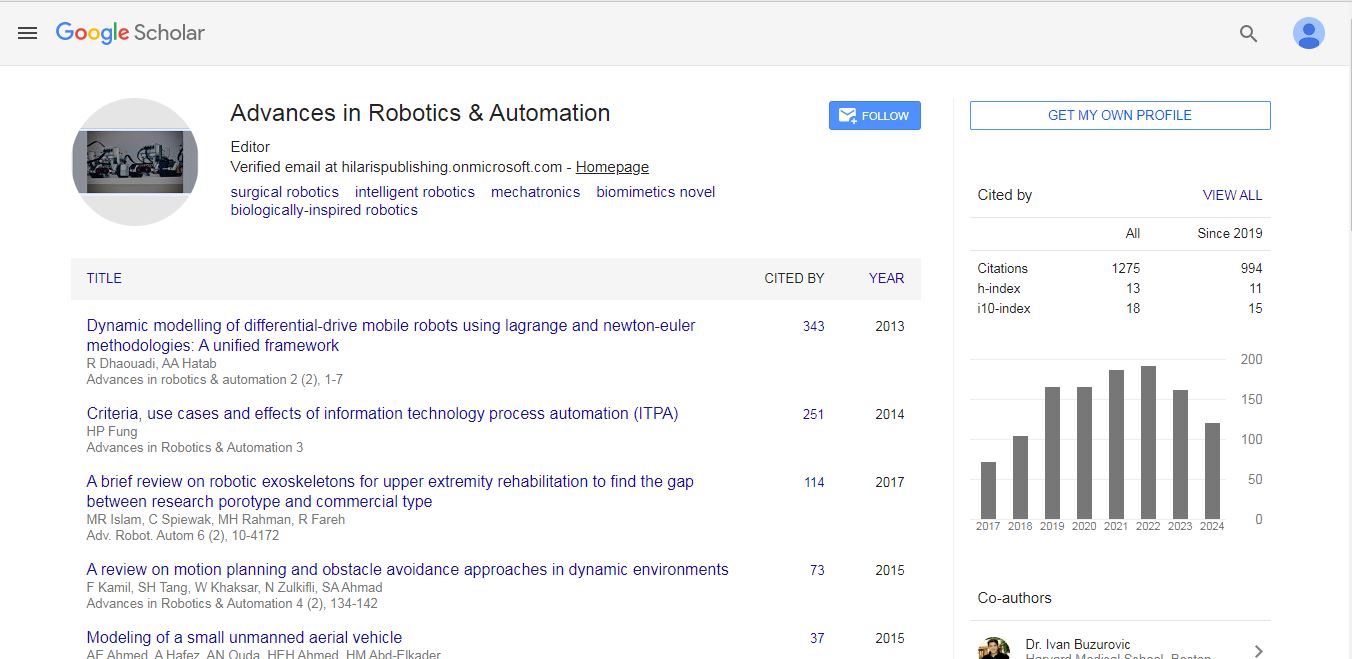
Advances in Robotics & Automation received 1275 citations as per Google Scholar report