Short Communication - (2025) Volume 15, Issue 4
Received: 31-Jul-2025, Manuscript No. jmcj-25-176907;
Editor assigned: 04-Aug-2025, Pre QC No. P-176907;
Reviewed: 18-Aug-2025, QC No. Q-176907;
Revised: 21-Aug-2025, Manuscript No. R-176907;
Published:
28-Aug-2025
, DOI: 10.37421/2165-7912.2025.15.637
Citation: Hartmann, Olivia M.. "Mobile Media: Benefits, Challenges in Health, Education." J Mass Communicat Journalism 15(2025):637
Copyright: © 2025 Hartmann M. Olivia This is an open-access article distributed under the terms of the Creative Commons Attribution License, which permits unrestricted use,
distribution and reproduction in any medium, provided the original author and source are credited.
Mobile media has rapidly transformed various aspects of modern life, with its influence profoundly felt across healthcare, education, and public health domains. Here's the thing, research consistently explores both the benefits and challenges associated with this pervasive technology. One significant area of investigation concerns the impact of social media use on the mental health of adolescents and young adults. Studies offer a comprehensive review, highlighting negative effects such as increased anxiety and depression, while also acknowledging potential positive aspects and emphasizing the critical need for balanced mobile media engagement and targeted interventions [1].
Moreover, the field of mobile health, or mHealth, has emerged as a powerful tool in chronic disease management. A systematic review examined the effectiveness of mHealth interventions in boosting patient engagement for diabetes management. It demonstrates that mobile applications, SMS, and wearable devices can significantly improve medication adherence, self-management behaviors, and clinical outcomes, underscoring the immense potential of mobile media in chronic care delivery [2].
Expanding on mHealth's role, research also delves into how mobile health applications influence health literacy. This scoping review reveals that while these apps offer significant potential to improve individuals' access to health information and understanding, their overall effectiveness heavily relies on factors such as user-friendliness, the quality of content provided, and proper integration into existing health systems [3].
This really means that the design and implementation are just as important as the technology itself. Specifically addressing mental well-being, the effectiveness of mobile mental health interventions for young adults has been a focal point. A systematic review and meta-analysis concluded that mobile applications and digital platforms can considerably reduce symptoms of both depression and anxiety, positioning them as accessible and promising tools for enhancing mental well-being within this demographic. However, it also points out the need for further research into their long-term effects [4].
What this shows is that mobile solutions are not just about diagnosis but also about active support. Beyond individual health, social media is increasingly leveraged for broader health promotion efforts. A systematic review analyzed these applications, highlighting the diverse ways mobile social media platforms are used to disseminate health information, foster community support, and encourage healthy behaviors. This research also acknowledges inherent challenges like the spread of misinformation and difficulties in maintaining user engagement [5].
In the educational sphere, particularly medical education, mobile learning tools have shown substantial effectiveness. A systematic review and meta-analysis demonstrated that mobile devices significantly enhance student engagement, facilitate knowledge acquisition, and improve clinical skills development. This highlights their crucial role in modernizing medical training and providing flexible learning opportunities for future healthcare professionals [6].
However, the increased reliance on mobile technology is not without its drawbacks. Smartphone addiction, for instance, has profound effects on mental health and academic performance. A systematic review identified a strong correlation between excessive mobile media use and increased rates of anxiety, depression, and poor academic outcomes. This research underscores the urgent need for interventions designed to promote digital well-being among users [7].
It is clear that while these devices offer many benefits, moderation is key. Furthermore, the delivery of healthcare services through telemedicine via mobile applications has been thoroughly evaluated for patient satisfaction. A systematic review and meta-analysis concluded that mobile telemedicine generally leads to high patient satisfaction, primarily due to its convenience and accessibility. Yet, it also identified areas for improvement, such as enhancing technical reliability and optimizing human interaction, to further enrich the user experience [8].
The broader effectiveness of mobile health interventions in facilitating health behavior change has also been investigated. Strong evidence suggests that mobile applications, SMS, and wearable technologies are indeed effective in promoting positive health behaviors across various populations. This reinforces their potential as scalable tools for widespread public health initiatives [9].
This demonstrates the transformative power of mobile technology in shaping healthier lifestyles. Finally, mobile phones are playing an increasingly vital role in public health monitoring, particularly for participatory surveillance of infectious diseases. A systematic review highlighted how mobile media effectively engages the public in reporting health data, thereby significantly enhancing early detection and response capabilities during outbreaks. This represents a considerable advancement in public health monitoring systems [10].
Mobile media has become an indispensable part of contemporary society, profoundly influencing health, education, and public health systems. The pervasive nature of smartphones and social media platforms has sparked extensive research into both their advantageous applications and potential drawbacks. For example, a significant body of work focuses on the intersection of social media use and mental health, particularly among younger demographics. One study provides a comprehensive overview, revealing that while social media can contribute to increased anxiety and depression in adolescents and young adults, it also presents avenues for positive engagement. Therefore, the discussion frequently turns to promoting balanced mobile media interaction and developing targeted interventions to mitigate adverse effects [1]. Correspondingly, other research directly addresses smartphone addiction, identifying it as a critical factor negatively impacting mental health and academic performance. This systematic review correlates excessive mobile media use with higher rates of anxiety, depression, and diminished academic outcomes, emphasizing an urgent need for strategies to enhance digital well-being [7]. These findings collectively highlight a complex relationship where digital engagement requires careful management to prevent detrimental psychological and educational consequences.
The field of mobile health (mHealth) stands out as a transformative area, offering innovative solutions for patient care and health promotion. Here's the thing, mHealth interventions have proven highly effective in managing chronic conditions. Specifically, a systematic review on diabetes management showcased how mobile applications, SMS messages, and wearable devices significantly boost patient engagement, leading to better medication adherence, improved self-management behaviors, and enhanced clinical outcomes. This firmly establishes mobile media's critical role in advancing chronic disease care [2]. Beyond disease management, mHealth applications are also pivotal in improving health literacy. A scoping review indicated that while these apps offer substantial potential for individuals to access and understand health information, their efficacy is contingent on factors such as user-friendliness, the quality of their content, and seamless integration into broader health systems [3]. This demonstrates that successful mHealth implementation requires not just technological innovation but also careful consideration of user experience and systemic integration.
Furthermore, mobile technology extends its reach into specialized areas like mental health interventions and broader health behavior change. What this really means is that mobile mental health interventions, specifically for young adults, have been rigorously evaluated. A systematic review and meta-analysis concluded that mobile applications and various digital platforms are effective in reducing symptoms of depression and anxiety, positioning them as accessible and promising tools for fostering mental well-being in this age group, although further investigation into long-term impacts is advised [4]. Similarly, the effectiveness of mobile health interventions in promoting positive health behaviors across diverse populations has been well-documented. Strong evidence supports that mobile applications, SMS, and wearable technologies successfully facilitate health behavior change, making them highly scalable tools for public health initiatives aimed at improving population health [9]. These studies underscore the immense potential for mobile technology to deliver accessible and effective health support.
Mobile media also plays a crucial role in enhancing educational paradigms and public health surveillance. In medical education, mobile learning tools have demonstrated significant effectiveness, as revealed by a systematic review and meta-analysis. These tools actively enhance student engagement, facilitate robust knowledge acquisition, and aid in the development of essential clinical skills. This signifies their integral role in modernizing medical training and offering flexible, accessible learning pathways [6]. Separately, mobile phones are revolutionizing public health monitoring by enabling participatory surveillance of infectious diseases. A systematic review highlighted how mobile media effectively mobilizes public involvement in reporting health data, leading to enhanced early detection capabilities and more rapid responses to outbreaks, marking a significant stride in public health surveillance mechanisms [10]. This demonstrates a powerful dual utility for mobile devices, serving both individual learning and collective health protection.
Finally, the patient experience with mobile-delivered healthcare services is also a critical area of study. Here's the thing, patient satisfaction with telemedicine services, particularly those accessed via mobile applications, has been a subject of systematic review and meta-analysis. The findings suggest generally high patient satisfaction, largely attributable to the convenience and accessibility offered by mobile telemedicine. However, the research also points to areas for improvement, specifically in technical reliability and the quality of human interaction, to further optimize the user experience [8]. Lastly, social media's application is not limited to individual health impacts but extends to broader health promotion strategies. A systematic review explored how mobile social media platforms are effectively used to disseminate health information, build community support, and encourage healthier lifestyles, while simultaneously acknowledging challenges like misinformation and ensuring sustained user engagement [5]. These insights emphasize the ongoing need to refine and strategically implement mobile technologies for maximum benefit in both individual and public health contexts.
The collected research underscores the diverse influence of mobile media across health, education, and public health sectors. Social media use has a notable impact on the mental health of adolescents and young adults, linked to increased anxiety and depression, yet mobile mental health interventions offer promising solutions for symptom reduction. Mobile health (mHealth) applications are crucial for enhancing patient engagement in managing chronic diseases like diabetes, improving health literacy, and fostering positive health behavior changes across populations. Furthermore, social media platforms serve as effective channels for health promotion, enabling the dissemination of vital health information and the cultivation of community support. In the realm of medical education, mobile learning tools significantly enhance student engagement, facilitate knowledge acquisition, and develop clinical skills, thereby modernizing training approaches. The pervasive nature of smartphones also brings challenges, notably smartphone addiction, which correlates with adverse mental health outcomes and diminished academic performance, highlighting the necessity for digital well-being strategies. Beyond individual health, mobile applications improve patient satisfaction with telemedicine services through increased convenience and accessibility. Moreover, mobile phones are instrumental in participatory surveillance for infectious diseases, bolstering early detection and rapid response efforts in public health. This body of work collectively illustrates mobile technology's dual role as a powerful enabler for advancements and a source of new challenges in contemporary society.
None
None
Sungeun H, Hyeon-Ju K, Yu JL. "The impact of social media use on mental health among adolescents and young adults: A systematic review and meta-analysis".J Adolesc 96 (2023):1-13.
Indexed at, Google Scholar, Crossref
Yan S, Ziqi W, Yen-Ling L. "Mobile Health Interventions for Promoting Patient Engagement in Diabetes Management: A Systematic Review".JMIR Mhealth Uhealth 10 (2022):e34567.
Indexed at, Google Scholar, Crossref
Juan Z, Xiaoxiao L, Yanan W. "Impact of Mobile Health Applications on Health Literacy: A Scoping Review".Int J Environ Res Public Health 19 (2022):6003.
Indexed at, Google Scholar, Crossref
Keying M, You-Jung K, Donghyun L. "Effectiveness of mobile mental health interventions for young adults: a systematic review and meta-analysis".J Affect Disord 288 (2021):109-119.
Indexed at, Google Scholar, Crossref
Na Z, Shan J, Wenyue Z. "Social media use for health promotion: a systematic review of the literature".Health Promot Int 37 (2022):daab101.
Indexed at, Google Scholar, Crossref
Fai MA, Hadeel AA, Arwa HA. "Effectiveness of Mobile Learning in Medical Education: A Systematic Review and Meta-Analysis".Cureus 15 (2023):e40422.
Indexed at, Google Scholar, Crossref
Sadaf H, Kawsar ZK, Sara A. "Smartphone addiction and its impact on mental health and academic performance: A systematic review".Brain Behav 13 (2023):e3101.
Indexed at, Google Scholar, Crossref
Mohammed NA, Mohammad TA, Mutaz AA. "Patient satisfaction with telemedicine services via mobile applications: a systematic review and meta-analysis".Ann Med Surg (Lond) 85 (2023):105151.
Indexed at, Google Scholar, Crossref
Young SP, Jihye K, Yujin L. "The effectiveness of mobile health interventions for changing health behaviors: A systematic review and meta-analysis".J Med Internet Res 22 (2020):e23456.
Indexed at, Google Scholar, Crossref
Sultan MA, Saleh BA, Abdulaziz MA. "Mobile phone-based participatory surveillance for infectious diseases: A systematic review".J Public Health Res 11 (2022):2546.
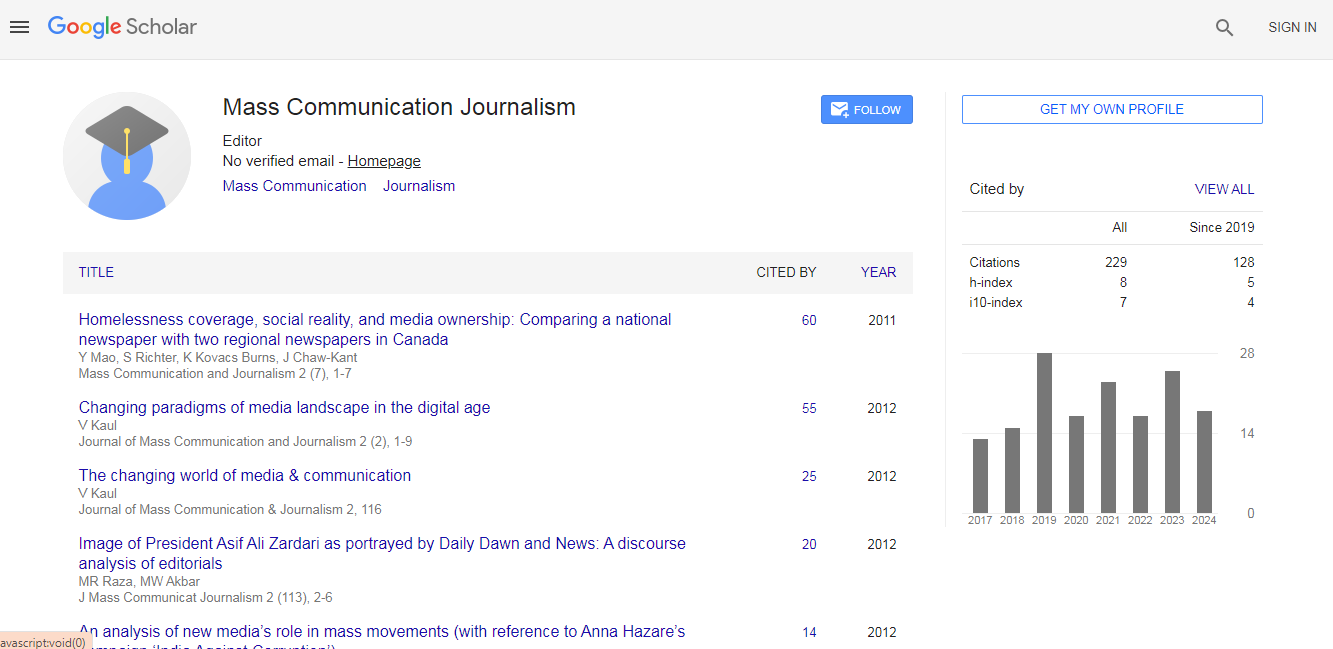
Journal of Mass Communication & Journalism received 205 citations as per Google Scholar report