Short Communication - (2025) Volume 15, Issue 5
Received: 30-Sep-2025, Manuscript No. jmcj-25-176927;
Editor assigned: 02-Oct-2025, Pre QC No. P-176927;
Reviewed: 14-Oct-2025, QC No. Q-176927;
Revised: 21-Oct-2025, Manuscript No. R-176927;
Published:
28-Oct-2025
, DOI: 10.37421/2165-7912.2025.15.647
Citation: Østergaard, Henrik J J.”Misinformation: Spread, Psychology, and Interventions.” J Mass Communicat Journalism 15(2025):647.
Copyright: © 2025 Østergaard J. Henrik This is an open-access article distributed under the terms of the Creative Commons Attribution License, which permits unrestricted
use, distribution and reproduction in any medium, provided the original author and source are credited.
This paper examines how social media platforms contribute to the widespread dissemination of misinformation across various global contexts. It explores the mechanisms, such as algorithmic amplification and social networks, that facilitate the rapid spread of inaccurate information, highlighting the challenges this poses for informed public discourse and decision-making worldwide[1].
This research investigates the diverse strategies employed by public health organizations in the United States to counter the spread of health-related misinformation. It evaluates various interventions, from direct debunking to public education campaigns, offering insights into their effectiveness and identifying best practices for promoting accurate health information amidst widespread falsehoods[2].
This study demonstrates the efficacy of psychological inoculation in enhancing individuals' resistance to misinformation encountered on social media platforms. By pre-exposing people to weakened forms of misinformation or its techniques, researchers found a significant improvement in their ability to discern and reject false information, offering a proactive approach to building public resilience[3].
This comprehensive review synthesizes existing social science research on interventions designed to combat misinformation. It critically evaluates various strategies, including fact-checking, media literacy education, and source credibility assessments, providing a framework for understanding what works and what doesn't in mitigating the harmful effects of false narratives across different contexts[4].
This study delves into the influence of various cognitive biases on individuals' susceptibility to believing misinformation. It identifies how mental shortcuts and pre-existing beliefs can impair critical evaluation, making people more likely to accept false information as true, and underscores the psychological underpinnings of misinformation's pervasive spread[5].
This retrospective analysis examines the prevalence and impact of misinformation during the 2020 US election. It explores the types of false information disseminated, the platforms on which it spread, and its potential effects on voter attitudes and behaviors, offering crucial insights into the role of misinformation in contemporary political processes[6].
This systematic review synthesizes findings on various interventions aimed at curbing health misinformation across social media platforms. It evaluates the effectiveness of different approaches, such as fact-checking, digital literacy programs, and platform-level content moderation, identifying promising strategies and critical gaps in current research and practice[7].
This study explores the underlying psychological factors that contribute to the belief in COVID-19 vaccine misinformation. It identifies how cognitive biases, trust in sources, and individual worldviews shape susceptibility to false narratives about vaccines, offering insights crucial for developing targeted communication strategies to enhance vaccine acceptance[8].
This scoping review investigates how social media algorithms contribute to the amplification of misinformation. It synthesizes current understanding of algorithmic mechanisms that prioritize engagement over accuracy, thereby inadvertently boosting the reach of false content, and discusses the implications for platform governance and user experience[9].
This evidence-based guide offers practical recommendations for effectively correcting misinformation. It distills key insights from psychological science on how people process and update beliefs, emphasizing the importance of clear, simple corrections, identifying credible sources, and understanding the persistence of false beliefs, to improve strategies for combating misinformation[10].
The pervasive challenge of misinformation is globally significant, with social media platforms playing a central role in its widespread dissemination [1]. This involves examining the intricate mechanisms, such as algorithmic amplification and the structure of social networks, that actively facilitate the rapid spread of inaccurate information. The consequence is a substantial challenge to informed public discourse and sound decision-making worldwide [1]. In direct relation to this, a scoping review extensively investigates how social media algorithms specifically contribute to the amplification of misinformation. It synthesizes the current understanding of these algorithmic mechanisms, which often prioritize engagement metrics over factual accuracy. This inadvertently boosts the reach of false content, leading to critical discussions about the implications for platform governance and the overall user experience [9].
To counteract misinformation, a range of interventions and strategies have been developed and evaluated. A comprehensive review synthesizes existing social science research, providing a critical evaluation of diverse strategies including fact-checking initiatives, media literacy education programs, and source credibility assessments. This research offers a crucial framework for understanding the effectiveness and limitations of various approaches in mitigating the harmful effects of false narratives across different contexts [4]. Focusing on health-related misinformation, research from the United States investigates the diverse strategies employed by public health organizations. This evaluates various interventions, from direct debunking efforts to broad public education campaigns, offering valuable insights into their effectiveness and identifying best practices for promoting accurate health information amidst widespread falsehoods [2]. Further, a systematic review specifically examines interventions designed to curb health misinformation on social media platforms. It rigorously evaluates different approaches, such as fact-checking, digital literacy programs, and platform-level content moderation, ultimately identifying promising strategies while also highlighting critical gaps in current research and practical application [7]. Finally, an evidence-based guide provides practical recommendations for effectively correcting misinformation. This guide distills key insights from psychological science regarding how people process and update beliefs, emphasizing the importance of clear, simple corrections, identifying credible sources, and understanding the inherent persistence of false beliefs to improve overall strategies for combating misinformation [10].
Underlying the spread and acceptance of misinformation are complex psychological factors that influence individual susceptibility. One area of study delves into the influence of various cognitive biases, identifying how mental shortcuts and pre-existing beliefs can significantly impair critical evaluation. This often makes people more likely to accept false information as true, thereby underscoring the deep psychological underpinnings of misinformation's pervasive spread [5]. This psychological dimension is particularly evident in studies exploring the drivers of COVID-19 vaccine misinformation beliefs. Here, researchers identify how cognitive biases, trust in specific sources, and individual worldviews collectively shape susceptibility to false narratives about vaccines, offering insights crucial for developing targeted communication strategies to enhance vaccine acceptance [8]. In contrast, a proactive and effective method to build resilience is psychological inoculation. This study demonstrates its efficacy in enhancing individuals' resistance to misinformation encountered on social media platforms. By pre-exposing people to weakened forms of misinformation or its underlying techniques, researchers found a significant improvement in their ability to discern and reject false information, offering a robust proactive approach to building public resilience [3].
The tangible impact of misinformation is clearly illustrated through specific real-world events. A retrospective analysis, for instance, thoroughly examines the prevalence and profound impact of misinformation during the 2020 US election. It explores the diverse types of false information disseminated, identifies the various platforms on which it spread, and critically assesses its potential effects on voter attitudes and behaviors, thereby offering crucial insights into the pervasive role of misinformation in contemporary political processes [6].
Misinformation's global spread is significantly influenced by social media platforms, where mechanisms like algorithmic amplification boost inaccurate content across diverse contexts [1, 9]. To counteract this, various intervention strategies have been explored, ranging from comprehensive social science approaches including fact-checking and media literacy [4], to specific public health campaigns in the US and systematic reviews of online health misinformation interventions [2, 7]. A key aspect of combating misinformation involves understanding its psychological underpinnings. Cognitive biases and pre-existing beliefs increase individual susceptibility to false information [5, 8], while proactive strategies like psychological inoculation can enhance resilience by pre-exposing individuals to weakened forms of misinformation techniques [3]. Moreover, effective correction strategies emphasize clarity, credible sources, and acknowledging the persistence of false beliefs [10]. The impact of misinformation is also evident in specific events, such as the 2020 US election, where false narratives influenced voter attitudes and behaviors [6]. Collectively, this research highlights the multifaceted nature of misinformation, from its rapid dissemination online to the complex psychological factors that drive belief, and the ongoing development of diverse strategies to mitigate its harmful effects on public discourse, health, and democratic processes.
None
None
Emily LV, David ML, Matthew AB. "The role of social media in the spread of misinformation: A global analysis".New Media Soc 22 (2020):2217-2236.
Indexed at, Google Scholar, Crossref
Rina JL, Anita V, Allison JL. "Combating Health Misinformation: An Examination of Approaches Used by Public Health Organizations in the United States".Health Secur 20 (2022):166-174.
Indexed at, Google Scholar, Crossref
Jon R, Sander vdL, Alexander MG. "Psychological inoculation improves resilience against misinformation on social media".Sci Adv 8 (2022):eabq1555.
Indexed at, Google Scholar, Crossref
Kathleen HJ, Dolores A, Dan MK. "Combating Misinformation: A Review of Research on Social Science Interventions".Annu Rev Public Health 44 (2023):117-135.
Indexed at, Google Scholar, Crossref
Bence B, Alexander MG, Ethan K. "The effect of cognitive bias on belief in misinformation".Cognition 224 (2022):105051.
Indexed at, Google Scholar, Crossref
Andrew MG, Brendan N, Jason R. "Misinformation in the 2020 Election: A Retrospective".Polit Behav 43 (2021):509-522.
Indexed at, Google Scholar, Crossref
Ahra K, Yeonhee J, Jinhyuk K. "A systematic review of interventions to reduce health misinformation on social media platforms".J Biomed Inform 130 (2022):104085.
Indexed at, Google Scholar, Crossref
Daniel J, Zinnia R, Stephen D. "Psychological drivers of COVID-19 vaccine misinformation beliefs".Br J Health Psychol 27 (2022):494-518.
Indexed at, Google Scholar, Crossref
Jenny B, Chen B, Eli M. "Algorithmic Amplification of Misinformation on Social Media: A Scoping Review".J Med Internet Res 26 (2024):e46206.
Indexed at, Google Scholar, Crossref
Stephan L, Ullrich KHE, Gilles EG. "Misinformation and its correction: an evidence-based guide".Public Health Res Pract 32 (2022):3222207.
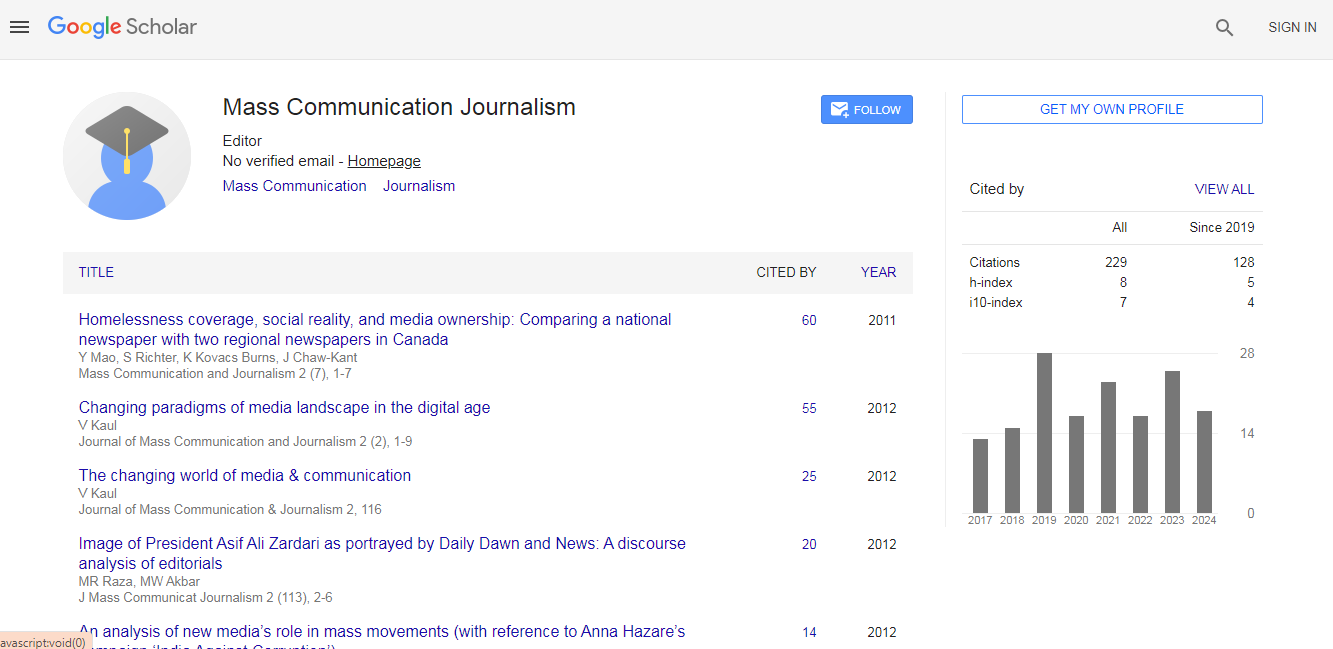
Journal of Mass Communication & Journalism received 205 citations as per Google Scholar report