Commentary - (2025) Volume 11, Issue 3
Received: 01-May-2025, Manuscript No. aso-26-184610;
Editor assigned: 05-May-2025, Pre QC No. P-184610;
Reviewed: 19-May-2025, QC No. Q-184610;
Revised: 22-May-2025, Manuscript No. R-184610;
Published:
29-May-2025
, DOI: 10.37421/2471-2671.2025.11.168
Citation: Bennett, Lucas. ”Minimally Invasive Surgery: Transforming
Cancer Care Outcomes.” Arch Surg Oncol 11 (2025):168.
Copyright: © 2025 Bennett L. This is an open-access article distributed under the terms of the Creative Commons Attribution License, which
permits unrestricted use, distribution and reproduction in any medium, provided the original author and source are credited.
Robotic and laparoscopic surgical approaches are increasingly transforming oncologic surgery, offering minimally invasive alternatives to traditional open procedures. These advanced techniques are characterized by their ability to reduce invasiveness, generally leading to a spectrum of patient benefits. Specifically, reduced blood loss during surgery is a commonly cited advantage, which can translate into fewer complications and a less demanding recovery period. Furthermore, patients undergoing these minimally invasive procedures often experience shorter hospital stays, allowing them to return to their homes and daily routines much sooner than after open surgery. The accelerated recovery times associated with robotic and laparoscopic surgery are a significant draw, enabling patients to resume their lives with greater alacrity [1].
For colon cancer, laparoscopic colectomy has emerged as a robust and well-established oncologic procedure. Extensive research and clinical practice have demonstrated that this minimally invasive approach yields oncologic outcomes that are equivalent to those achieved with open surgery. This equivalence extends to critical metrics such as survival rates and patterns of cancer recurrence, assuring patients that their cancer treatment is not compromised by the choice of surgical technique. The benefits for patients are substantial, including significantly decreased postoperative pain, which is a common source of discomfort after abdominal surgery. Moreover, there is a notable reduction in postoperative complications, contributing to a safer surgical experience and a smoother convalescence. This leads to a quicker return to normal activities, enhancing the patient's quality of life during the recovery phase [2].
In the field of gynecologic oncology, robotic-assisted surgery is experiencing a substantial increase in adoption for various procedures. The enhanced visualization and dexterity afforded by robotic systems are believed to significantly improve the precision with which tumors can be resected and lymph nodes can be sampled. This enhanced precision can lead to more thorough cancer removal and more accurate staging. The benefits for patients are similar to those seen in other specialties, including reduced blood loss and shorter recovery periods, which are critical for an optimal post-operative experience. While the oncologic safety and long-term outcomes are continuously being evaluated across a range of gynecologic cancers, current data suggest equivalence to open surgery for many indications, although more extensive data is still being accumulated for rare or particularly complex cases [3].
For oncologic surgery within the thorax, video-assisted thoracoscopic surgery (VATS) has become the recognized standard of care for many patients diagnosed with early-stage lung cancers. VATS offers considerable advantages when compared with traditional open thoracotomy, a technique that involves a larger incision and often more significant trauma to the chest wall. The primary benefits for patients include substantially reduced postoperative pain, which is a major factor in patient comfort and mobility. There is also a lower incidence of complications associated with VATS compared to open procedures. Crucially, these benefits are achieved without compromising oncologic outcomes, meaning that rates of local recurrence and overall survival remain comparable to open surgery. The successful implementation of VATS relies heavily on surgeons developing proficiency, and the learning curve is a key factor to consider [4].
In the realm of prostate cancer treatment, robotic prostatectomy has become the predominant surgical modality for localized disease. This technique is favored for its ability to achieve excellent functional outcomes, which are of paramount importance to patients undergoing treatment for prostate cancer. Specifically, it is associated with high rates of urinary continence and preservation of erectile function, significantly impacting a patient's quality of life post-surgery. Alongside these functional benefits, robotic prostatectomy also delivers robust oncologic control, ensuring that the cancer is effectively treated. The procedure is characterized by minimal blood loss, which is a hallmark of minimally invasive surgery, and a generally rapid recovery period for patients. While long-term oncologic data continue to mature and provide further evidence of its efficacy, current data strongly support its effectiveness in achieving negative surgical margins and preventing cancer recurrence [5].
The application of robotic surgery has notably expanded into head and neck oncologic procedures, with transoral robotic surgery (TORS) being particularly prominent for cancers of the oropharynx and larynx. TORS enables surgeons to perform precise dissections within the complex and often confined anatomical regions of the head and neck. This improved dexterity and visualization can lead to better functional outcomes for patients, preserving critical structures and enhancing their quality of life. The oncologic safety of TORS is maintained through adequate tumor resection and appropriate lymph node sampling, ensuring that the cancer is comprehensively addressed. Early results from the use of TORS are highly promising, and ongoing studies are continuing to confirm its long-term oncologic efficacy and safety in these challenging anatomical areas [6].
Within the domain of oncologic liver surgery, laparoscopic approaches have demonstrated significant benefits for patients undergoing resection of liver tumors. These minimally invasive techniques are associated with reduced blood loss compared to open resections, contributing to a more favorable perioperative course. Patients also experience shorter hospital stays, facilitating a quicker transition back to their home environment and usual activities. The faster recovery observed with laparoscopic liver surgery is a major advantage, allowing for a less burdensome convalescence. Importantly, oncologic outcomes, such as the achievement of R0 resection rates (complete tumor removal) and recurrence-free survival, are comparable to those seen with open surgery for resectable liver tumors, indicating that minimally invasive techniques do not compromise cancer control [7].
For patients requiring surgical intervention for esophageal cancer, robotic-assisted esophagectomy presents potential advantages over traditional open procedures. These benefits often include a reduction in blood loss during the operation and a lower incidence of perioperative complications, contributing to a safer surgical experience. The enhanced dexterity and superior visualization provided by robotic systems can facilitate a more meticulous dissection of critical anatomical structures, such as the recurrent laryngeal nerves and the vagus nerve, which are vital for vocal cord function and gastrointestinal motility. While oncologic outcomes are generally found to be comparable to open surgery, long-term data concerning survival and recurrence patterns are still being gathered to fully solidify its position as a standard of care for all patients with esophageal cancer [8].
In the context of pancreatic oncologic surgery, the adoption of minimally invasive techniques, encompassing both laparoscopic and robotic approaches, is progressively gaining momentum. These advanced methods are being explored with the primary aim of reducing the significant morbidity that is often associated with open pancreatoduodenectomy, a complex and historically high-risk procedure. While these minimally invasive techniques offer potential benefits such as reduced postoperative pain and a faster return to normal activities, ensuring oncologic safety remains a paramount concern. This includes achieving complete tumor resection and performing an adequate lymphadenectomy, both of which are critical for effective cancer treatment and are active areas of ongoing research and refinement [9].
The overall impact of robotic and laparoscopic surgery on patient recovery in oncologic settings is profoundly positive. These minimally invasive techniques consistently demonstrate reduced operative pain, shorter hospitalizations, and a quicker return to daily activities when contrasted with conventional open surgery. This expedited recovery not only enhances patient satisfaction but also can facilitate the earlier initiation of adjuvant therapies, such as chemotherapy or radiation, when they are indicated. Such timely commencement of adjuvant treatments can positively influence the overall trajectory of cancer care and potentially improve treatment outcomes for patients [10].
Robotic and laparoscopic surgical approaches are revolutionizing oncologic surgery by offering minimally invasive alternatives that yield significant patient benefits, including reduced blood loss, shorter hospital stays, and faster recovery times compared to open surgery. These techniques generally maintain or improve oncologic safety, defined by clear margins and adequate lymph node dissection, though learning curves and patient selection remain important considerations [1].
Laparoscopic colectomy for colon cancer is a well-established oncologic procedure demonstrating equivalent oncologic outcomes to open surgery, including survival rates and recurrence patterns. Patient advantages include decreased postoperative pain, reduced complications, and a quicker return to normal activities, with ongoing refinement of techniques for optimal lymphadenectomy and specimen extraction to ensure oncologic adequacy [2].
Robotic-assisted surgery is increasingly adopted for gynecologic oncologic procedures, providing enhanced visualization and dexterity that may improve the precision of tumor resection and lymph node dissection. Benefits include reduced blood loss and shorter recovery, with current data suggesting oncologic equivalence to open surgery for many indications, while long-term data continues to be evaluated for complex cases [3].
Video-assisted thoracoscopic surgery (VATS) has become the standard for many early-stage lung cancers in thoracic oncologic surgery. VATS offers significant advantages over open thoracotomy, such as reduced postoperative pain, fewer complications, and shorter hospital stays, without compromising oncologic outcomes like local recurrence and survival. The learning curve for successful implementation is a key factor [4].
Robotic prostatectomy is the leading surgical treatment for localized prostate cancer, offering excellent functional outcomes, including urinary continence and erectile function, alongside robust oncologic control. Benefits include minimal blood loss and rapid recovery. Current evidence supports its efficacy for achieving negative surgical margins and preventing recurrence, with ongoing maturation of long-term oncologic data [5].
Transoral robotic surgery (TORS) has expanded the application of robotic surgery in head and neck oncologic procedures for oropharyngeal and laryngeal cancers. TORS allows for precise dissection in complex anatomical regions, potentially improving functional outcomes and quality of life, while maintaining oncologic safety through adequate resection and lymph node sampling. Early results are promising with ongoing studies confirming long-term efficacy [6].
In oncologic liver surgery, laparoscopic approaches provide significant benefits such as reduced blood loss, shorter hospital stays, and faster recovery compared to open resection. Oncologic outcomes, including R0 resection rates and recurrence-free survival, are comparable to open surgery for resectable liver tumors, with expanding utility for complex procedures [7].
Robotic-assisted esophagectomy for esophageal cancer offers potential advantages in reduced blood loss and perioperative complications due to enhanced dexterity and visualization, which can facilitate meticulous dissection. Oncologic outcomes are generally comparable to open surgery, though long-term data on survival and recurrence are still being gathered to establish its standard of care role [8].
Minimally invasive techniques, including laparoscopic and robotic approaches, are gaining traction in pancreatic oncologic surgery to reduce the morbidity associated with open pancreatoduodenectomy. While offering potential benefits in reduced pain and faster recovery, ensuring oncologic safety through complete tumor resection and adequate lymphadenectomy remains a primary challenge and an active area of research [9].
Robotic and laparoscopic surgery profoundly impact patient recovery in oncologic settings, consistently showing reduced operative pain, shorter hospital stays, and quicker return to daily activities compared to open surgery. This expedited recovery contributes to improved patient satisfaction and can facilitate earlier initiation of adjuvant therapies, positively influencing the overall treatment trajectory [10].
Minimally invasive surgical techniques, including robotic and laparoscopic approaches, are transforming oncologic surgery across various specialties. These methods consistently offer significant advantages over open surgery, such as reduced blood loss, shorter hospital stays, and faster patient recovery. Oncologic outcomes, including tumor resection adequacy and cancer recurrence rates, are generally comparable or even improved with these techniques in many procedures. Specific applications range from colorectal and prostate cancer to gynecologic, thoracic, head and neck, liver, esophageal, and pancreatic surgeries. While the benefits are substantial, considerations such as the learning curve for surgeons, cost, and appropriate patient selection are important factors in their widespread adoption. Ongoing research continues to validate their efficacy and refine their application.
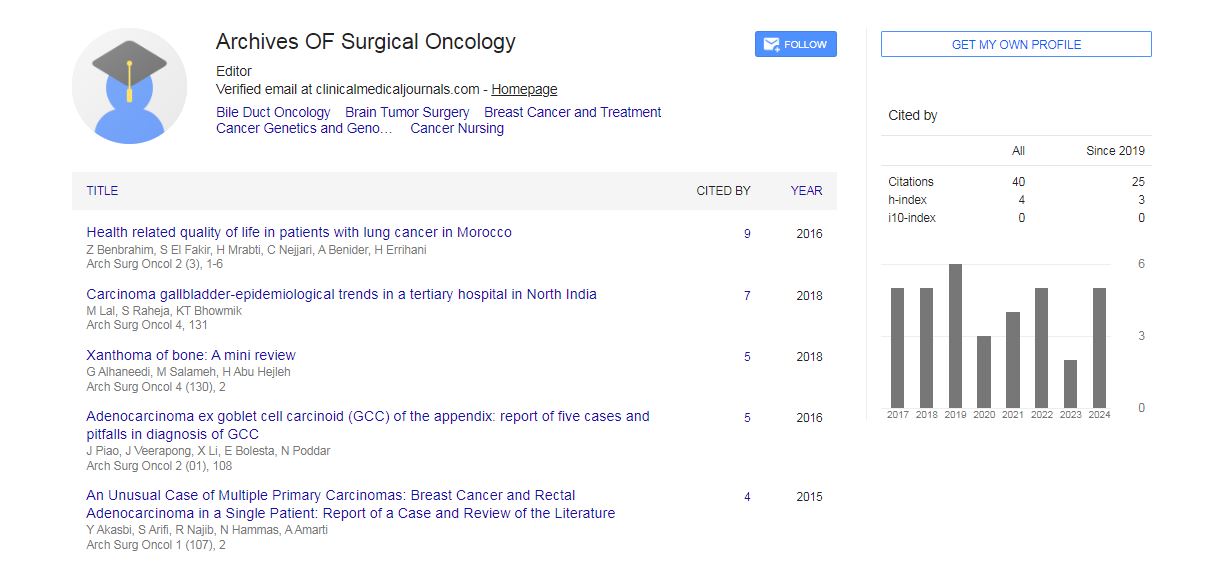
Archives of Surgical Oncology received 37 citations as per Google Scholar report