Perspective - (2025) Volume 11, Issue 5
Received: 01-Sep-2025, Manuscript No. aso-25-184651;
Editor assigned: 03-Sep-2025, Pre QC No. P-184651;
Reviewed: 17-Sep-2025, QC No. Q-184651;
Revised: 22-Sep-2025, Manuscript No. R-184651;
Published:
29-Sep-2025
, DOI: 10.37421/2471-2671.2025.11.194
Citation: Wei, Li. ”Minimally Invasive Surgery: Oncologic Safety
and Efficacy.” Arch Surg Oncol 11 (2025):194.
Copyright: © 2025 Wei L. This is an open-access article distributed under the terms of the Creative Commons Attribution License, which permits unrestricted use, distribution
and reproduction in any medium, provided the original author and source are credited.
Minimally invasive surgery (MIS) has emerged as a transformative approach in modern cancer treatment, significantly altering patient care paradigms by offering reduced morbidity and accelerated recovery periods. The evolution of surgical techniques has led to a greater emphasis on oncologic safety, particularly concerning the achievement of clear tumor margins and the minimization of local recurrence rates. Long-term outcomes, encompassing survival rates and the crucial aspect of quality of life, are also increasingly scrutinized to fully appreciate the benefits of these advanced procedures [1].
The oncologic safety of laparoscopic colorectal cancer resection is a subject of paramount importance, necessitating detailed analysis of critical surgical parameters. Studies have focused on evaluating margin status and the adequacy of lymph node dissection in minimally invasive procedures when compared to traditional open surgical techniques. These investigations aim to establish the oncologic equivalence and safety of MIS in this complex patient population [2].
Robotic-assisted surgery represents a significant advancement within the realm of minimally invasive oncologic procedures, offering surgeons enhanced visualization capabilities and improved dexterity during complex operations. A comprehensive assessment of oncologic outcomes comparing robotic versus conventional MIS for a variety of cancer types is essential to delineate its efficacy and safety profile. This includes an examination of local control and recurrence rates [3].
The impact of minimally invasive techniques on established oncologic principles, particularly in challenging procedures like pancreatic cancer surgery, warrants critical evaluation. Retrospective studies comparing laparoscopic and open Whipple procedures are vital for assessing outcomes such as margin positivity, lymphadenectomy completeness, and subsequent recurrence patterns. Such analyses help determine if MIS is a viable option for select patients [4].
Assessing the long-term oncologic outcomes and the subsequent impact on patient quality of life following minimally invasive esophagectomy for esophageal cancer is a crucial endeavor. Comprehensive studies are needed to present data on survival rates, recurrence-free survival, and patient-reported outcomes to fully understand the benefits of MIS in this context [5].
The oncologic implications of robotic-assisted radical prostatectomy have been extensively examined, with a focused assessment on key metrics such as margin status, biochemical recurrence, and cancer-specific survival. Large-scale analyses are critical for comparing these outcomes to traditional open radical prostatectomy and confirming oncologic equivalence [6].
This review synthesizes the current body of evidence pertaining to the oncologic safety and long-term efficacy of minimally invasive hysterectomy utilized in the treatment of various gynecologic cancers. Important considerations include the potential for tumor spillage, the accuracy of lymph node metastasis detection, and overall recurrence rates, all of which are vital for patient management [7].
The oncologic adequacy of minimally invasive liver resection, specifically for hepatocellular carcinoma, is a significant area of research. Studies comparing laparoscopic and open approaches are essential for evaluating outcomes related to margin positivity, intrahepatic recurrence, and overall survival, providing insights into the safety and effectiveness of MIS in this complex oncologic surgery [8].
This article delves into the long-term oncologic outcomes and the consequent impact on quality of life following minimally invasive lung cancer surgery. A critical review of studies comparing video-assisted thoracoscopic surgery (VATS) with open thoracotomy is necessary to assess recurrence rates, survival data, and pulmonary function, thereby supporting the oncologic safety of VATS [9].
The oncologic safety and long-term implications associated with minimally invasive approaches for gastric cancer treatment are subjects of ongoing exploration. Meta-analyses comparing laparoscopic and open gastrectomy are crucial for evaluating margin status, lymph node dissection efficacy, and survival outcomes, thereby informing the use of MIS in selected early-stage gastric cancer patients [10].
Minimally invasive surgery (MIS) represents a significant advancement in cancer treatment, offering a paradigm shift towards reduced patient morbidity and faster recovery times. A key aspect of this evolution is the rigorous evaluation of oncologic safety, with a particular focus on achieving clear tumor margins and minimizing local recurrence rates. Furthermore, understanding the long-term implications, including survival and quality of life, is paramount to fully assessing the value of MIS. Evidence consistently suggests that when applied to carefully selected patients and specific tumor types, MIS can yield oncologic outcomes comparable to those achieved with traditional open surgery. However, the success of these procedures is intrinsically linked to the surgeon's experience and strict adherence to fundamental oncologic principles. Future research endeavors should prioritize the standardization of MIS techniques and continue to explore long-term functional and oncologic results across a diverse spectrum of cancer types [1].
Within the domain of colorectal cancer surgery, the oncologic safety of laparoscopic resection is a critical area of investigation. Studies meticulously analyze margin status and the adequacy of lymph node dissection in MIS compared to open procedures to establish its oncologic equivalence. The results from these analyses generally indicate comparable rates of R0 resection and sufficient lymph node yield, thereby supporting the use of MIS as a safe and effective alternative. Moreover, long-term survival data further corroborate the oncologic equivalence of laparoscopic approaches, underscoring the indispensable role of robust surgical training and unwavering adherence to established surgical guidelines [2].
Robotic-assisted surgery has become increasingly prevalent in oncologic procedures, largely attributed to its ability to provide enhanced visualization and superior dexterity to the operating surgeon. A systematic review assessing the oncologic outcomes of robotic versus conventional MIS for various cancers highlights equivalent oncologic control, characterized by negative margins and low recurrence rates. The long-term implications of these techniques on patient survival and functional recovery are also subjects of ongoing discussion, with emerging trends consistently favoring MIS due to its less invasive nature and potential for improved patient outcomes [3].
The critical evaluation of the impact of minimally invasive techniques on established oncologic principles in pancreatic cancer surgery is of considerable importance. Retrospective studies that compare laparoscopic and open Whipple procedures meticulously focus on key oncologic parameters such as margin positivity, the completeness of lymphadenectomy, and the patterns of recurrence. The findings from such studies consistently demonstrate that experienced surgical centers can achieve comparable oncologic safety with MIS, suggesting it as a viable and potentially advantageous option for carefully selected patients, with anticipated benefits in terms of postoperative recovery [4].
Assessing the long-term oncologic outcomes and the subsequent impact on quality of life following minimally invasive esophagectomy for esophageal cancer is an essential undertaking. Studies in this area present data on vital oncologic endpoints, including survival rates and recurrence-free survival, alongside patient-reported outcomes. The current evidence suggests that MIS can effectively achieve excellent long-term oncologic control while simultaneously offering significant advantages in postoperative recovery and a reduction in long-term morbidity when contrasted with traditional open surgical approaches [5].
The oncologic implications of robotic-assisted radical prostatectomy have been the subject of extensive investigation, with a particular emphasis on the evaluation of margin status, the rate of biochemical recurrence, and overall cancer-specific survival. Large-scale analyses consistently indicate that robotic surgery provides oncologically equivalent results when compared to open radical prostatectomy. Furthermore, the long-term functional outcomes, such as the return of continence and potency, are also thoughtfully discussed, highlighting the continuous evolution and refinement of MIS within the field of urologic oncology [6].
This review critically synthesizes the current body of evidence regarding the oncologic safety and long-term efficacy of minimally invasive hysterectomy for gynecologic cancers. The assessment addresses critical issues such as the potential for tumor spillage during the procedure, the accuracy of lymph node metastasis detection, and the incidence of recurrence. The prevailing consensus within the literature is that for patients with early-stage disease, MIS is oncologically safe and confers substantial benefits in terms of postoperative recovery, with long-term survival rates demonstrating comparability to those achieved with open procedures [7].
The oncologic adequacy of minimally invasive liver resection for hepatocellular carcinoma is a subject that has garnered considerable attention in recent years. Studies in this domain compare outcomes related to margin positivity, the rate of intrahepatic recurrence, and overall survival between laparoscopic and open approaches. The findings consistently suggest that MIS can be performed safely and effectively in experienced hands, achieving similar oncologic control and offering long-term survival benefits for carefully selected patient cohorts [8].
This article meticulously examines the long-term oncologic outcomes and the subsequent impact on quality of life following minimally invasive lung cancer surgery. It provides a comprehensive review of studies that compare video-assisted thoracoscopic surgery (VATS) with open thoracotomy, with a specific focus on recurrence rates, survival data, and pulmonary function. The cumulative evidence strongly supports VATS as an oncologically safe and highly effective surgical approach, offering notable advantages in terms of postoperative recovery and potentially improved long-term functional status for patients [9].
The oncologic safety and long-term implications of minimally invasive approaches for the surgical management of gastric cancer are thoroughly explored in this meta-analysis. By comparing laparoscopic and open gastrectomy, the study evaluates key parameters such as margin status, lymph node dissection completeness, and overall survival outcomes. The results suggest that MIS is oncologically equivalent to open surgery for selected patients diagnosed with early-stage gastric cancer, offering the added advantage of potentially improved early recovery and a reduction in postoperative complications [10].
Minimally invasive surgery (MIS) has revolutionized cancer treatment by providing reduced morbidity and faster recovery, with oncologic outcomes comparable to open surgery for selected patients. Key oncologic parameters like margin status and local recurrence rates are consistently favorable across various cancer types, including colorectal, pancreatic, gastric, liver, lung, and gynecologic cancers. Robotic-assisted surgery further enhances MIS capabilities, offering equivalent oncologic control. While MIS demonstrates oncologic safety and efficacy, surgeon experience and adherence to principles are crucial. Long-term survival and quality of life are also positively impacted, making MIS a valuable alternative to open procedures. Ongoing research focuses on standardizing techniques and further evaluating long-term results.
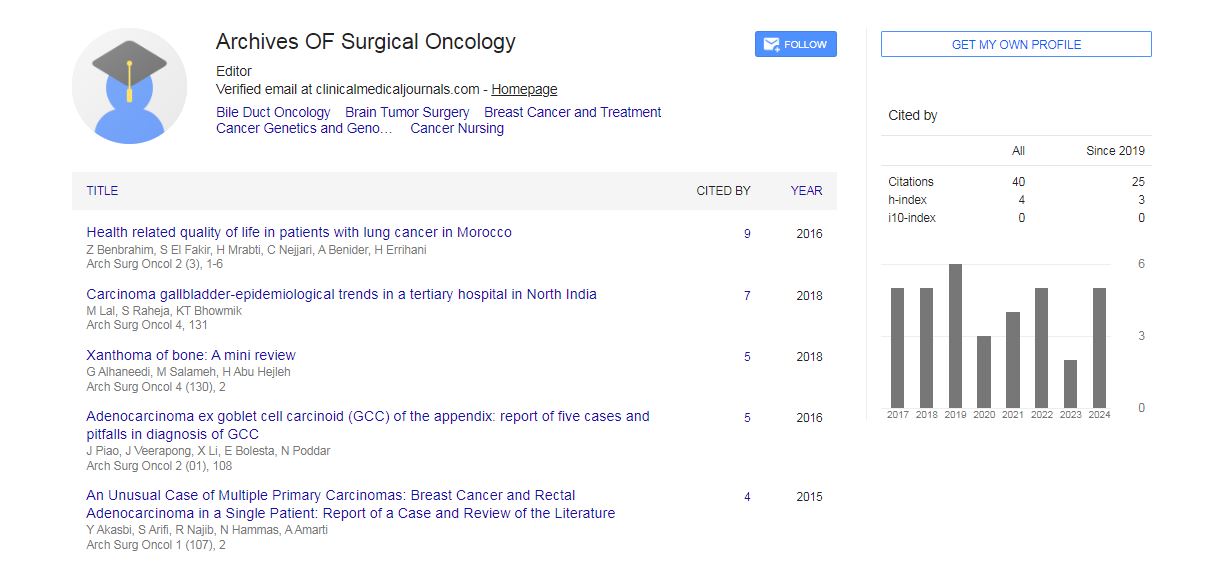
Archives of Surgical Oncology received 37 citations as per Google Scholar report