Opinion - (2025) Volume 14, Issue 2
Received: 01-Mar-2025, Manuscript No. aim-25-177342;
Editor assigned: 03-Mar-2025, Pre QC No. P-177342;
Reviewed: 17-Mar-2025, QC No. Q-177342;
Revised: 24-Mar-2025, Manuscript No. R-177342;
Published:
31-Mar-2025
, DOI: 10.37421/2427-5162.2025.14.562
Citation: El-Karim, Ahmed. ”Mind-Body Interventions: Broad Efficacy and Integration.” Alt Integr Med 14 (2025):563.
Copyright: © 2025 El-Karim A. This is an open-access article distributed under the terms of the Creative Commons Attribution License, which permits unrestricted use, distribution and reproduction in any medium, provided the original author and source are credited.
A systematic review and meta-analysis elucidated the profound benefits of mind-body interventions for women grappling with gynecological cancers. These interventions demonstrably improve overall well-being and significantly mitigate psychological distress, offering a vital layer of support beyond conventional treatments. They address the considerable emotional toll of cancer, thereby serving as essential components of comprehensive care strategies [1].
Similarly, a comprehensive review and meta-analysis highlighted the efficacy of mind-body interventions in ameliorating mental health challenges faced by individuals undergoing various cancer treatments. The findings specifically underscored their effectiveness in reducing symptoms of anxiety and depression, firmly establishing their role in fostering psychological resilience and providing holistic cancer care [2].
The high levels of stress experienced by healthcare professionals have been a persistent concern. A systematic review and meta-analysis specifically demonstrated that Mindfulness-Based Interventions are remarkably effective in reducing this occupational stress. This evidence suggests that integrating such practices is crucial for cultivating and sustaining the well-being and resilience of those operating on the front lines of healthcare delivery [3].
Beyond mental health, certain mind-body practices have shown remarkable efficacy in managing physical ailments. A systematic review and meta-analysis confirmed that yoga stands as an effective integrative treatment for chronic low back pain. This finding is particularly significant for patients seeking non-pharmacological alternatives, as yoga consistently provides benefits in pain reduction and functional improvement, making it a viable element of a holistic pain management regimen [4].
For cancer patients, psychological distress, including anxiety and depression, often accompanies treatment. A systematic review and meta-analysis revealed that meditation and guided imagery offer substantial benefits in alleviating these forms of distress and enhancing the overall quality of life. These mind-body practices are therefore considered essential tools in navigating the complexities of cancer treatment [5].
Headache disorders represent another area where non-pharmacological interventions are highly sought after. A systematic review and meta-analysis provided compelling evidence that biofeedback interventions are effective in managing a variety of headache conditions. This approach empowers patients by teaching them to control physiological responses, leading to significant reductions in headache frequency and intensity [6].
Maintaining mobility and preventing falls are critical concerns for an aging population. A systematic review and meta-analysis underscored that Tai Chi profoundly improves balance and substantially helps in preventing falls among older adults. This demonstrates the immense value of gentle movement practices as an accessible and effective intervention for preserving mobility and minimizing injury risk within this demographic [7].
The broader concept of integrative medicine has also been rigorously examined for its role in chronic pain. A recent systematic review and meta-analysis provided robust evidence confirming the effectiveness of integrative medicine approaches for chronic pain management. This research indicates that combining conventional treatments with various mind-body therapies leads to superior pain relief and improved patient outcomes, advocating for multimodal care [8].
Adolescent mental health is a growing area of concern, and mind-body practices present a promising avenue for support. A systematic review and meta-analysis highlighted their potential to significantly improve mental health in adolescents, specifically addressing issues like anxiety and depression. These non-pharmacological options are often well-received by young individuals and their families, offering accessible care [9].
Ultimately, the impact of mind-body interventions on the overall quality of life for cancer patients cannot be overstated. A robust systematic review and meta-analysis clearly demonstrated their significant positive influence. These therapies are not merely complementary but are truly impactful in enhancing well-being and reducing the profound distress often associated with cancer treatment, proving their integral role in patient care [10].
The utility of mind-body interventions (MBIs) has been thoroughly investigated in the context of women suffering from gynecological cancers, with a systematic review and meta-analysis concluding their capacity to considerably enhance well-being and reduce psychological distress. This implies that such therapies provide indispensable emotional and psychological support, augmenting traditional medical care [1]. Further expanding on the benefits within oncology, a comprehensive systematic review and meta-analysis specifically evaluated MBIs for mental health among individuals undergoing various forms of cancer treatment. The findings unequivocally demonstrated that these interventions are effective in mitigating anxiety and depression, contributing significantly to holistic cancer care and bolstering psychological resilience [2]. Addressing occupational stressors, particularly among healthcare professionals, has become paramount. A dedicated systematic review and meta-analysis meticulously revealed that Mindfulness-Based Interventions (MBIs) are highly effective in reducing stress levels among this critical demographic. This underscores the potential for MBIs to serve as vital tools in safeguarding the well-being and enhancing the resilience of caregivers [3]. For individuals experiencing chronic low back pain, a widespread debilitating condition, a systematic review and meta-analysis presented compelling evidence for yoga as an effective integrative treatment. This research positions yoga as a significant non-pharmacological alternative, consistently demonstrating its capacity to reduce pain and improve functional outcomes [4]. Psychological distress, including anxiety and depression, is a common co-morbidity for cancer patients. A systematic review and meta-analysis focused on meditation and guided imagery elucidated their significant role in alleviating these distressing symptoms and notably improving patient quality of life. These practices offer a crucial means of support to cope with treatment demands [5]. The management of headache disorders often benefits from diverse therapeutic approaches. A systematic review and meta-analysis established biofeedback interventions as an effective modality for various headache types. This non-pharmacological strategy empowers patients through self-regulation of physiological responses, resulting in a demonstrable decrease in both frequency and intensity [6]. Promoting healthy aging through fall prevention is a key public health objective. A systematic review and meta-analysis of Tai Chi interventions clearly indicated its significant impact on improving balance and preventing falls in older adults. This highlights Tai Chi as an accessible and gentle yet highly effective physical activity [7]. The efficacy of integrative medicine, which combines conventional and complementary therapies, for chronic pain management was robustly supported by a recent systematic review and meta-analysis. The findings emphasized that such integrated approaches lead to superior pain relief and improved overall patient outcomes [8]. In the realm of adolescent mental health, which demands innovative and patient-centered solutions, a systematic review and meta-analysis demonstrated that mind-body practices offer a promising avenue. These interventions effectively address prevalent issues like anxiety and depression, providing well-received non-pharmacological alternatives [9]. The overarching impact of mind-body interventions on the quality of life for cancer patients was definitively confirmed by a significant systematic review and meta-analysis. The study concluded that these therapies are instrumental in enhancing patient well-being and alleviating the distress associated with cancer and its treatments [10].
This collection of systematic reviews and meta-analyses consistently demonstrates the broad efficacy of various mind-body interventions across a spectrum of health conditions and populations. Key findings highlight their significant role in improving mental health, particularly in reducing anxiety and depression among cancer patients and adolescents. Furthermore, these interventions are shown to enhance overall well-being and quality of life for individuals undergoing cancer treatment, offering crucial emotional support. Beyond psychological benefits, specific practices like yoga and Tai Chi prove effective in managing chronic physical ailments such as low back pain and improving balance in older adults, thereby preventing falls. Biofeedback interventions are also validated for their effectiveness in headache management. The cumulative evidence underscores that integrative medicine approaches, which often incorporate mind-body therapies, provide superior outcomes for chronic pain. These studies collectively advocate for the integration of mind-body practices as valuable, non-pharmacological additions to comprehensive care, enhancing resilience and addressing both physical and psychological distress across diverse patient groups.
None
None
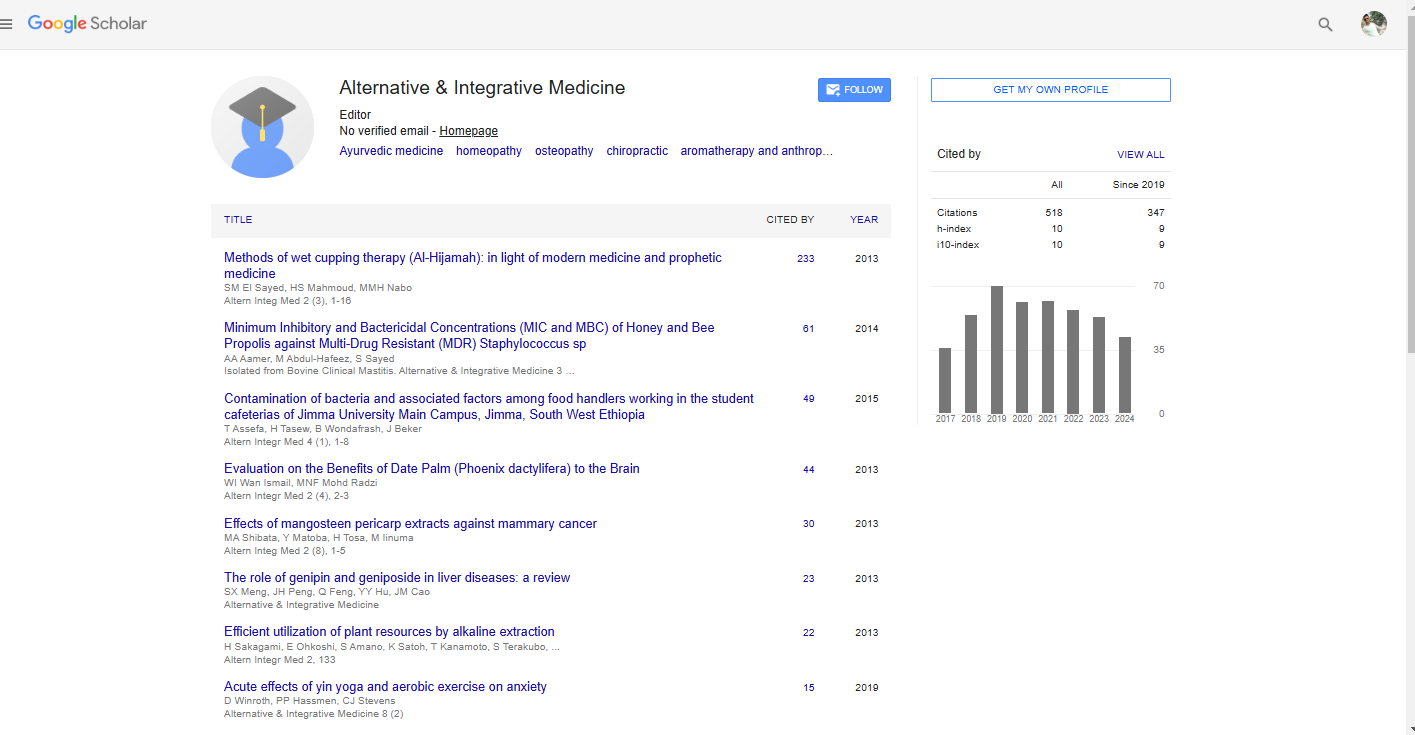
Alternative & Integrative Medicine received 476 citations as per Google Scholar report