Perspective - (2025) Volume 15, Issue 4
Received: 02-Jul-2025, Manuscript No. jbpbt-25-178515;
Editor assigned: 04-Jul-2025, Pre QC No. P-178515;
Reviewed: 18-Jul-2025, QC No. Q-178515;
Revised: 23-Jul-2025, Manuscript No. R-178515;
Published:
30-Jul-2025
, DOI: 10.37421/2155-9821.2025.15.691
Citation: Dlamini, Thabo M.. ”Microalgal Bioprocessing: High-Value Compounds Extraction Innovations.” J Bioprocess Biotech 15 (2025): 691.
Copyright: © 2025 Dlamini M. Thabo This is an open-access article distributed under the terms of the Creative Commons Attribution License, which permits unrestricted use,
distribution and reproduction in any medium, provided the original author and source are credited.
Recent advancements in microalgal bioprocessing are significantly enhancing the extraction and purification of valuable compounds such as carotenoids, omega-3 fatty acids, and proteins. Novel cultivation, harvesting, and downstream processing techniques are being developed to improve yields and reduce costs, making microalgal biomass a more viable source for nutraceuticals, pharmaceuticals, and biofuels. The emphasis is on sustainable and scalable methods to unlock the full potential of microalgae [1].
Enhanced production of astaxanthin from *Haematococcus pluvialis* is being achieved through optimized photobioreactor designs and light regimes. Controlling environmental factors like light intensity and nutrient availability has been shown to profoundly impact astaxanthin accumulation. Research is also exploring innovative harvesting and cell disruption methods to maximize extraction efficiency, paving the way for industrial-scale production [2].
Progress in extracting valuable lipids, particularly omega-3 fatty acids like EPA and DHA, from marine microalgae is substantial. Various extraction techniques, including supercritical fluid extraction and enzymatic methods, are being compared based on their scalability and environmental impact. The focus is on improving the purity and bioavailability of these essential fatty acids for the nutraceutical and pharmaceutical industries [3].
The potential of using integrated cultivation and harvesting systems for microalgae to produce bioactive proteins is being explored. This research examines protein profiles from different microalgal species and discusses the challenges and opportunities in large-scale protein extraction. The impact of cultivation conditions on protein content and quality for food and functional ingredient applications is also being addressed [4].
The use of ultrasound-assisted extraction (UAE) for recovering valuable compounds from microalgal biomass is gaining traction. This technique offers a comprehensive approach to extracting pigments, lipids, and polysaccharides. The advantages of UAE, such as reduced extraction time and solvent consumption, are highlighted, along with its potential for industrial implementation in bioprocessing [5].
Enzymatic hydrolysis of microalgal cell walls is proving effective in improving the release of intracellular high-value compounds. Specific enzymes are being utilized to break down complex cell structures, thereby enhancing the efficiency of subsequent extraction processes for lipids and proteins. The impact of different enzyme cocktails and reaction conditions on yield and purity is being evaluated [6].
Novel downstream processing techniques for microalgal pigments, especially fucoxanthin, are under development. Methods like liquid-liquid extraction and chromatography are being examined to achieve high purity and stability of the pigment. The goal is to overcome economic barriers in pigment production by optimizing separation and purification steps for pharmaceutical and cosmetic applications [7].
Membrane filtration technologies are being investigated for efficient harvesting and dewatering of microalgal biomass. Various membrane configurations and their suitability for different microalgal species and cultivation conditions are discussed. Optimizing membrane processes is emphasized as a means to significantly reduce energy consumption and operational costs in microalgal bioprocessing [8].
Microalgae are being evaluated as a sustainable source for producing polyunsaturated fatty acids (PUFAs) for the pharmaceutical industry. Different microalgal strains and cultivation strategies optimized for PUFA production are being compared. Advanced extraction and purification techniques are being explored to obtain high-quality PUFAs with improved bioavailability and reduced contaminants [9].
The integration of bioprocessing steps for the co-production of multiple high-value compounds from microalgal biomass is a key area of research. Strategies for sequential extraction and purification of lipids, proteins, and pigments from a single microalgal strain are being developed. This aims to enhance the economic feasibility of microalgal cultivation by maximizing the value derived from the biomass [10].
Microalgal bioprocessing is witnessing significant advancements in optimizing the extraction and purification of high-value compounds like carotenoids, omega-3 fatty acids, and proteins. Novel techniques in cultivation, harvesting, and downstream processing are being implemented to boost yields and reduce costs, thereby establishing microalgal biomass as a more viable resource for nutraceuticals, pharmaceuticals, and biofuels. The overarching goal is to employ sustainable and scalable methods to fully harness the potential of microalgae [1].
The production of astaxanthin from *Haematococcus pluvialis* is being enhanced through the optimization of photobioreactor designs and light regimes. Controlling crucial environmental factors, such as light intensity and nutrient availability, plays a significant role in the accumulation of astaxanthin. Furthermore, innovative harvesting and cell disruption methods are being explored to maximize extraction efficiency, presenting a clear pathway towards industrial-scale production [2].
Substantial progress has been made in the extraction of valuable lipids, particularly omega-3 fatty acids like EPA and DHA, from marine microalgae. A comparative analysis of various extraction techniques, including supercritical fluid extraction and enzymatic methods, is being conducted, considering their scalability and environmental implications. The primary objective is to enhance the purity and bioavailability of these essential fatty acids for their application in the nutraceutical and pharmaceutical sectors [3].
Research is actively investigating the potential of integrated cultivation and harvesting systems for microalgae specifically for the production of bioactive proteins. This research involves examining the protein profiles of different microalgal species and identifying the challenges and opportunities inherent in large-scale protein extraction. The influence of cultivation conditions on protein content and quality, crucial for food and functional ingredient applications, is also a key consideration [4].
The application of ultrasound-assisted extraction (UAE) for the recovery of valuable compounds from microalgal biomass is becoming increasingly prominent. This method provides a comprehensive overview of the principles of UAE and its utility in extracting pigments, lipids, and polysaccharides. The advantages of UAE, such as reduced extraction times and lower solvent consumption, are emphasized, alongside its potential for industrial adoption within bioprocessing frameworks [5].
Enzymatic hydrolysis of microalgal cell walls is proving to be a highly effective strategy for enhancing the release of intracellular high-value compounds. The study involves the use of specific enzymes to break down complex cellular structures, thereby improving the efficiency of subsequent lipid and protein extraction processes. The impact of different enzyme cocktails and reaction conditions on the yield and purity of the extracted products is being rigorously evaluated [6].
Novel downstream processing strategies are being developed for microalgal pigments, with a particular focus on fucoxanthin. Techniques such as liquid-liquid extraction and chromatography are being investigated to achieve high purity and stability of the pigment. The aim is to surmount the economic hurdles associated with microalgal pigment production by refining separation and purification steps for pharmaceutical and cosmetic uses [7].
Membrane filtration technologies are being explored for their efficiency in harvesting and dewatering microalgal biomass. The research discusses various membrane configurations and assesses their suitability for different microalgal species and cultivation conditions. Optimizing these membrane processes is highlighted as a critical factor in substantially reducing energy consumption and operational costs in microalgal bioprocessing, thereby improving economic viability [8].
Microalgae are being assessed for their potential as a sustainable source for producing polyunsaturated fatty acids (PUFAs) tailored for the pharmaceutical industry. A comparative evaluation of different microalgal strains and cultivation strategies optimized for PUFA production is underway. Furthermore, advanced extraction and purification techniques are being investigated to yield high-quality PUFAs, such as docosahexaenoic acid (DHA) and eicosapentaenoic acid (EPA), with enhanced bioavailability and minimal contaminants [9].
There is a significant focus on integrating bioprocessing steps to facilitate the co-production of multiple high-value compounds from microalgal biomass. This involves exploring strategies for sequential extraction and purification of lipids, proteins, and pigments from a single microalgal strain. The primary objective is to elevate the economic feasibility of microalgal cultivation by maximizing the value extracted from the biomass, presenting a comprehensive approach to microalgal bioprocessing [10].
This collection of research explores advancements in microalgal bioprocessing for extracting high-value compounds. Studies detail optimized photobioreactor designs for astaxanthin production, comparisons of extraction techniques for omega-3 fatty acids, and the development of methods for bioactive proteins. The use of ultrasound-assisted extraction, enzymatic cell wall disruption, and membrane filtration technologies are highlighted for their efficiency and cost-effectiveness. Research also focuses on novel downstream processing for pigments like fucoxanthin and the potential of microalgae for pharmaceutical-grade polyunsaturated fatty acids. Integrated bioprocessing for co-production of multiple compounds from microalgal biomass is presented as a strategy to enhance economic viability.
None
None
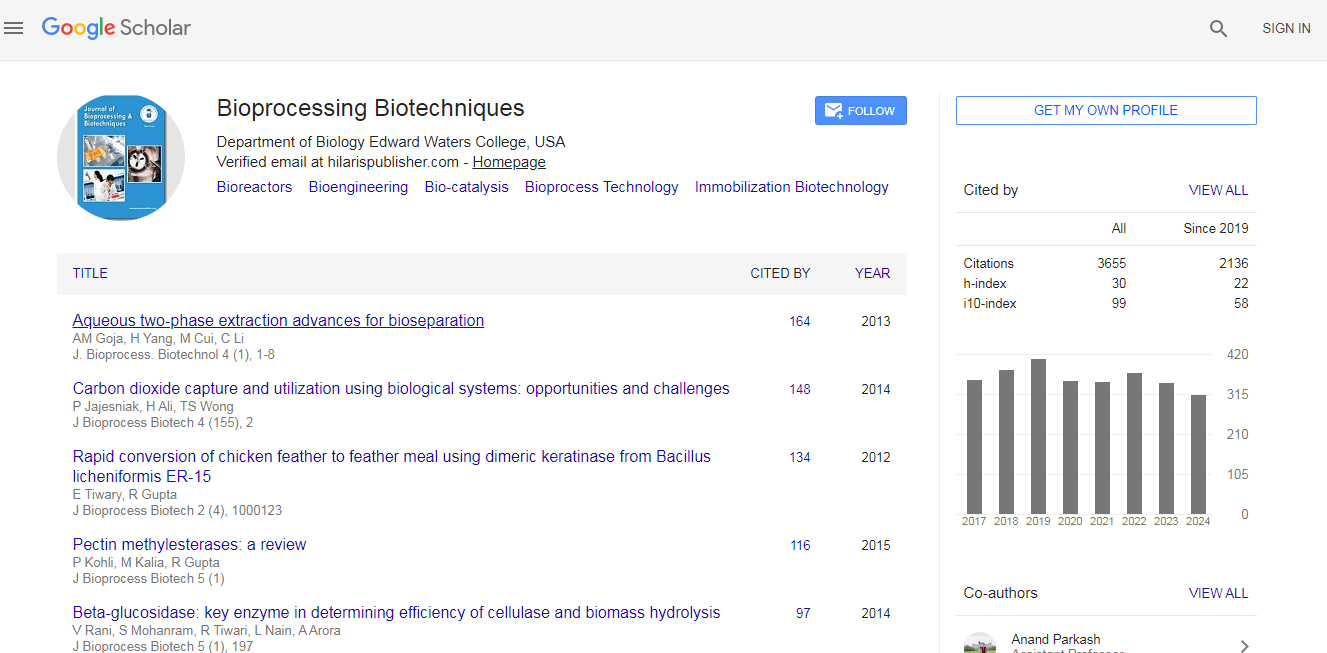
Journal of Bioprocessing & Biotechniques received 3351 citations as per Google Scholar report