Perspective - (2025) Volume 15, Issue 3
Received: 01-Sep-2025, Manuscript No. jpdbd-25-174981;
Editor assigned: 03-Sep-2025, Pre QC No. P-174981;
Reviewed: 17-Sep-2025, QC No. Q-174981;
Revised: 22-Sep-2025, Manuscript No. R-174981;
Published:
29-Sep-2025
, DOI: 10.37421/2153-0769.2025.15.428
Citation: Beaumont, Clara. ”Metabolomics: Unlocking Microbial Secrets and Applications.” Metabolomics 15 (2025):428.
Copyright: © 2025 Beaumont C. This is an open-access article distributed under the terms of the Creative Commons Attribution License, which permits unrestricted use, distribution and reproduction in any medium, provided the original author and source are credited.
The field of microbial metabolomics stands as a pivotal area of scientific inquiry, offering profound insights into the intricate world of microbial communities. Recent advancements in untargeted metabolomics techniques are particularly highlighted for their role in deciphering complex microbial community interactions and their underlying functional mechanisms. This progress is built upon significant improvements in sample preparation, the deployment of advanced analytical platforms like LC-MS and GC-MS, and sophisticated data processing strategies, all pointing towards achieving deeper biological insights [1].
Microbial metabolomics isn't just an incremental step; it's revolutionizing our understanding of microbial communities, especially in diverse and critical environments such as the gut and soil. The methodologies involved in this discipline are detailed, and its extensive potential across health, disease, and various industrial applications solidifies its pivotal role in future microbiome research [2].
A key application area involves the precise modulation of the gut microbiome. Understanding the metabolic outputs of microbes can directly inform targeted interventions aimed at improving human health. This endeavor utilizes a spectrum of analytical techniques and computational approaches designed to unravel complex host-microbe interactions, giving us a roadmap to better health outcomes [3].
More broadly, metabolomics is comprehensively employed to study the intricate relationships between microbes and their hosts. It shines a light on crucial applications, including mapping metabolic pathways, identifying vital biomarkers for disease, and revealing the fundamental mechanisms of interaction. This offers invaluable insights into both beneficial and detrimental associations that shape host physiology [4].
To achieve this depth of understanding, continuous innovation in analytical strategies for microbial metabolomics is essential. The latest papers focus on improving sample preparation, refining separation techniques such as chromatography, and advancing detection methods like mass spectrometry and nuclear magnetic resonance. These efforts are consistently aimed at enhancing the overall depth and breadth of metabolic profiling across various microbial systems [5].
This systematic use of metabolomics also serves to decode microbial metabolic functions by outlining both the current state and emerging directions of research. It provides tools to identify novel metabolites, understand complex metabolic pathways, and explore microbial interactions within a multitude of ecosystems. This predictive capacity foresees a significant role for metabolomics in future biotechnological applications, driving innovation across industries [6].
Beyond therapeutic and biotechnological contexts, microbial metabolomics plays a critical role in ensuring food safety. Metabolomic profiling provides rapid and sensitive methods to detect foodborne pathogens, identify spoilage microorganisms, and accurately assess food quality, thus strengthening monitoring and control measures throughout the entire food supply chain [7].
Examining current strategies and future outlooks for analyzing the microbiome through metabolomics emphasizes the technique's profound power. Metabolic profiling is instrumental in characterizing microbial communities, clarifying their functional roles, and deciphering host-microbe metabolic crosstalk. This paves the way for advanced insights into the complexities of health and disease [8].
As an emerging and vital tool, microbial metabolomics facilitates a deeper comprehension of microbial interactions in both healthy and diseased states. It leverages diverse analytical techniques and bioinformatics tools to reveal subtle metabolic changes within microbial communities that profoundly impact host physiology, thereby opening new avenues for therapeutic interventions and personalized medicine [9].
Finally, the broad applications of microbial metabolomics extend significantly into environmental microbiology. This discipline helps us understand microbial responses to environmental shifts, the mechanics of nutrient cycling, bioremediation processes, and the overarching functions of ecosystems. It provides a powerful lens through which to study microbial life in diverse natural habitats, enriching our ecological understanding [10].
Microbial metabolomics represents a rapidly expanding scientific domain that is fundamentally transforming our ability to understand complex biological systems. It acts as an indispensable tool for deciphering the intricate interactions within microbial communities and elucidating their functional mechanisms across various environments, from the human gut to diverse soil ecosystems [1]. This analytical approach is revolutionizing our comprehension of how these communities function, laying a robust foundation for future microbiome research and its expansive applications in health, disease, and industrial sectors [2]. The core strength of metabolomics lies in its capacity to provide a comprehensive snapshot of metabolic outputs, which are essentially the end products of cellular processes. This deep profiling allows researchers to move beyond mere microbial identification to understanding what these microbes are actively doing, how they influence their surroundings or hosts, and how their metabolic activities contribute to the overall health or dysfunction of an ecosystem [6, 8]. The insights gained are crucial for addressing a wide array of scientific and practical challenges.
Significant progress in the field is largely driven by continuous advancements in analytical strategies. These improvements encompass every stage of the metabolomics workflow, beginning with enhanced sample preparation techniques that ensure representative and high-quality data. Analytical platforms such as Liquid Chromatography-Mass Spectrometry (LC-MS) and Gas Chromatography-Mass Spectrometry (GC-MS) have seen considerable evolution, offering increased sensitivity, resolution, and broader coverage of the metabolome. Beyond these, detection methods like Nuclear Magnetic Resonance (NMR) spectroscopy also contribute significantly to the depth and breadth of metabolic profiling for microbial systems [1, 5]. This technological push is vital for unraveling the thousands of metabolites present in a single sample. Coupled with these instrumental advances are sophisticated data processing and bioinformatics tools, which are critical for extracting meaningful biological insights from the vast and complex datasets generated by these high-throughput techniques [9]. The ongoing refinement of these tools makes metabolomics an increasingly powerful and accessible approach for researchers.
The application of microbial metabolomics is particularly impactful in understanding and modulating human health. For example, it provides a powerful means for precisely modulating the gut microbiome. By understanding specific microbial metabolic outputs, researchers can develop targeted interventions to improve human health outcomes, effectively unraveling complex host-microbe interactions through various analytical and computational approaches [3]. This capability is crucial for studying the intricate relationships between microbes and their hosts, aiding in the identification of metabolic pathways, discovering novel biomarkers for disease, and revealing the fundamental mechanisms behind both beneficial and detrimental associations [4]. Ultimately, these insights offer new avenues for therapeutic interventions, personalized medicine, and the development of innovative health strategies, transforming our approach to preventing and treating disease [9]. The ability to pinpoint specific metabolites that correlate with health or disease states is a game-changer.
The utility of microbial metabolomics extends well beyond direct human health applications, playing a critical role in vital sectors such as food safety and environmental microbiology. In the context of food safety, metabolomic profiling offers rapid and sensitive methods for detecting foodborne pathogens, identifying spoilage microorganisms, and accurately assessing the quality of food products throughout the entire supply chain [7]. This provides a proactive approach to consumer protection and quality control. Within environmental microbiology, metabolomics provides a powerful lens to understand how microbial communities respond to environmental changes, contribute to essential nutrient cycling, engage in bioremediation processes, and support broader ecosystem functions in diverse natural habitats [10]. This includes insights into how microbes interact with pollutants or contribute to soil fertility. This dual application highlights the versatility and broad relevance of metabolomics in addressing pressing global challenges related to food security, ecological sustainability, and environmental health.
Looking forward, microbial metabolomics is clearly positioned as the future of microbiome analysis, offering unparalleled capabilities. It empowers scientists to characterize microbial communities with unprecedented detail, understand their specific functional roles, and meticulously decode host-microbe metabolic crosstalk, leading to advanced insights into health and disease states [2, 8]. The ongoing efforts to identify novel metabolites and precisely map metabolic pathways within various ecosystems predict a significant and continuously expanding role for metabolomics in future biotechnological applications. This field not only sheds light on the unseen world of microbial interactions but also actively contributes to innovative solutions across medicine, agriculture, and environmental management, promising a deeper and more actionable understanding of life itself and its complex metabolic underpinnings [6].
Microbial metabolomics has emerged as a crucial field, significantly advancing our understanding of microbial communities and their complex interactions. This approach provides detailed insights into functional mechanisms, both within diverse environments like the gut and soil, and in host-microbe relationships. Key advancements include sophisticated techniques in untargeted metabolomics, improving sample preparation, analytical platforms such as LC-MS and GC-MS, and advanced data processing strategies. The power of metabolomics extends to identifying novel metabolites, deciphering metabolic pathways, and characterizing microbial metabolic outputs, which are vital for targeted interventions in human health, disease prevention, and various industrial applications. Beyond health, its applications are revolutionizing food safety by detecting pathogens and assessing quality, while also deepening our comprehension of environmental microbiology, including microbial responses to change, nutrient cycling, and bioremediation. The ongoing evolution in analytical strategies, from chromatography to mass spectrometry and nuclear magnetic resonance, continually enhances the depth of metabolic profiling. This collective body of work underscores metabolomics as an indispensable tool, offering a powerful lens for future microbiome analysis and biotechnological innovation.
None
None
Zhaowei L, Jing H, Lin F. "Recent advances in untargeted metabolomics for microbial community analysis".TrAC Trends Anal Chem 167 (2023):117215.
Indexed at, Google Scholar, Crossref
Rashi G, Subir S, Sarita D. "Microbial metabolomics: The future of microbiome analysis".World J Microbiol Biotechnol 38 (2022):17.
Indexed at, Google Scholar, Crossref
Hongyan D, Xiaolong W, Zhaoyang L. "Exploring Microbial Metabolomics for Precision Gut Microbiome Modulation".J Agric Food Chem 71 (2023):11571-11585.
Indexed at, Google Scholar, Crossref
Yanan W, Lin F, Xiaojiao L. "Applications of metabolomics to microbial and host-microbe interactions".Crit Rev Food Sci Nutr 61 (2021):1813-1836.
Indexed at, Google Scholar, Crossref
Kai Z, Lingyu D, Jianbo X. "Recent advances in analytical strategies for microbial metabolomics".Trends Anal Chem 122 (2020):115744.
Indexed at, Google Scholar, Crossref
Jing Z, Qian L, Jun L. "Unraveling microbial metabolic functions through metabolomics: Current status and future trends".Appl Microbiol Biotechnol 105 (2021):8143-8159.
Indexed at, Google Scholar, Crossref
Chengyang X, Xinxin W, Yanli H. "Microbial metabolomics in food safety: A review".Food Control 139 (2022):109062.
Indexed at, Google Scholar, Crossref
Stephanie AS, Jennifer AF, Timothy JG. "Current Strategies and Future Prospects for Analyzing the Microbiome through Metabolomics".J Proteome Res 19 (2020):36-47.
Indexed at, Google Scholar, Crossref
Jing L, Huimin T, Yongjun T. "Microbial metabolomics: an emerging tool for understanding microbial interactions in health and disease".Crit Rev Food Sci Nutr 60 (2020):3154-3168.
Indexed at, Google Scholar, Crossref
Wenjie Q, Meng L, Kai Z. "Advancements in microbial metabolomics and its applications in environmental microbiology".Environ Sci Process Impacts 23 (2021):337-353.
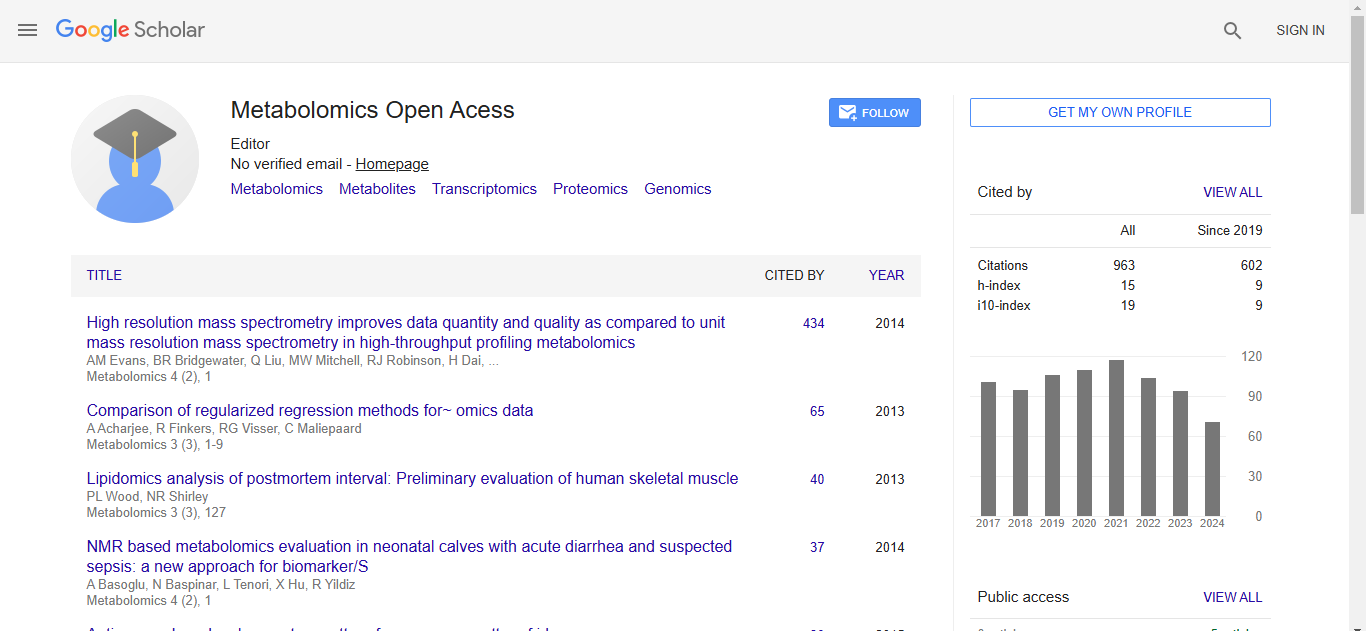
Metabolomics:Open Access received 895 citations as per Google Scholar report