Perspective - (2025) Volume 15, Issue 4
Received: 01-Dec-2025, Manuscript No. jpdbd-25-174988;
Editor assigned: 03-Dec-2025, Pre QC No. P-174988;
Reviewed: 17-Dec-2025, QC No. Q-174988;
Revised: 22-Dec-2025, Manuscript No. R-174988;
Published:
29-Dec-2025
, DOI: 10.37421/2153-0769.2025.15.435
Citation: Chen, Julia. ”Metabolomics: Assessing Environmental Health and Risk.” Metabolomics 15 (2025):435.
Copyright: © 2025 C. Julia This is an open-access article distributed under the terms of the Creative Commons Attribution License, which permits unrestricted use, distribution and reproduction in any medium, provided the original author and source are credited.
Environmental metabolomics offers a powerful lens into how our surroundings impact health. What this really means is, by looking at the small molecules in biological samples, we can connect environmental exposures to changes within living systems. This field isn't just theoretical; it's actively being applied to understand human health risks, evaluate toxicity, and even guide precision medicine, making it a key tool for spotting early biomarkers of disease or adverse effects [1].
When we talk about aquatic environments, environmental metabolomics provides crucial insights into how pollution affects marine and freshwater life. Here's the thing: it helps us identify specific metabolic changes in aquatic organisms exposed to contaminants, serving as a sensitive indicator of stress and toxicity. This information is vital for protecting our water systems and the diverse species that call them home, moving beyond simple pollutant detection to understanding biological impact [2].
Biodiversity conservation is a huge challenge, but environmental metabolomics is stepping up as a promising tool. By analyzing metabolic profiles, scientists can assess the health of ecosystems and individual species, identify environmental stressors before they cause irreversible damage, and even track the impact of conservation efforts. It's about getting a detailed biochemical snapshot of an organism's interaction with its habitat, helping us make smarter conservation choices [3].
Assessing the ecological risk of emerging contaminants is a critical task, and here's where environmental metabolomics truly shines. This approach allows researchers to understand the complex biological responses to novel pollutants, providing a more nuanced risk assessment than traditional methods. What this really means is we can better predict the long-term impacts of these contaminants on ecosystems, leading to more effective environmental management strategies [4].
Environmental metabolomics is a field constantly evolving, with new methods and trends emerging all the time. The focus here is on developing more sensitive and comprehensive analytical techniques to capture the full spectrum of metabolic changes induced by environmental factors. It's about refining our ability to measure and interpret these biochemical signals, pushing the boundaries of what we can understand about environmental interactions [5].
The journey from environmental metabolomics to precision environmental health is a significant one. What this really means is using detailed metabolic data to understand individual variability in response to environmental exposures. This isn't just about general population health; it's about tailoring environmental health advice and interventions based on a person's unique biological makeup and exposure history, leading to more targeted and effective preventative strategies [6].
For assessing health risks, integrating 'omics' technologies with environmental factors is key, and environmental metabolomics is at the heart of this. It helps us paint a comprehensive picture of how environmental exposures interact with our biology at a molecular level. This multi-faceted approach provides deeper insights into disease mechanisms and pathways, moving beyond single-factor analyses to understand complex environmental health challenges [7].
Metabolomics has become an indispensable tool in environmental risk assessment and toxicology. It lets us delve into the specific biochemical changes that occur when organisms are exposed to toxins. What this really means is we can identify new biomarkers of exposure and effect, clarify toxic mechanisms, and evaluate the overall health impacts of various pollutants, offering a more sensitive and predictive approach to environmental protection [8].
Bridging environmental health and exposure science is a crucial role for environmental metabolomics. It helps us understand the true extent and impact of environmental exposures by mapping them to specific metabolic changes. This connection is vital for identifying at-risk populations, understanding disease etiology tied to environment, and developing targeted interventions, ultimately strengthening our public health responses [9].
For ecological risk assessment, environmental metabolomics is really advancing our capabilities. It provides a granular view of how ecosystems respond to stressors, offering early warning signals and a deeper understanding of toxicity mechanisms. This means we're moving towards more accurate and predictive assessments, which is fundamental for effective environmental policy and management, helping preserve ecological integrity [10].
Environmental metabolomics provides a powerful way to see how our surroundings affect health. Looking at small molecules in biological samples lets us link environmental exposures directly to changes within living systems. This field isn't just theory; it's being used to understand human health risks, evaluate toxicity, and even guide precision medicine, making it a key tool for spotting early biomarkers of disease or adverse effects [1].
When considering aquatic environments, environmental metabolomics gives us crucial insights into pollution's effects on marine and freshwater life. It helps pinpoint specific metabolic changes in aquatic organisms exposed to contaminants, acting as a sensitive indicator of stress and toxicity. This information is vital for protecting our water systems and their diverse species, moving beyond simple pollutant detection to understanding biological impact [2]. Biodiversity conservation, a significant challenge, is also benefiting from environmental metabolomics. Analyzing metabolic profiles helps scientists assess ecosystem and species health, identify environmental stressors before damage is irreversible, and track conservation efforts. It's all about getting a detailed biochemical snapshot of an organism's interaction with its habitat, supporting smarter conservation choices [3].
Assessing the ecological risk of emerging contaminants is a critical task, and environmental metabolomics truly shines here. This method allows researchers to grasp complex biological responses to new pollutants, offering a more nuanced risk assessment than older approaches. What this really means is we can better predict the long-term impacts of these contaminants on ecosystems, leading to more effective environmental management strategies [4]. Metabolomics has become an essential tool in broader environmental risk assessment and toxicology. It lets us explore specific biochemical changes that happen when organisms encounter toxins. This means we can identify new biomarkers of exposure and effect, clarify toxic mechanisms, and evaluate the overall health impacts of various pollutants, giving us a more sensitive and predictive way to protect the environment [8]. For ecological risk assessment, environmental metabolomics is really advancing our capabilities. It provides a granular view of how ecosystems respond to stressors, offering early warning signals and a deeper understanding of toxicity mechanisms. This allows for more accurate and predictive assessments, fundamental for effective environmental policy and management, helping preserve ecological integrity [10].
Environmental metabolomics is a field constantly evolving, with new methods and trends emerging all the time. The focus here is on developing more sensitive and comprehensive analytical techniques to capture the full spectrum of metabolic changes driven by environmental factors. It's about refining our ability to measure and interpret these biochemical signals, pushing the boundaries of what we can understand about environmental interactions [5].
The journey from environmental metabolomics to precision environmental health is a significant one. What this really means is using detailed metabolic data to understand how individuals respond differently to environmental exposures. This isn't just about general population health; it's about tailoring environmental health advice and interventions based on a person's unique biological makeup and exposure history, leading to more targeted and effective preventative strategies [6]. For assessing health risks, integrating 'omics' technologies with environmental factors is key, and environmental metabolomics sits at the heart of this. It helps paint a comprehensive picture of how environmental exposures interact with our biology at a molecular level. This multi-faceted approach provides deeper insights into disease mechanisms and pathways, moving beyond single-factor analyses to understand complex environmental health challenges [7]. Bridging environmental health and exposure science is another crucial role for environmental metabolomics. It helps us understand the true extent and impact of environmental exposures by mapping them to specific metabolic changes. This connection is vital for identifying at-risk populations, understanding disease etiology linked to the environment, and developing targeted interventions, ultimately strengthening our public health responses [9].
Environmental metabolomics provides a powerful lens into how our surroundings impact health, connecting environmental exposures to changes within living systems by examining small molecules in biological samples. This field is actively applied to understand human health risks, evaluate toxicity, and guide precision medicine, serving as a key tool for spotting early biomarkers of disease or adverse effects [1]. Beyond human health, it offers crucial insights into aquatic environments by identifying specific metabolic changes in organisms exposed to contaminants, which is vital for protecting water systems and diverse species [2]. It also steps up as a promising tool for biodiversity conservation, assessing ecosystem health and identifying environmental stressors through metabolic profiles [3]. Environmental metabolomics truly shines in assessing the ecological risk of emerging contaminants, offering nuanced biological responses and predicting long-term impacts for effective environmental management [4]. The field constantly evolves, focusing on developing more sensitive analytical techniques to capture the full spectrum of metabolic changes [5]. This journey extends to precision environmental health, using detailed metabolic data for tailored interventions based on individual biological makeup [6]. Integrating 'omics' technologies, it paints a comprehensive picture of environmental exposure interactions with biology for health risk assessment [7]. It's an indispensable tool in environmental risk assessment and toxicology, clarifying toxic mechanisms and evaluating pollutant impacts [8]. Ultimately, environmental metabolomics bridges environmental health and exposure science, identifying at-risk populations and strengthening public health responses by mapping environmental exposures to metabolic changes [9]. It also advances ecological risk assessment, providing a granular view of ecosystem responses to stressors and early warning signals for environmental policy [10].
None
None
Shuying M, Huaiyong L, Mingyang Y. "Environmental metabolomics: applications in human health, toxicology, and precision medicine".Metabolites 13 (2023):63.
Indexed at, Google Scholar, Crossref
Meng S, Shuo H, Peng Z. "Environmental metabolomics in aquatic toxicology: Current applications and future perspectives".TrAC Trends Anal Chem 157 (2022):116743.
Indexed at, Google Scholar, Crossref
Michal H, Miroslav L, Markéta K. "Environmental metabolomics: A promising tool for biodiversity conservation".Metabolites 12 (2022):1275.
Indexed at, Google Scholar, Crossref
Peng L, Yujuan L, Xi Z. "Advancements and applications of environmental metabolomics in assessing ecological risk of emerging contaminants".Environ Int 157 (2021):106852.
Indexed at, Google Scholar, Crossref
Byeonghwa K, Jinyoung G, Gwanghyeon K. "Environmental Metabolomics: Current Approaches and Emerging Trends".J Anal Sci Technol 11 (2020):16.
Indexed at, Google Scholar, Crossref
Patrick MR, Jeff L, Jeffrey DL. "From Environmental Metabolomics to Precision Environmental Health".Metabolites 10 (2020):147.
Indexed at, Google Scholar, Crossref
Xiao Z, Xiaoyan W, Jianbin W. "Environmental Metabolomics: Integrating Omics and Environmental Factors for Health Risk Assessment".Environ Pollut 337 (2023):122474.
Indexed at, Google Scholar, Crossref
Shuang W, Shuang W, Cheng Y. "Applications of metabolomics in environmental risk assessment and toxicology: A review".Chemosphere 307 (2022):135899.
Indexed at, Google Scholar, Crossref
Tianming Z, Zhizhong Z, Sihao J. "Environmental metabolomics: Bridging environmental health and exposure science".J Hazard Mater 406 (2021):124316.
Indexed at, Google Scholar, Crossref
Meng S, Peng Z, Chenghong D. "Advances in Environmental Metabolomics for Ecological Risk Assessment".Environ Sci Technol Lett 10 (2023):708-718.
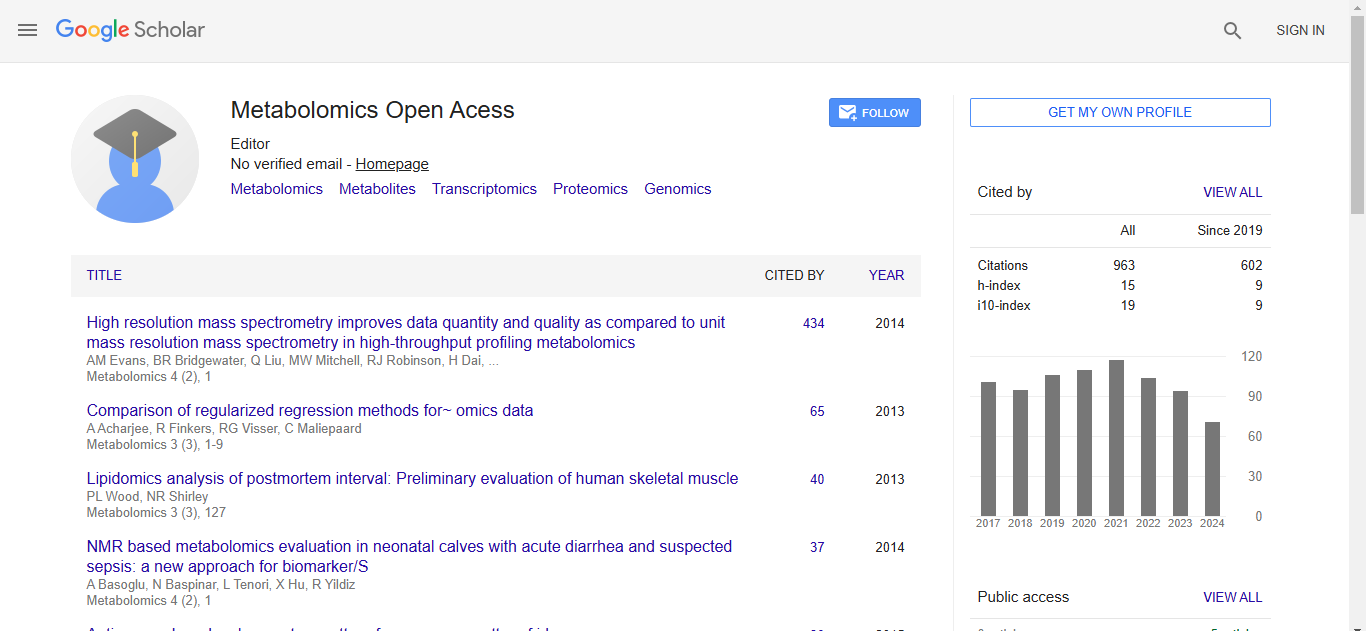
Metabolomics:Open Access received 895 citations as per Google Scholar report