Opinion - (2025) Volume 15, Issue 4
Received: 01-Dec-2025, Manuscript No. jpdbd-25-174986;
Editor assigned: 03-Dec-2025, Pre QC No. P-174986;
Reviewed: 17-Dec-2025, QC No. Q-174986;
Revised: 22-Dec-2025, Manuscript No. R-174986;
Published:
29-Dec-2025
, DOI: 10.37421/2153-0769.2025.15.433
Citation: Koroma, Selina. ”Metabolic Modeling: Bio-Innovation’s Indispensable Tool.” Metabolomics 15 (2025):433.
Copyright: © 2025 Koroma S. This is an open-access article distributed under the terms of the Creative Commons Attribution License, which permits unrestricted use, distribution and reproduction in any medium, provided the original author and source are credited.
The study of metabolic networks has profoundly transformed our understanding of complex biological systems, offering computational frameworks to decipher intricate biochemical reactions and their implications across various domains. These analytical and modeling approaches are now central to identifying critical pathways and metabolites that drive disease progression, developing novel therapeutic interventions, and optimizing biotechnological processes. From mapping disease-specific vulnerabilities to engineering microbial factories, metabolic network analysis stands as a cornerstone of modern systems biology. One powerful application involves pinpointing essential metabolic hubs within various human diseases. By mapping complex biochemical reactions, researchers have identified critical pathways and metabolites whose perturbations significantly impact disease progression, thus offering new targets for therapeutic intervention and diagnostic markers [1].
Building upon this, the reconstruction of genome-scale metabolic models (GEMs) provides a foundational methodology for comprehensively understanding human disease and metabolic processes. This approach involves detailing the entire set of biochemical reactions occurring within an organism, enabling predictions of metabolic phenotypes and the identification of therapeutic targets through computational simulations [2].
Similarly, constraint-based modeling is a vital technique in microbial metabolism, detailing steps from genome-scale model reconstruction to diverse applications. These models effectively predict microbial behavior, optimize bioproduction processes, and offer insights into complex host-microbe interactions, making them powerful tools for metabolic engineering [3].
In the realm of cancer research, metabolic pathway analysis proves to be an indispensable method for deciphering the unique metabolic shifts characteristic of malignancies. Identifying altered metabolic pathways reveals novel vulnerabilities in cancer cells, paving the way for targeted therapies that exploit these metabolic dependencies for more effective treatment strategies [4].
Central to many of these analyses is flux balance analysis (FBA), a cornerstone of metabolic network analysis, widely applied in metabolic engineering. FBA elucidates the theoretical foundations for optimizing microbial strains in producing biofuels, chemicals, and pharmaceuticals, highlighting its predictive power for metabolic interventions [5].
Developing robust computational methods remains crucial for the reconstruction and analysis of these intricate metabolic networks within systems biology. Various algorithms and tools are employed to build complex models and perform analyses like FBA, thereby enhancing our understanding of complex biological systems and informing biotechnological applications [6].
Beyond diagnosis and engineering, metabolic network modeling plays a significant role in accelerating drug discovery, particularly in the context of cancer metabolism. Computational models excel at identifying novel therapeutic targets by predicting vulnerabilities in cancer metabolic pathways, streamlining the drug development process and leading to more effective, targeted therapies [7].
While static models offer valuable insights, dynamic modeling approaches provide a more comprehensive understanding of metabolic networks by incorporating time-resolved data. These models offer deeper insights into metabolic regulation, adaptation, and transient behaviors, which static models often miss, highlighting their growing importance in understanding complex cellular responses and disease progression [8].
The application of metabolic modeling also extends to understanding complex ecological systems, such as gut microbiome interactions. These models are instrumental in dissecting the intricate metabolic exchanges between different microbial species and with the host, providing crucial insights into gut health, disease pathogenesis, and potential interventions through dietary or microbial modulation [9].
Looking to the future, the integration of machine learning techniques into metabolic engineering signifies a major advance. Machine Learning (ML) can significantly enhance metabolic network analysis by predicting optimal genetic modifications, identifying key enzymes, and accelerating strain design for producing desired compounds, ultimately improving the efficiency and success rate of biotechnological applications [10].
Collectively, these diverse approaches underscore the transformative impact of metabolic network analysis and modeling. They provide a comprehensive toolkit for understanding biological complexity, addressing critical health challenges, and driving innovation in biotechnology.
Metabolic network analysis and modeling represent powerful computational frameworks for understanding the complex web of biochemical reactions that define life. These approaches enable researchers to systematically investigate metabolism at a systems level, moving beyond individual reactions to understand emergent properties and regulatory mechanisms. The utility of these methods spans diverse biological contexts, from deciphering human disease mechanisms to engineering microorganisms for industrial applications.
A significant area of application is in human health, where metabolic network analysis helps identify critical metabolic hubs in various diseases [1]. By mapping complex biochemical reactions, researchers can pinpoint pathways and metabolites that, when disrupted, profoundly influence disease progression. This detailed understanding is instrumental in discovering novel therapeutic targets and developing robust diagnostic markers. Complementing this, genome-scale metabolic models (GEMs) provide a comprehensive platform for studying human diseases and metabolic processes. These models allow for the prediction of metabolic phenotypes under different conditions and are crucial for identifying potential therapeutic targets by simulating the effects of genetic or environmental perturbations [2]. This systematic reconstruction and analysis offer a deep dive into how human metabolism operates and dysregulates in pathological states.
The methodologies extend robustly into microbial metabolism, particularly through constraint-based modeling. This approach details the entire process from reconstructing genome-scale models to their varied applications [3]. Such models are indispensable for predicting microbial behavior, a crucial aspect for optimizing bioproduction processes. Moreover, they shed light on the intricate host-microbe interactions, which are vital for understanding microbiome-related health and disease. A core component often utilized in these models is flux balance analysis (FBA), which is foundational to metabolic network analysis and its applications in metabolic engineering [5]. FBA's predictive power allows scientists to optimize microbial strains for the efficient production of valuable compounds, including biofuels, chemicals, and pharmaceuticals, by directing metabolic flow towards desired products.
In oncology, metabolic pathway analysis has emerged as a critical tool for understanding the distinct metabolic reprogramming that characterizes cancer cells [4]. This analysis helps identify unique metabolic vulnerabilities in cancer, offering avenues for designing targeted therapies that specifically exploit these dependencies, potentially leading to more effective and less toxic treatments. The development of computational methods for metabolic network reconstruction and analysis is fundamental to these advancements across all fields. These methods encompass various algorithms and tools essential for building intricate models and conducting analyses like FBA, ultimately contributing to a deeper understanding of complex biological systems and informing biotechnological innovations [6]. The application of metabolic network modeling specifically in drug discovery, particularly for cancer metabolism, leverages these computational capabilities to predict novel therapeutic targets, thereby accelerating the drug development pipeline and fostering the creation of more precise, targeted therapies [7].
Beyond static representations, dynamic modeling approaches for metabolic networks are gaining prominence. These time-resolved models offer deeper insights into metabolic regulation, adaptation, and transient behaviors that static models often overlook [8]. By capturing the temporal dynamics of metabolic shifts, these models are increasingly important for understanding complex cellular responses and the progression of diseases. Furthermore, metabolic modeling is proving invaluable for dissecting the complex interactions within the gut microbiome [9]. These models help elucidate the metabolic exchanges between different microbial species and with the host, providing crucial insights into gut health, disease pathogenesis, and potential interventions through dietary or microbial modulation. Finally, the integration of cutting-edge machine learning techniques into metabolic engineering represents a significant leap forward. Machine Learning (ML) enhances metabolic network analysis by predicting optimal genetic modifications, identifying key enzymes, and accelerating strain design for producing desired compounds, thereby improving the efficiency and success rate of biotechnological applications [10]. This synthesis of computational power and biological insight is continuously expanding the frontiers of metabolic research and its practical applications.
Metabolic network analysis and modeling have become indispensable tools across biology and biotechnology. Researchers leverage these computational approaches to unravel complex biochemical interactions in diverse systems, from human diseases to microbial communities. For instance, metabolic network analysis pinpoints essential metabolic hubs in human diseases, identifying critical pathways that impact progression and offering new therapeutic targets and diagnostic markers. Genome-scale metabolic models (GEMs) are crucial for understanding human disease and metabolic processes, predicting phenotypes and identifying potential drug targets. Constraint-based modeling extends this utility to microbial metabolism, allowing predictions of microbial behavior, optimization of bioproduction, and insights into host-microbe interactions. Specifically in cancer research, metabolic pathway analysis serves as a comprehensive tool to understand altered metabolism, revealing vulnerabilities in cancer cells that can be exploited for targeted therapies. Flux balance analysis (FBA), a cornerstone technique, is widely applied in metabolic engineering to optimize microbial strains for producing valuable compounds like biofuels, chemicals, and pharmaceuticals. The field also encompasses the development of computational methods for reconstructing and analyzing these intricate networks, which are fundamental to systems biology. Recent advancements include dynamic modeling approaches that offer time-resolved insights into metabolic regulation and adaptation, overcoming limitations of static models. Moreover, metabolic modeling is increasingly applied to understand gut microbiome interactions, shedding light on gut health and disease pathogenesis. The integration of machine learning techniques further enhances metabolic engineering by predicting optimal genetic modifications and accelerating strain design, promising improved efficiency and success rates in biotechnological applications. This collective body of work underscores the power of metabolic modeling in accelerating scientific discovery and therapeutic development.
None
None
Mengqi L, Jinlong L, Qirui L. "Metabolic network analysis reveals critical hubs in human disease".Comput Struct Biotechnol J 21 (2023):2289-2298.
Indexed at, Google Scholar, Crossref
Nao M, Daniel RM, Joao APC. "Reconstructing genome-scale metabolic models for studying disease and metabolism".Curr Opin Syst Biol 30 (2022):100418.
Indexed at, Google Scholar, Crossref
Ali E, Farbod K, Arian A. "Constraint-based modeling of microbial metabolism: from reconstruction to applications".Front Microbiol 12 (2021):668026.
Indexed at, Google Scholar, Crossref
Kshitiz S, Swati P, Debashis S. "Metabolic Pathway Analysis: A Comprehensive Tool for Understanding Cancer Metabolism".Front Oncol 10 (2020):588264.
Indexed at, Google Scholar, Crossref
Yuancheng C, Xinru L, Jing H. "A review of flux balance analysis and its applications in metabolic engineering".Synth Syst Biotechnol 9 (2023):100727.
Indexed at, Google Scholar, Crossref
Arindam S, Saurabh SS, Prashant KS. "Computational Methods for Metabolic Network Reconstruction and Analysis in Systems Biology".Methods Mol Biol 1898 (2019):1-17.
Indexed at, Google Scholar, Crossref
Yu-Hsiang L, Ting-Fu H, Chun-Chao L. "Metabolic Network Modeling and Drug Discovery: A Focus on Cancer Metabolism".Int J Mol Sci 23 (2022):7665.
Indexed at, Google Scholar, Crossref
Daniel AS, Daniel W, Wolfgang M. "Dynamic modeling of metabolic networks: Current status and future directions".Curr Opin Syst Biol 28 (2021):100373.
Indexed at, Google Scholar, Crossref
Md. IK, Sayantan S, Sudipta B. "Metabolic modeling of gut microbiome interactions: An overview".Comput Struct Biotechnol J 21 (2023):5462-5473.
Indexed at, Google Scholar, Crossref
Yanan S, Rui X, Jing Z. "Machine learning in metabolic engineering: Recent advances and future directions".Synth Syst Biotechnol 5 (2020):221-229.
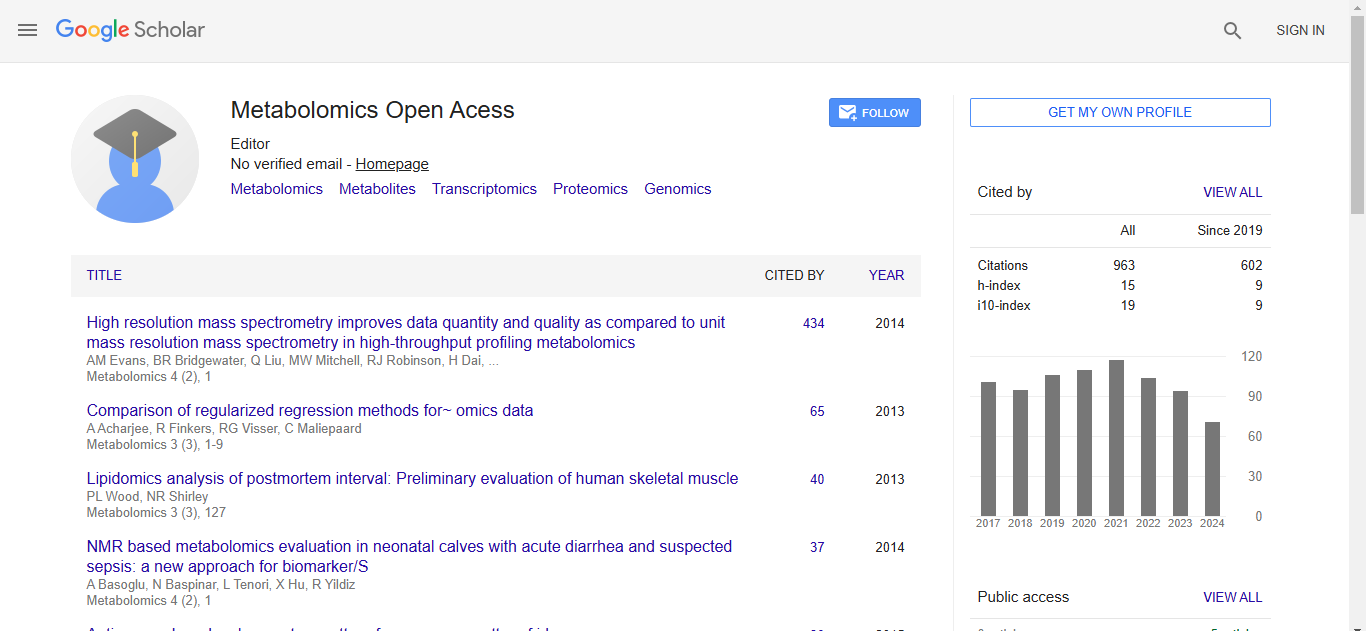
Metabolomics:Open Access received 895 citations as per Google Scholar report