Opinion - (2025) Volume 14, Issue 2
Received: 01-Jun-2025, Manuscript No. jms-25-172631;
Editor assigned: 03-Jun-2025, Pre QC No. P-172631;
Reviewed: 17-Jun-2025, QC No. Q-172631;
Revised: 23-Jun-2025, Manuscript No. R-172631;
Published:
30-Jun-2025
, DOI: 10.37421/2167-0943.2024.13.404
Citation: Radin, Mikhail. ”Metabolic Health: Factors, Disease, and Insights.” J Metabolic Synd 14 (2025):404.
Copyright: © 2025 Radin M. This is an open-access article distributed under the terms of the Creative Commons Attribution License, which permits unrestricted use, distribution
and reproduction in any medium, provided the original author and source are credited
The gut microbiome plays a crucial role in the development and progression of metabolic syndrome, influencing host metabolism through various mechanisms. Recent research highlights how dysbiosis contributes to insulin resistance, obesity, and other metabolic derangements, suggesting that targeting the microbiome could offer novel therapeutic strategies[1].
Cancer cells often exhibit significant metabolic reprogramming, shifting from oxidative phosphorylation to glycolysis to support rapid proliferation. Understanding these altered metabolic pathways, such as enhanced glucose uptake and lactate production, opens avenues for developing targeted therapies that exploit cancer-specific vulnerabilities[2].
Mitochondrial dynamics, including fusion and fission, along with metabolic adaptations, are profoundly altered during aging and contribute to age-related pathologies. Maintaining mitochondrial health and metabolic flexibility is critical for healthy aging, and therapeutic interventions targeting these processes show promise[3].
Advances in single-cell metabolomics and fluxomics are revolutionizing our understanding of cellular metabolism by enabling the analysis of metabolic processes at unprecedented resolution. These technologies reveal heterogeneity in metabolic states within cell populations, offering new insights into disease mechanisms and therapeutic targets[4].
Disruption of circadian rhythms, often due to modern lifestyles, significantly impacts metabolic health, leading to conditions like obesity, diabetes, and metabolic syndrome. The intricate interplay between the circadian clock and metabolic pathways highlights the importance of maintaining proper sleep-wake cycles for optimal metabolic function[5].
Nutrient sensing pathways, such as mTOR, AMPK, and sirtuins, are central to metabolic regulation, integrating signals from nutrient availability with cellular growth and energy homeostasis. Dysregulation of these pathways contributes significantly to metabolic diseases, making them key targets for therapeutic intervention[6].
Lipid metabolism plays a central role in the pathogenesis of various metabolic diseases, including obesity, type 2 diabetes, and non-alcoholic fatty liver disease. Dysregulation in lipid synthesis, storage, and catabolism leads to lipotoxicity and contributes to systemic metabolic dysfunction, offering therapeutic avenues through lipid-modulating interventions[7].
Amino acid metabolism is intricately linked to overall metabolic health, influencing insulin sensitivity, energy expenditure, and fat deposition. Dysregulation in branched-chain amino acid metabolism, for instance, is increasingly recognized as a hallmark of insulin resistance and type 2 diabetes, providing potential biomarkers and therapeutic targets[8].
Epigenetic mechanisms, including DNA methylation, histone modification, and non-coding RNAs, play a significant role in the etiology and progression of metabolic diseases. Environmental factors and lifestyle choices can modify these epigenetic marks, highlighting the potential for epigenetic therapies to prevent and treat metabolic disorders[9].
Metabolic flexibility, the ability of an organism to switch between different fuel sources (e.g., glucose and fatty acids) in response to nutrient availability or energy demands, is critical for maintaining metabolic health. Regular exercise significantly enhances metabolic flexibility, offering a powerful strategy to prevent and manage metabolic disorders[10].
Metabolic health is a complex interplay of various biological processes and external factors. The gut microbiome, for example, is increasingly recognized for its crucial role in the development and progression of metabolic syndrome. Dysbiosis, an imbalance in gut microbiota, directly contributes to insulin resistance, obesity, and other metabolic derangements, underscoring the potential for microbiome-targeted therapies [1]. Beyond systemic conditions, cellular metabolism is also a key player in disease. Cancer cells demonstrate significant metabolic reprogramming, shifting primarily to glycolysis to fuel rapid proliferation, a vulnerability that novel targeted therapies aim to exploit [2].
Intracellular mechanisms are central to metabolic regulation and disease. Mitochondrial dynamics, involving processes like fusion and fission, are profoundly altered during aging and contribute directly to age-related pathologies. Maintaining mitochondrial health and metabolic flexibility is vital for healthy aging, with therapeutic strategies showing promise in this area [3]. Similarly, nutrient sensing pathways such as mTOR, AMPK, and sirtuins are fundamental to metabolic regulation, integrating signals from nutrient availability with cellular growth and energy homeostasis. Dysregulation here is a common thread in metabolic diseases, marking these pathways as critical therapeutic targets [6].
Specific metabolic pathways like lipid and amino acid metabolism are deeply implicated in metabolic dysfunction. Dysregulation in lipid synthesis, storage, and catabolism contributes significantly to conditions like obesity, type 2 diabetes, and non-alcoholic fatty liver disease, leading to lipotoxicity and systemic metabolic dysfunction. This makes lipid-modulating interventions a promising therapeutic avenue [7]. Furthermore, amino acid metabolism directly impacts insulin sensitivity, energy expenditure, and fat deposition. Aberrations, particularly in branched-chain amino acid metabolism, are hallmarks of insulin resistance and type 2 diabetes, offering potential as biomarkers and therapeutic targets [8].
External and systemic factors also profoundly influence metabolic health. Circadian rhythms, often disrupted by modern lifestyles, significantly impact metabolic health, contributing to obesity, diabetes, and metabolic syndrome. Understanding the intricate interplay between the circadian clock and metabolic pathways highlights the importance of maintaining proper sleep-wake cycles for optimal metabolic function [5]. Epigenetic mechanisms, encompassing DNA methylation, histone modification, and non-coding RNAs, are significant in the etiology and progression of metabolic diseases. Environmental factors and lifestyle choices can modify these epigenetic marks, suggesting that epigenetic therapies could prevent and treat metabolic disorders [9].
Technological advancements and lifestyle interventions are shaping new approaches to metabolic health. Single-cell metabolomics and fluxomics are revolutionizing our understanding by enabling high-resolution analysis of metabolic processes. These technologies reveal heterogeneity in metabolic states within cell populations, providing new insights into disease mechanisms and identifying therapeutic targets [4]. Finally, metabolic flexibilityâ??the ability to adapt fuel sources based on nutrient availabilityâ??is crucial for maintaining metabolic health. Regular exercise is a powerful strategy, significantly enhancing this flexibility and helping to prevent and manage metabolic disorders [10].
Metabolic health is a complex field influenced by diverse biological and environmental factors, playing a critical role in various diseases. Research shows the gut microbiome's impact on metabolic syndrome, with dysbiosis contributing to insulin resistance and obesity. Cancer cells exhibit unique metabolic reprogramming, highlighting targets for novel therapies. Aging is linked to altered mitochondrial dynamics and metabolic adaptations, emphasizing the importance of mitochondrial health for longevity. Advanced single-cell metabolomics and fluxomics are providing unprecedented insights into cellular metabolism, revealing heterogeneity in metabolic states and potential therapeutic avenues. Disruptions in circadian rhythms from modern lifestyles profoundly affect metabolic health, leading to conditions like obesity and diabetes. Key nutrient sensing pathways such as mTOR, AMPK, and sirtuins are central to metabolic regulation, with their dysregulation contributing to various diseases. Lipid and amino acid metabolism are critical in metabolic disease pathogenesis, with dysregulation leading to conditions like non-alcoholic fatty liver disease and insulin resistance. Epigenetic mechanisms are also significant in metabolic diseases, showing how lifestyle choices can impact gene expression. Finally, maintaining metabolic flexibility, the body's ability to adapt fuel sources, is crucial, and regular exercise is a powerful strategy to enhance it, preventing and managing metabolic disorders.
None
None
Indexed at, Google Scholar, Crossref
Indexed at, Google Scholar, Crossref
Indexed at, Google Scholar, Crossref
Indexed at, Google Scholar, Crossref
Indexed at, Google Scholar, Crossref
Indexed at, Google Scholar, Crossref
Indexed at, Google Scholar, Crossref
Indexed at, Google Scholar, Crossref
Indexed at, Google Scholar, Crossref
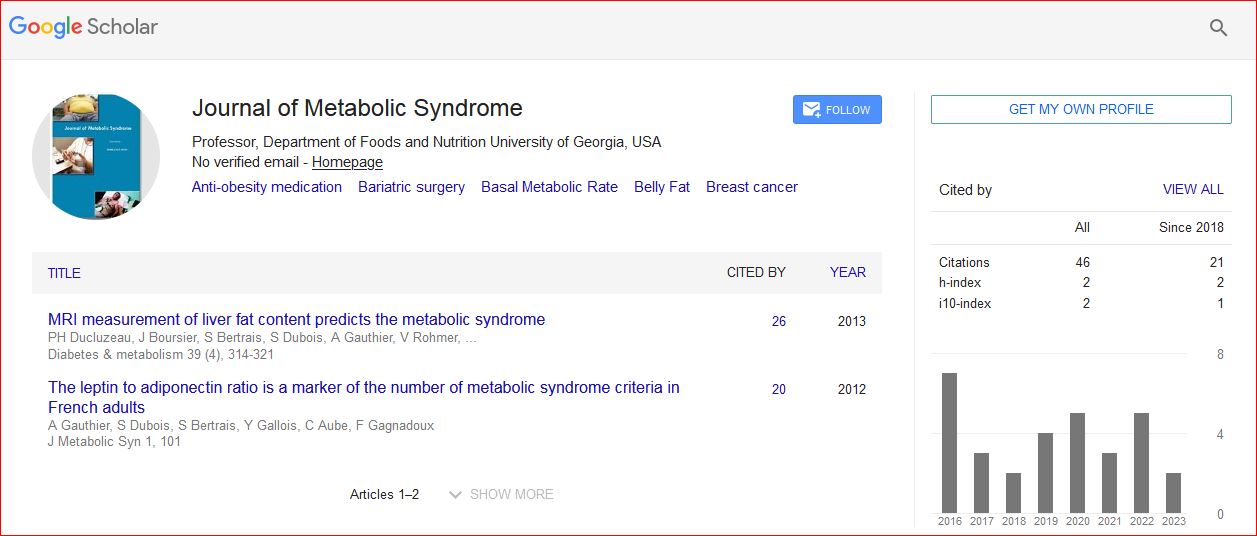
Journal of Metabolic Syndrome received 48 citations as per Google Scholar report