Opinion - (127) Volume 11, Issue 2
Received: 31-Mar-2025, Manuscript No. cdp-25-165839;
Editor assigned: 02-Apr-2025, Pre QC No. P-165839;
Reviewed: 16-Apr-2025, QC No. Q-165839;
Revised: 24-Apr-2025, Manuscript No. R-165839;
Published:
30-Apr-2025
, DOI: 10.37421/2572-0791.2025.11.169
Citation: Moyano, Ruimin. “Memory Consolidation and Emotional Processing During Psychedelic Integration.” Clin Depress 11 (2025): 169.
Copyright: © 2025 Moyano R. This is an open-access article distributed under the terms of the Creative Commons Attribution License, which permits unrestricted use, distribution and reproduction in any medium, provided the original author and source are credited.
The resurgence of interest in psychedelics as therapeutic agents has revitalized research into the mechanisms by which these substances catalyze enduring psychological change. While much attention has been directed toward the acute effects of compounds such as psilocybin, LSD, and MDMAâ??ranging from ego dissolution to mystical-type experiencesâ??the period following the psychedelic session, known as integration, is increasingly recognized as equally critical to the therapeutic process. Integration involves making sense of and incorporating the insights, emotions, and experiences that arise during the altered state into daily life. A central, yet often underexplored, component of this process is how psychedelic experiences interact with the mechanisms of memory consolidation and emotional processing. Understanding how these processes are engaged during integration provides valuable insight into why psychedelics may facilitate long-term changes in behavior, cognition, and emotional regulation [1].
Psychedelic states are known to evoke highly salient and emotionally charged experiences that often resemble vivid memories or powerful symbolic narratives. These experiences may involve re-experiencing past trauma, encountering archetypal imagery, or gaining insight into relational patterns and self-concepts. The emotional intensity and novelty of these events contribute to their memorability. Research in cognitive neuroscience has long shown that emotionally significant experiences are preferentially encoded and consolidated in long-term memory, a process mediated by the interaction between the amygdala, hippocampus, and medial prefrontal cortex. Psychedelics appear to amplify this interaction by increasing neural plasticity, enhancing emotional responsiveness, and disrupting default patterns of thought, thereby opening a unique window for therapeutic memory reconsolidation [2].
During the acute psychedelic experience, the brain enters a state characterized by increased entropy and network flexibility. Functional neuroimaging studies have consistently shown a decrease in the coherence of the default mode network, along with increased global connectivity and reduced top-down regulatory control [3]. These shifts are thought to allow for the emergence of novel associations between disparate memories, emotions, and thoughts. From a neurobiological perspective, this disintegration of habitual neural hierarchies creates conditions conducive to memory updating. Individuals often report spontaneous re-experiencing of autobiographical eventsâ??sometimes with altered emotional tone or newfound understanding. In this state, old memories can be revisited and reframed with reduced psychological defensiveness, offering a powerful therapeutic opportunity to recontextualize trauma or reprocess unresolved emotional material [4].
The subsequent period of integration is when these reorganized memory traces are stabilizedâ??or, conversely, when their therapeutic potential may be lost if not adequately supported. Memory consolidation is not a passive process but an active re-encoding that occurs during periods of reflection, sleep, and emotionally salient recall. Following a psychedelic session, individuals are often in a neurobiologically sensitive period marked by heightened emotional salience, increased brain-derived neurotrophic factor (BDNF) expression, and synaptic remodeling. These processes collectively support the stabilization of new learning and adaptive emotional associations. In this context, therapeutic integration sessions function as a scaffold to guide the direction of consolidation, helping individuals connect the insights gained during the session with real-life challenges and goals [5].
In conclusion, memory consolidation and emotional processing are central to the enduring therapeutic effects of psychedelics, and the integration period plays a vital role in facilitating these processes. Psychedelics may unlock a neurobiological window in which emotionally charged memories are reactivated and rendered malleable, allowing for cognitive and emotional restructuring. The effectiveness of this transformation, however, depends heavily on the quality of the integration process. Through skilled therapeutic support, embodied practices, and intentional reflection, the experiences catalyzed during the psychedelic state can be meaningfully consolidated into adaptive narratives, emotional healing, and sustainable life change. As the field of psychedelic therapy continues to mature, developing evidence-based integration models that honor the neurobiological and psychological complexity of this process will be essential for maximizing its transformative potential.
None.
None.
Google Scholar Cross Ref Indexed at
Google Scholar Cross Ref Indexed at
Google Scholar Cross Ref Indexed at
Google Scholar Cross Ref Indexed at
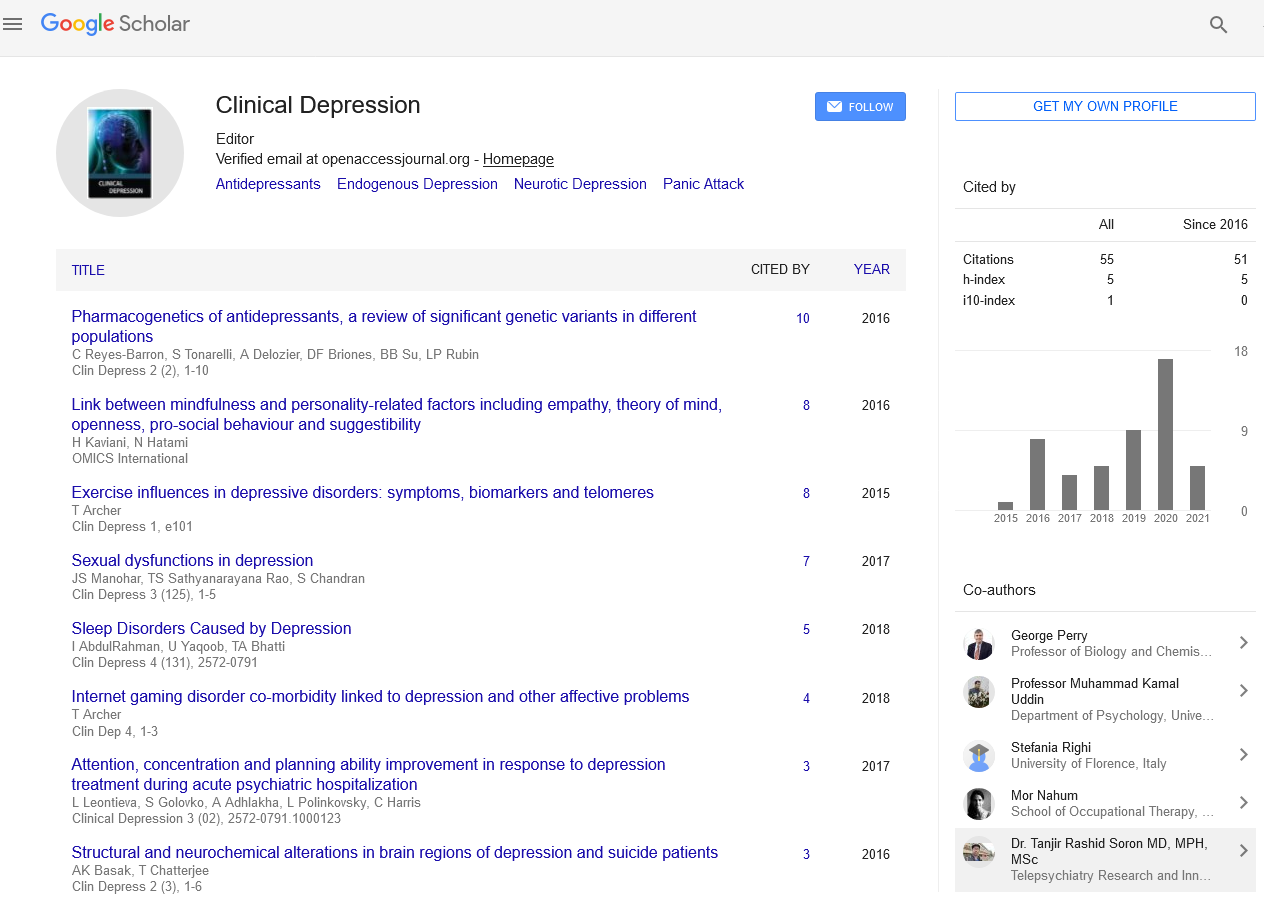
Clinical Depression received 89 citations as per Google Scholar report