Opinion - (2025) Volume 15, Issue 6
Received: 01-Dec-2025, Manuscript No. mccr-25-178200;
Editor assigned: 03-Dec-2025, Pre QC No. P-178200;
Reviewed: 17-Dec-2025, QC No. Q-178200;
Revised: 22-Dec-2025, Manuscript No. R-178200;
Published:
29-Dec-2025
, DOI: 10.37421/2161-0444.2025.15.812
Citation: Whitmore, James L.. ”Medicinal Chemistry: Pillars of Anticancer Drug Discovery.” Med Chem 15 (2025):812.
Copyright: © 2025 Whitmore L. James This is an open-access article distributed under the terms of the Creative Commons Attribution License, which permits unrestricted use, distribution and reproduction in any medium, provided the original author and source are credited.
The development of novel anticancer drugs represents a critical and evolving area within pharmaceutical research, with medicinal chemistry serving as a cornerstone in this endeavor. This discipline focuses on the design, synthesis, and optimization of molecules intended to interact with specific biological targets implicated in cancer pathogenesis. Understanding the intricate biology of various cancers is paramount to identifying and validating these targets, which then guides the application of sophisticated synthetic and analytical methodologies for creating and refining potential drug candidates. Current research trends in anticancer drug discovery are actively exploring diverse strategies to combat the complexities of cancer, including overcoming inherent or acquired drug resistance and ultimately improving patient prognoses. A significant avenue of investigation involves the development of inhibitors that selectively target crucial signaling pathways, such as those mediated by kinases, which are frequently dysregulated in cancer cells. These kinase inhibitors have proven to be transformative in cancer therapy, and ongoing efforts are dedicated to enhancing their selectivity, minimizing adverse effects due to off-target interactions, and addressing emerging resistance mechanisms through advanced drug design paradigms like structure-based and fragment-based approaches [2].
Beyond directly inhibiting key proteins, an innovative class of therapeutic agents known as proteolysis-targeting chimeras (PROTACs) has emerged, offering a revolutionary method for eliminating cancer-causing proteins. PROTACs function by leveraging the cell's endogenous protein degradation machinery, the ubiquitin-proteasome system, to selectively target and degrade oncoproteins that were previously considered undruggable. The success of PROTAC technology hinges on meticulous medicinal chemistry efforts in designing effective linker components and appropriate warhead functionalities to facilitate efficient protein degradation [3].
The synergy between medicinal chemistry and the burgeoning field of cancer immunotherapy is also indispensable for developing next-generation treatments. While established modalities like monoclonal antibodies and immune checkpoint inhibitors have revolutionized cancer care, medicinal chemistry plays a vital role in designing small molecules that can modulate the tumor microenvironment and enhance anti-tumor immunity. This includes the development of agents that suppress immunosuppressive cytokines or activate immune cells, thereby creating a more favorable environment for immune-mediated tumor eradication [4].
Drug resistance remains a formidable challenge in the successful treatment of cancer, necessitating continuous innovation from medicinal chemists. Strategies to overcome resistance encompass the design of next-generation inhibitors capable of circumventing resistance-conferring mutations, the development of combination therapies that simultaneously target multiple oncogenic pathways, and the creation of prodrugs engineered for selective activation within tumor cells. These multifaceted approaches aim to restore drug sensitivity and prolong therapeutic efficacy [5].
Furthermore, the tumor microenvironment (TME) is recognized as a complex ecosystem that profoundly influences cancer progression and response to therapy. Medicinal chemistry is actively engaged in developing agents that can effectively modulate the TME. This includes designing drugs that inhibit tumor angiogenesis, reprogram immunosuppressive cells within the microenvironment, or disrupt the extracellular matrix, all with the goal of enhancing the effectiveness of other anticancer treatments [6].
Fragment-based drug discovery (FBDD) stands out as a powerful and efficient technique in medicinal chemistry for identifying novel starting points for anticancer drug development. By screening libraries of small molecular fragments, FBDD can effectively explore vast chemical space and generate low-molecular-weight scaffolds that serve as excellent foundations for subsequent elaboration into potent and selective anticancer agents [7].
Complementing FBDD, structure-based drug design (SBDD) is an indispensable tool in contemporary anticancer drug development. By utilizing detailed three-dimensional structural information of target proteins, medicinal chemists can rationally design molecules with precisely engineered high affinity and specificity for their intended targets. This rational approach leads to the development of therapies that are not only more effective but also possess improved safety profiles [8].
A sophisticated application of medicinal chemistry in oncology is the development of antibody-drug conjugates (ADCs). This approach skillfully integrates the targeting capabilities of antibodies with the potent cytotoxic activity of small molecules. The design of ADCs requires careful consideration of highly potent payloads, stable and cleavable linker chemistries, and the precise conjugation of these components to the antibody to ensure targeted delivery and minimize systemic toxicity [9].
The integration of artificial intelligence (AI) and machine learning into medicinal chemistry workflows is rapidly transforming anticancer drug discovery. These advanced computational technologies accelerate the identification of promising hit compounds, enable accurate prediction of pharmacokinetic properties, and facilitate the optimization of lead compounds, thereby significantly streamlining the entire drug development pipeline [10].
The collaborative efforts across these diverse medicinal chemistry strategies underscore a dynamic and innovative landscape aimed at developing more effective and safer anticancer therapies. By continually pushing the boundaries of molecular design and synthetic innovation, medicinal chemists are at the forefront of addressing the persistent challenges in cancer treatment. The ongoing evolution of these approaches holds significant promise for improving outcomes for cancer patients worldwide [1].
The development of novel anticancer drugs is a sophisticated process where medicinal chemistry plays a central role in the rational design of molecules targeting specific cancer pathways. This involves a deep understanding of cancer biology, the identification of druggable targets, and the application of advanced synthetic and analytical techniques to create and refine drug candidates. Modern advancements are focused on strategies such as kinase inhibition, targeted protein degradation, and immunotherapy to overcome resistance and improve patient outcomes [1].
Small molecule kinase inhibitors have been instrumental in revolutionizing cancer therapy. Medicinal chemists are continually working to enhance the selectivity of these agents, minimize off-target toxicities, and address resistance mechanisms. Structure-based drug design and fragment-based approaches are key methodologies employed for the identification and optimization of potent and selective inhibitors of oncogenic kinases [2].
Targeted protein degradation, particularly through the use of proteolysis-targeting chimeras (PROTACs), represents a groundbreaking approach in anticancer drug development. These molecules exploit the cell's natural degradation machinery to eliminate specific oncoproteins, providing a means to target proteins previously considered undruggable. Medicinal chemistry is essential for the design of effective linker chemistries and warheads required for successful PROTAC development [3].
The intersection of medicinal chemistry and immunology is critical for the advancement of cancer immunotherapies. While antibodies and checkpoint inhibitors are well-established, medicinal chemistry also contributes to the design of small molecules that modulate immune responses within the tumor microenvironment, such as inhibitors of immunosuppressive cytokines or activators of immune cells [4].
Overcoming drug resistance remains a significant hurdle in oncology. Medicinal chemistry strategies to combat resistance include the design of next-generation inhibitors that bypass resistance mutations, the development of combination therapies targeting distinct pathways, and the creation of prodrugs for selective tumor activation [5].
The tumor microenvironment (TME) is a complex system influencing cancer progression and therapeutic response. Medicinal chemistry efforts are focused on developing drugs that modulate the TME, including agents that inhibit tumor angiogenesis, reprogram immunosuppressive cells, or disrupt the extracellular matrix, thereby enhancing the efficacy of other anticancer treatments [6].
Fragment-based drug discovery (FBDD) is a powerful technique in medicinal chemistry for identifying novel starting points for drug development. By screening small molecular fragments, FBDD efficiently explores chemical space and yields low-molecular-weight scaffolds that can be elaborated into potent anticancer agents [7].
Structure-based drug design (SBDD) is indispensable in modern anticancer drug development. By leveraging detailed three-dimensional structures of target proteins, medicinal chemists can rationally design molecules with high affinity and specificity, leading to more effective and safer therapies [8].
The development of antibody-drug conjugates (ADCs) exemplifies a sophisticated medicinal chemistry approach to deliver potent cytotoxic agents specifically to cancer cells. This involves designing highly potent payloads, stable linker chemistries, and ensuring proper conjugation to the antibody for targeted delivery [9].
Artificial intelligence (AI) and machine learning are increasingly integrated into medicinal chemistry workflows for anticancer drug discovery. These technologies accelerate hit identification, predict pharmacokinetic properties, and optimize lead compounds, streamlining the drug development process [10].
Medicinal chemistry is central to anticancer drug discovery, employing strategies like kinase inhibition, targeted protein degradation using PROTACs, and modulation of the tumor microenvironment. Overcoming drug resistance is a key focus, addressed through next-generation inhibitors and combination therapies. Advanced techniques such as fragment-based drug discovery and structure-based drug design are crucial for identifying and optimizing drug candidates. Antibody-drug conjugates represent a sophisticated delivery method, while artificial intelligence is accelerating the entire drug development pipeline. These diverse approaches collectively aim to create more effective and safer cancer therapies.
None
None
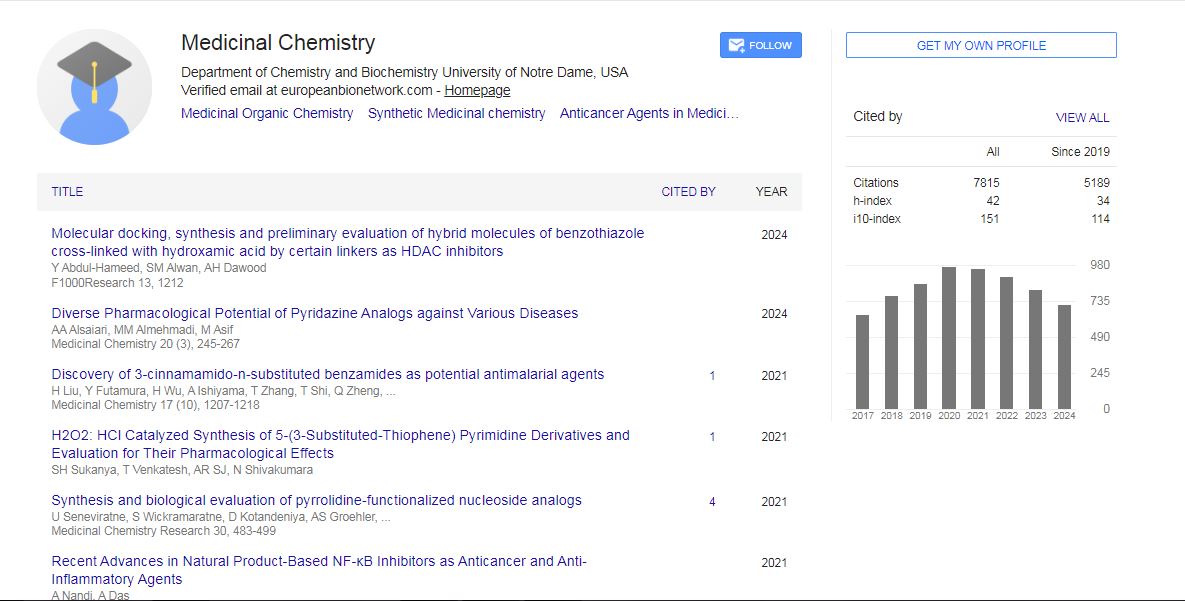
Medicinal Chemistry received 6627 citations as per Google Scholar report