Short Communication - (2025) Volume 7, Issue 3
Received: 01-Aug-2025, Manuscript No. jspd-25-174863;
Editor assigned: 04-Aug-2025, Pre QC No. P-174863;
Reviewed: 18-Aug-2025, QC No. Q-174863;
Revised: 22-Aug-2025, Manuscript No. R-174863;
Published:
29-Aug-2025
, DOI: 10.37421/2684-4575.2025.6.030
Citation: Farzan, Omid. ”Medical Technology Revolution: Diagnostics to Personalized Care.” J Surg Path Diag 07 (2025):30.
Copyright: © 2025 Farzan O. This is an open-access article distributed under the terms of the Creative Commons Attribution License, which permits unrestricted use, distribution and reproduction in any medium, provided the original author and source are credited.
The medical landscape is undergoing a profound transformation, driven by an array of sophisticated technologies redefining diagnostic capabilities and therapeutic approaches. These innovations are paving the way for more precise, less invasive, and personalized patient care. Liquid biopsy, for instance, has emerged as a cornerstone for non-invasive cancer detection and monitoring. It leverages circulating tumor DNA (ctDNA) and exosomes as critical biomarkers for earlier cancer diagnoses and tracking treatment response. What this really means is, new technologies provide crucial diagnostic information from a simple blood draw, leading to less invasive procedures and more personalized patient management [1].
Metagenomic sequencing is rapidly becoming an indispensable tool for diagnosing infectious diseases. This powerful technique identifies pathogens, including those difficult to culture, directly from patient samples by analyzing all genetic material. The clear advantage is quicker, more accurate identification, especially crucial for emergent or rare infections, fundamentally transforming clinical microbiology [2].
Further enhancing our understanding of disease at its most fundamental level is single-cell RNA sequencing (scRNA-seq). This method offers an unparalleled, granular view into cellular heterogeneity, vital for unraveling complex disease mechanisms and developing targeted therapies. By analyzing gene expression at the individual cell level, scientists pinpoint subtle changes often overlooked by bulk sequencing. This powerful tool is truly changing our understanding of complex diseases like cancer and autoimmune disorders [3].
Mass spectrometry-based metabolomics is another remarkable advancement reshaping clinical diagnosis. This technology provides a unique snapshot of an individual's metabolic state, with applications in biomarker discovery for various diseases, from metabolic disorders to cancer. The core idea is that changes in metabolic profiles serve as early warning signs, offering a non-invasive and high-throughput method for disease detection and guiding personalized treatment strategies [4].
Artificial Intelligence (AI) is driving a major revolution in digital pathology. AI algorithms now analyze complex histopathological images with remarkable precision, identifying subtle disease patterns and assisting pathologists in making more accurate, faster diagnoses. This development helps reduce human error, dramatically improves workflow efficiency, and opens new avenues for quantitative analysis in research and routine diagnostics [5].
Wearable sensors are advancing rapidly, bringing continuous, real-time health monitoring directly into daily lives. These innovations encompass improved sensor technology and sophisticated data processing techniques. They have broad applications, from managing chronic diseases and tracking fitness to enabling early detection of health issues. What this really means is people gain more control over their health, with vital data collected seamlessly throughout their daily lives [6].
CRISPR-based diagnostic platforms are emerging as game-changers, revolutionizing infectious disease and cancer detection. These platforms are celebrated for their remarkable specificity, sensitivity, and speed, frequently enabling point-of-care testing without complex lab infrastructure. The key takeaway is that these gene-editing tools are being repurposed into powerful, rapid diagnostic systems, offering quick answers critical in urgent clinical scenarios [7].
In drug discovery and development, organ-on-a-chip technology represents a monumental leap forward. These microphysiological systems meticulously mimic human organ functions, allowing for significantly more accurate preclinical testing of drug efficacy and toxicity. This innovation reduces reliance on animal models, which often fail to predict human responses accurately. Let's break it down: these tiny devices provide more relevant human data, accelerating new medication development while potentially reducing costs [8].
Microfluidics is truly transforming point-of-care diagnostics by bringing sophisticated laboratory capabilities closer to the patient. This technology highlights advancements in miniaturized devices that perform complex analyses using minimal sample volumes, consistently providing rapid results. This really means faster diagnoses, especially critical in resource-limited settings or emergencies, improving accessibility to essential health information for a wider population [9].
Finally, next-generation sequencing (NGS) has profoundly impacted the diagnosis of inherited genetic disorders. This advanced technology allows for rapid and comprehensive analysis of genes, identifying causative mutations with unprecedented speed and accuracy. The implications are enormous: quicker diagnoses for rare diseases, improved genetic counseling, and the potential for earlier interventions, all leading to better patient outcomes [10].
The rapid evolution of biotechnologies and computational tools is fundamentally reshaping medical diagnostics and treatment paradigms. In oncology, the emergence of liquid biopsy presents a less invasive alternative to traditional tissue biopsies. By analyzing circulating tumor DNA (ctDNA) and exosomes from a simple blood draw, clinicians can detect cancer earlier and monitor treatment efficacy with greater personalization [1]. Complementing this, single-cell RNA sequencing (scRNA-seq) offers an unprecedented resolution into cellular heterogeneity, unveiling subtle molecular changes crucial for understanding disease progression and designing highly targeted therapies for conditions like cancer and autoimmune disorders [3]. These advancements together are enhancing our ability to precisely characterize disease states.
The battle against infectious diseases is also seeing revolutionary changes. Metagenomic sequencing has become a pivotal tool, capable of identifying a wide spectrum of pathogens, including those that are notoriously difficult to culture, directly from patient samples. This comprehensive genetic analysis provides rapid and accurate diagnoses, which is critically important for managing emergent or rare infections and for refining clinical microbiology practices [2]. Moreover, CRISPR-based diagnostic platforms are transforming infectious disease detection with their exceptional specificity, sensitivity, and speed. These systems facilitate point-of-care testing, making rapid diagnoses accessible even without sophisticated laboratory infrastructure, which is a major advantage in urgent clinical situations [7].
Beyond specific disease detection, broader health monitoring and systemic insights are being advanced. Mass spectrometry-based metabolomics provides a dynamic snapshot of an individual's metabolic health, enabling the discovery of biomarkers for a diverse range of diseases from metabolic disorders to cancers. This non-invasive, high-throughput method offers early warning signs and supports personalized treatment strategies [4]. Parallel to this, wearable sensors are extending healthcare into everyday life, allowing for continuous, real-time monitoring of physiological signals and biomarkers. These sensors are vital for managing chronic conditions, tracking fitness, and enabling early detection of health issues, empowering individuals with continuous data on their well-being [6].
Technological innovations are also streamlining and enhancing laboratory and drug development processes. Artificial Intelligence (AI) is making significant inroads in digital pathology, where algorithms analyze complex histopathological images to identify subtle disease patterns. AI assistance leads to more accurate and faster diagnoses, reducing human error, optimizing workflow, and introducing quantitative analysis into diagnostics [5]. Furthermore, microfluidics is redefining point-of-care diagnostics by miniaturizing laboratory capabilities. These advanced devices perform complex analyses using minimal sample volumes, delivering rapid results essential for remote or emergency settings and improving access to critical health information [9].
Finally, the frontier of drug discovery and genetic diagnostics is experiencing profound shifts. Organ-on-a-chip technology, with its microphysiological systems mimicking human organs, allows for more accurate preclinical testing of drug efficacy and toxicity. This innovation reduces the reliance on animal models, offering more human-relevant data and potentially accelerating the development of new medications while reducing costs [8]. Concurrently, next-generation sequencing (NGS) has dramatically improved the diagnosis of inherited genetic disorders. Its ability to rapidly and comprehensively analyze genes identifies causative mutations with unprecedented speed and accuracy, leading to quicker rare disease diagnoses, better genetic counseling, and opportunities for earlier, more effective interventions [10]. These collective advancements herald an era of increasingly precise and personalized medicine.
Modern medicine is seeing a significant shift with new diagnostic and therapeutic technologies. Liquid biopsy is making cancer detection and monitoring less invasive by using blood samples to find biomarkers like circulating tumor DNA and exosomes. This leads to more personalized care. Meanwhile, metagenomic sequencing is transforming how we diagnose infectious diseases, quickly identifying pathogens, even elusive ones, by analyzing genetic material directly from patients. Single-cell RNA sequencing is giving us an unmatched view of cell differences, which helps unlock disease mechanisms and create specific treatments. Mass spectrometry-based metabolomics provides immediate insights into a person's metabolic health, finding early warning biomarkers for many conditions, from metabolic issues to cancer, paving the way for tailored interventions. Artificial Intelligence is improving digital pathology by analyzing complex images, helping pathologists diagnose faster and more accurately, and reducing errors. Wearable sensors are expanding healthcare outside clinics, offering continuous monitoring of vital signs and biomarkers, putting more health control into people's hands. CRISPR-based tools are changing diagnostics for infections and cancer, providing quick, sensitive results often usable at the point of care. Organ-on-a-chip technology is speeding up drug development by creating tiny human organ mimics for better drug testing, cutting down on animal trials. Microfluidics is bringing rapid lab-level diagnostics to patients, especially where resources are limited. Finally, next-generation sequencing has made diagnosing inherited genetic disorders faster and more accurate, leading to earlier help and better patient results.
None
None
Xiaohui W, Mengjia L, Xiaoxue L. "Recent advances in liquid biopsy for cancer detection: a comprehensive review".Front Oncol 13 (2023):1118177.
Indexed at, Google Scholar, Crossref
Ji-Hui L, Wen-Jun Z, Xiao-Hui H. "Metagenomic sequencing for the diagnosis of infectious diseases: A systematic review and meta-analysis".World J Clin Cases 11 (2023):5828-5838.
Indexed at, Google Scholar, Crossref
Mengxue Z, Yun L, Qiuming H. "Single-cell RNA sequencing: A powerful tool for disease diagnosis and treatment".Front Genet 13 (2022):951566.
Indexed at, Google Scholar, Crossref
Wenwen C, Qiong X, Xiaojuan Z. "Recent Advances in Mass Spectrometry-Based Metabolomics for Clinical Diagnosis".Metabolites 12 (2022):793.
Indexed at, Google Scholar, Crossref
Pengcheng X, Xiaoke H, Mingfeng X. "Artificial intelligence in digital pathology: a comprehensive review".J Pathol Inform 12 (2021):42.
Indexed at, Google Scholar, Crossref
Jinsong H, Jingwen G, Wei L. "Wearable Sensors for Continuous Monitoring of Physiological Signals and Biomarkers: A Review".Sensors 21 (2021):3309.
Indexed at, Google Scholar, Crossref
Wenyan S, Xiaoping W, Xiaohui Z. "CRISPR-based diagnostic platforms for infectious diseases and cancer: a review".Anal Chim Acta 1173 (2021):338575.
Indexed at, Google Scholar, Crossref
Jie Z, Mengjiao W, Qing L. "Organ-on-a-chip technology for drug discovery and development: Recent advances and challenges".Acta Biomater 116 (2020):12-25.
Indexed at, Google Scholar, Crossref
Xiaoyu M, Peng S, Rui W. "Microfluidics for point-of-care diagnostics: Recent advances and future perspectives".Lab Chip 20 (2020):480-492.
Indexed at, Google Scholar, Crossref
Ming-Liang X, Yan-Ni F, Long C. "Next-generation sequencing in the diagnosis of inherited genetic disorders: Recent advances and applications".Hum Genet 139 (2020):205-217.
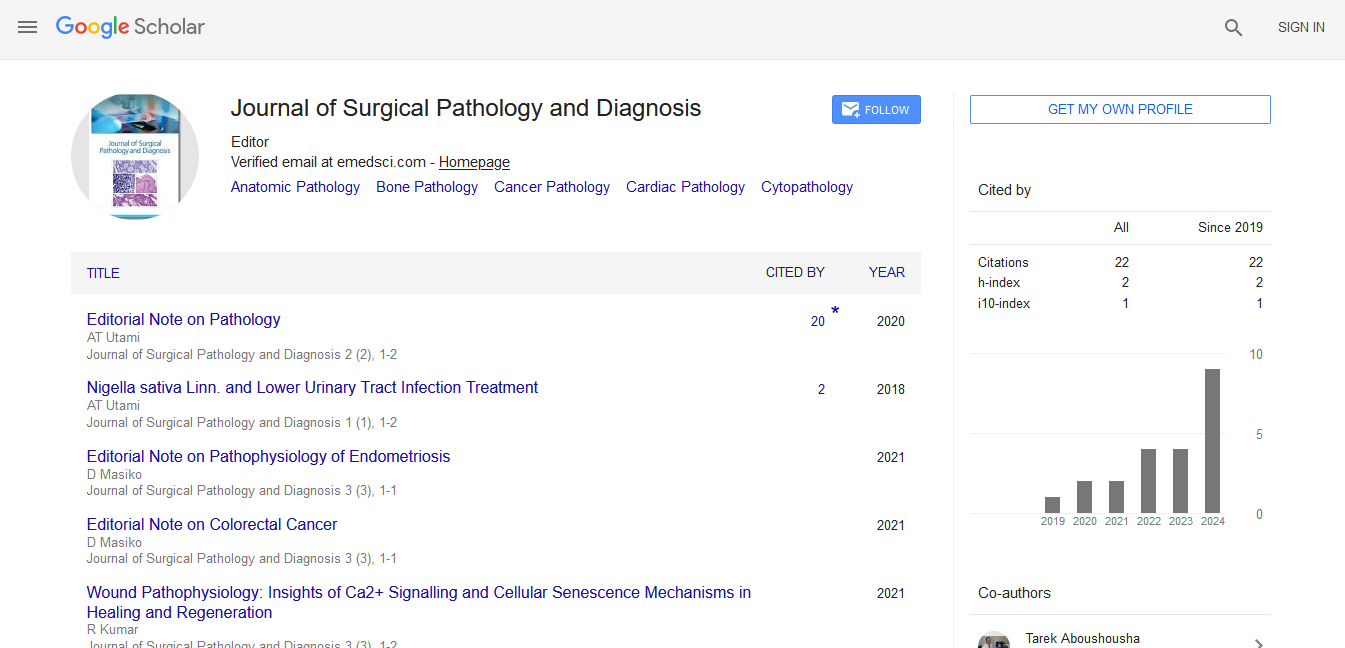
Journal of Surgical Pathology and Diagnosis received 15 citations as per Google Scholar report