Brief Report - (2025) Volume 15, Issue 4
Received: 31-Jul-2025, Manuscript No. jmcj-25-176893;
Editor assigned: 04-Aug-2025, Pre QC No. P-176893;
Reviewed: 18-Aug-2025, QC No. Q-176893;
Revised: 21-Aug-2025, Manuscript No. R-176893;
Published:
28-Aug-2025
, DOI: 10.37421/2165-7912.2025.15.628
Citation: Hale, Marcus J.. âMedia Literacy: Cornerstone of Informed Citizenship.â J Mass Communicat Journalism 15(2025):628.
Copyright: © 2025 Hale J. Marcus This is an open-access article distributed under the terms of the Creative Commons Attribution License, which permits unrestricted use, distribution and reproduction in any medium, provided the original author and source are credited.
The COVID-19 pandemic highlighted a critical need for robust media literacy skills, as misinformation spread rapidly. This systematic review synthesizes research on media literacy during the pandemic, revealing trends in educational interventions and the impact of digital media consumption. It underscores the importance of critical evaluation skills and digital citizenship in navigating complex information landscapes[1].
Cultivating media literacy and digital citizenship in young people is essential for their participation in contemporary society. This review identifies key strategies and challenges in developing these competencies, emphasizing the intertwined nature of critical media engagement and responsible online behavior. Effective educational approaches often integrate practical skills with ethical considerations[2].
Critical thinking is a cornerstone of higher education, and media literacy plays a pivotal role in developing this skill. This study explores how integrating media literacy education can enhance students' abilities to analyze information, evaluate sources, and construct reasoned arguments, preparing them to critically engage with diverse media content[3].
The proliferation of misinformation demands effective strategies for correction. This research investigates the efficacy of various media literacy interventions in mitigating the impact of false information. Findings suggest that teaching source evaluation and inoculation techniques can significantly improve individuals' ability to identify and resist misinformation[4].
Effective media literacy initiatives often stem from robust policy frameworks. This comparative study analyzes different European approaches to media literacy policy development, identifying common strategies and unique challenges across countries. It highlights the importance of national and supranational coordination in fostering a media-literate citizenry[5].
Youth navigate complex online environments, encountering various risks. This study examines how media literacy skills and parental mediation influence adolescents' experiences with online risks. Findings suggest that higher media literacy empowers young people to better manage online threats and enhance their digital well-being[6].
In the digital age, the lines between media consumption and production are blurred, making media literacy crucial for both citizens and aspiring journalists. This article explores how journalism education can integrate media literacy principles to equip future journalists with the skills to navigate misinformation and uphold ethical reporting standards, while also helping citizens understand media production processes[7].
Access to accurate health information is vital, yet misinformation abounds. This systematic review examines media literacy interventions aimed at improving health literacy and discerning reliable health information. It identifies effective strategies for empowering individuals to critically evaluate health messages and make informed decisions[8].
Active civic engagement in a democratic society relies on an informed citizenry, making media literacy a crucial component. This review synthesizes research on the relationship between media literacy education and youth civic engagement, highlighting how critical media skills can foster informed participation and democratic values among young people[9].
Teachers are instrumental in fostering media literacy among students, but they themselves require adequate training. This systematic review examines the current state of teachers' media literacy competencies and identifies effective professional development programs. It underscores the urgent need for robust teacher training to address the evolving digital landscape in education[10].
Media literacy is critically important in our current information environment, helping people navigate complex digital landscapes. The COVID-19 pandemic highlighted this, demonstrating an urgent need for robust media literacy skills to counter rapidly spreading misinformation [1]. The constant flow of information demands effective strategies for correction, and research shows that interventions focusing on source evaluation and inoculation techniques significantly improve people's ability to identify and resist false information [4]. Furthermore, in the digital age, access to accurate health information is crucial. Media literacy interventions specifically aimed at health literacy help individuals discern reliable health information, empowering them to critically evaluate health messages and make informed decisions [8].
Cultivating media literacy and digital citizenship in young people is essential for their active participation in society. Developing these competencies involves combining practical skills with ethical considerations to foster critical media engagement and responsible online behavior [2]. Youth frequently encounter various online risks, and studies indicate that strong media literacy skills, alongside parental mediation, significantly influence how adolescents handle these threats, leading to better management of online dangers and improved digital well-being [6].
Beyond personal safety, media literacy education also supports youth civic engagement, promoting informed participation and democratic values, which are vital for an active citizenry [9]. Within educational settings, media literacy serves as a cornerstone for developing critical thinking skills, particularly in higher education. Integrating media literacy education helps students analyze information, evaluate sources, and construct well-reasoned arguments, preparing them for critical engagement with diverse media content [3].
The evolving digital age also blurs the lines between media consumption and production, making media literacy crucial for both citizens and aspiring journalists. Journalism education can incorporate these principles to equip future professionals to navigate misinformation and uphold ethical reporting standards, while also educating the public on media production processes [7]. Crucially, teachers play an instrumental role in cultivating media literacy among students. However, they require adequate training themselves, highlighting an urgent need for robust professional development programs to address their media literacy competencies in the ever-changing digital landscape [10].
Effective media literacy initiatives often originate from well-structured policy frameworks. A comparative analysis of European approaches to media literacy policy development reveals common strategies and distinct challenges across countries. It underscores the importance of coordinated national and supranational efforts in fostering a comprehensively media-literate citizenry [5].
Media literacy is vital in our complex information landscape. It helps individuals navigate misinformation, promote critical thinking, and foster responsible digital citizenship. The COVID-19 pandemic, for instance, showed a clear need for strong media literacy skills to combat the rapid spread of false information and promote critical evaluation. Cultivating these skills in young people is essential for their societal participation, emphasizing a link between critical media engagement and ethical online behavior. Effective educational methods often combine practical skills with ethical principles. Media literacy underpins critical thinking in higher education, enhancing students' ability to analyze sources and build reasoned arguments. Research into interventions against misinformation reveals that teaching source evaluation significantly improves people's capacity to identify and resist false content. Policy frameworks also play a key role, with comparative studies showing national and international coordination is important for developing a media-literate public. Youth frequently encounter online risks, and studies indicate that higher media literacy empowers adolescents to better manage these threats, improving their digital well-being. Media literacy is also crucial for journalism education, equipping future journalists to handle misinformation while helping citizens understand media production. In health, media literacy interventions improve health literacy, enabling individuals to critically assess health messages and make informed choices. This also extends to civic engagement, where media literacy education fosters informed participation and democratic values among young people. Teachers, though instrumental in this process, need robust professional development to keep up with the evolving digital education landscape.
None
None
M. Y, Y. A, T. EG. "Media Literacy in the Age of COVID-19: A Systematic Literature Review".SAGE Open 13 (2023):21582440231189033.
Indexed at, Google Scholar, Crossref
J. M, S. H, K. S. "Developing media literacy and digital citizenship among young people: a systematic review".Journal of Youth Studies 26 (2023):549-566.
Indexed at, Google Scholar, Crossref
A. HA, K. K, A. SA. "The role of media literacy in fostering critical thinking skills in higher education".Education and Information Technologies 27 (2022):2073-2090.
Indexed at, Google Scholar, Crossref
J. R, S. vdL, B. G. "Correcting Misinformation: The Efficacy of Media Literacy Interventions".Journal of Applied Research in Memory and Cognition 9 (2020):385-394.
Indexed at, Google Scholar, Crossref
L. D, M. W, P. GMvdH. "Media literacy policy development: A comparative analysis of European approaches".New Media & Society 21 (2019):859-878.
Indexed at, Google Scholar, Crossref
S. L, E. JH, M. L. "Adolescents' Online Risk Experiences: The Role of Media Literacy and Parental Mediation".Journal of Broadcasting & Electronic Media 65 (2021):388-410.
Indexed at, Google Scholar, Crossref
F. V, P. F, M. C. "Bridging the gap: Media literacy and journalism education in the digital age".Journalism Practice 14 (2020):432-449.
Indexed at, Google Scholar, Crossref
W. YSC, A. G, J. NC. "Media Literacy for Health: A Systematic Review of Interventions and Their Effectiveness".Journal of Health Communication 25 (2020):479-491.
Indexed at, Google Scholar, Crossref
S. AR, J. K, A. SH. "Media Literacy Education and Youth Civic Engagement: A Scoping Review".Communication Education 71 (2022):1-22.
Indexed at, Google Scholar, Crossref
M. E, K. K, T. Y. "Teachers' media literacy in the digital age: A systematic review".Education and Information Technologies 28 (2023):7365-7389.
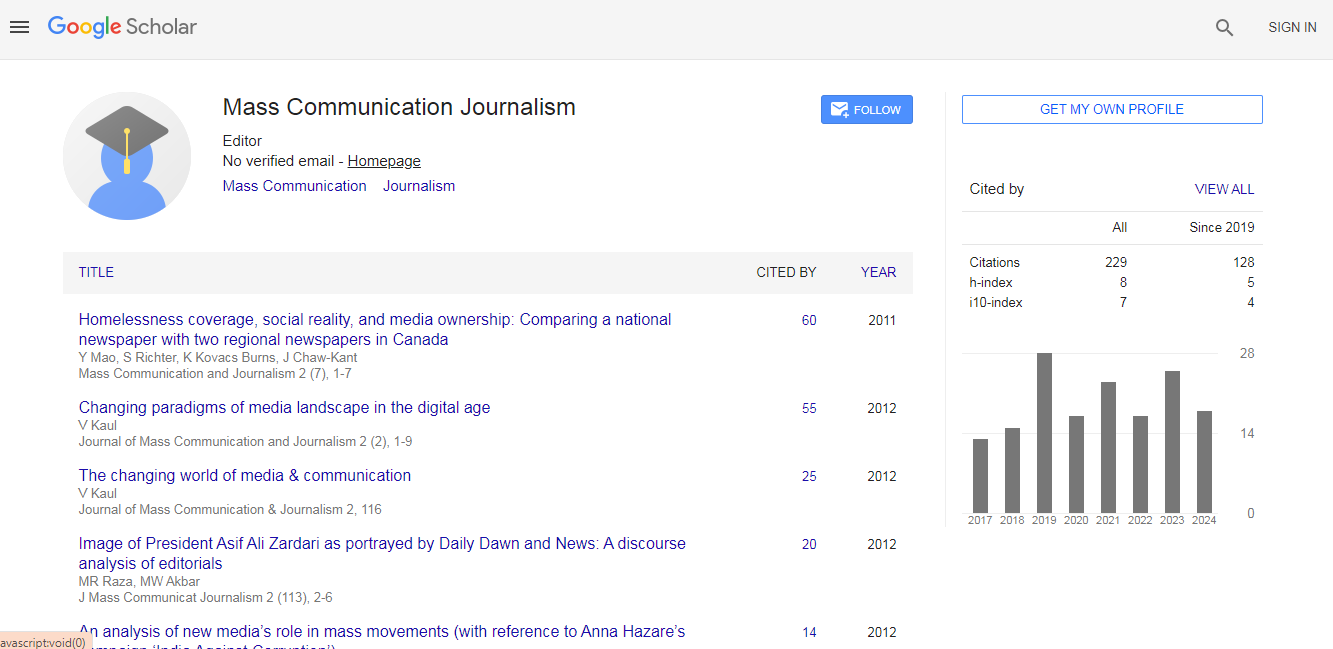
Journal of Mass Communication & Journalism received 205 citations as per Google Scholar report