Short Communication - (2025) Volume 15, Issue 3
Received: 30-May-2025, Manuscript No. jmcj-25-176491;
Editor assigned: 02-Jun-2025, Pre QC No. P-176491;
Reviewed: 13-Jun-2025, QC No. Q-176491;
Revised: 20-Jun-2025, Manuscript No. R-176491;
Published:
27-Jun-2025
, DOI: 10.37421/2165-7912.2025.15.619
Citation: Langford, Sophie K.. ”Media Ethics: Health, Trust, and Accountability.” J Mass Communicat Journalism 15(2025):619.
Copyright: © 2025 Langford K. Sophie This is an open-access article distributed under the terms of the Creative Commons Attribution License, which permits unrestricted use, distribution and reproduction in any medium, provided the original author and source are credited.
This article delves into the critical discussion surrounding the feasibility and pressing necessity of establishing a dedicated press council. Such a body would meticulously oversee ethical reporting practices, particularly when dealing with sensitive and often complex topics such as reproductive health. By drawing upon comprehensive comparative insights gleaned from various established models of media self-regulation, the authors propose an effective, adaptable framework. This framework is meticulously designed to bolster accountability within journalistic practices and, crucially, to maintain and enhance public trust in the integrity of news reporting [1].
The paper subsequently outlines the profound ethical obligations incumbent upon media organizations, especially during periods of public health crises. It emphasizes the absolutely critical role that robust accountability mechanisms must play in these challenging times. To address this, the authors propose a comprehensive and resilient framework specifically engineered to guide media organizations in undertaking responsible reporting. The core aim of this framework is to effectively mitigate the spread of misinformation and to cultivate and solidify public trust during emergencies [2].
Furthermore, this research meticulously examines the multifaceted aspects of responsible reporting, with a particular focus on both the ethical dilemmas frequently encountered and the practical, actionable solutions available within health journalism. It highlights with conviction the fundamental importance of steadfastly adhering to professional standards. Such adherence is essential to ensure the utmost accuracy in reporting and to assiduously avoid sensationalism, which is a critical factor for maintaining journalistic integrity and fostering unwavering public confidence [3].
The article then provides a systematic and thorough review of established ethical guidelines specifically tailored for media reporting on the sensitive topic of suicide. It diligently identifies both exemplary best practices and common pitfalls to be avoided. The review strongly advocates for heightened media accountability as a primary means to prevent harm, significantly reduce stigma, and actively promote a responsible, thoughtful public discourse surrounding mental health issues [4].
Additionally, this research powerfully advocates for the implementation of stronger, more pervasive accountability mechanisms designed to actively promote health literacy through responsible media practices. It underscores the undeniable necessity for journalistic integrity and rigorously ethical reporting. This ensures that the public consistently receives accurate and unbiased health information, thereby directly contributing to and significantly improving public health outcomes across communities [5].
The paper also thoughtfully explores the various ethical considerations that arise in the context of reporting on infectious diseases. It draws invaluable key lessons directly from the profound experience of the COVID-19 pandemic. It emphatically underscores the media's vital and indispensable role in public education and highlights the absolute necessity for accurate, empathetic, and responsible coverage to avoid the twin perils of widespread panic and pervasive misinformation [6].
This review comprehensively addresses the significant challenges and outlines the best practices essential for ensuring both accuracy and ethics within medical journalism. It illuminates the inherent complexities involved in successfully translating intricate scientific information for a general lay audience. Moreover, it stresses the paramount importance of upholding rigorous journalistic standards to guarantee credible and unfailingly reliable health reporting [7].
The article additionally delves into a crucial discussion regarding the media's profound role within bioethical discourse. It passionately advocates for the media’s inherent capacity to promote informed public debate and to uphold ethical reporting practices in this specialized field. It pointedly underscores how the media can significantly shape public understanding and exert considerable influence on policy decisions related to complex bioethical issues [8].
This paper meticulously examines the ethical considerations pertinent for both journalists and policymakers concerning the undeniable influence of media on health policy. It highlights with clarity the media's immense power in shaping public perception and consequently impacting policy decisions. The discussion stresses the urgent need for comprehensive ethical guidelines to meticulously prevent bias and ensure a fair and equitable representation of complex health issues [9].
Finally, the article delves into the intricate ethical challenges that characterize digital health communication. It strongly emphasizes the critical importance of establishing and adhering to robust professional standards and consistent oversight in this rapidly evolving domain. It precisely addresses how the digital landscape inherently complicates ethical reporting and articulates the necessity for strong, adaptive frameworks to effectively guide online media practices [10].
Journalism plays a pivotal role in shaping public understanding and trust, particularly concerning health matters. The discourse highlights the continuous imperative for ethical reporting and robust accountability mechanisms across all media platforms. For instance, discussions around establishing a press council underscore its necessity for overseeing ethical reporting, particularly for sensitive subjects like reproductive health. By drawing comparative insights from various models of media self-regulation, effective frameworks can be proposed to bolster accountability and maintain public trust in journalism [1]. This critical need for ethical oversight becomes even more pronounced during public health crises. Media organizations face significant ethical obligations in these times, emphasizing the crucial role of accountability mechanisms. Developing a robust framework is vital to guide responsible reporting, aiming to mitigate misinformation and foster essential public trust during such emergencies [2].
The realm of health journalism is frequently confronted with complex ethical dilemmas, demanding practical and effective solutions for responsible reporting. Adhering strictly to professional standards is paramount, ensuring accuracy and actively avoiding sensationalism to safeguard journalistic integrity and maintain public confidence [3]. In specific and highly sensitive areas like reporting on suicide, dedicated ethical guidelines are indispensable. Systematic reviews have identified best practices and common pitfalls, strongly advocating for media accountability to prevent harm, reduce stigma, and promote a responsible and empathetic public discourse around mental health [4]. Similarly, the experience gleaned from reporting on infectious diseases, such as during the COVID-19 pandemic, vividly underscores the media's vital role in public education. Such coverage demands not only accuracy but also empathy and responsibility to effectively prevent widespread panic and the proliferation of misinformation [6].
Beyond immediate crisis reporting, the media holds a substantial responsibility in actively promoting public health literacy. There is a clear call for stronger accountability mechanisms to ensure media outlets disseminate health information responsibly and accurately. Journalistic integrity and unwavering ethical reporting are fundamental to providing the public with unbiased and credible health information, which directly contributes to improved public health outcomes [5]. The inherent complexities involved in translating intricate scientific information for a lay audience further highlight the importance of accuracy and ethics in medical journalism. Comprehensive reviews of best practices consistently emphasize the necessity of rigorous journalistic standards for delivering credible and reliable health reporting [7]. This extends broadly to the media’s engagement in bioethical discourse, where it possesses a unique capacity to facilitate informed public debate, ultimately shaping public understanding and influencing policy on intricate bioethical issues [8].
The influence of media extends deeply into the domain of health policy, where the ethical considerations for both journalists and policymakers are significant. The media's profound power in shaping public perception and subsequently influencing policy decisions necessitates the establishment of clear ethical guidelines. These guidelines are crucial to prevent bias and ensure a fair and comprehensive representation of complex health issues [9]. Furthermore, the rapidly evolving digital landscape introduces new and distinct ethical challenges for digital health communication. In this environment, professional standards and robust oversight become increasingly critical. The necessity for strong frameworks to guide online media practices is evident, ensuring integrity and responsibility in the digital age [10].
Collectively, these discussions emphasize a continuous and unwavering commitment to ethical principles, media accountability, and the broader public welfare across all journalistic endeavors. The ongoing need for vigilance, adaptive frameworks, and a strong sense of responsibility underpins the media's essential role in a healthy, informed society.
Ethical reporting and media accountability are critical pillars for maintaining public trust in journalism, particularly concerning health-related topics. Discussions highlight the importance of establishing regulatory bodies, such as press councils, to oversee sensitive areas like reproductive health, drawing lessons from various self-regulation models to ensure journalistic integrity. In times of public health crises, media organizations face significant ethical obligations, needing robust frameworks to guide responsible reporting, mitigate misinformation, and foster public confidence. This also extends to specific, sensitive areas like suicide reporting, where adherence to ethical guidelines is paramount to prevent harm and reduce stigma. The COVID-19 pandemic further emphasized the media’s educational role, requiring accurate, empathetic, and responsible coverage of infectious diseases to avoid panic. Beyond crisis management, responsible media plays a crucial role in promoting health literacy by ensuring accurate and unbiased health information, thereby improving public health outcomes. This requires addressing ethical dilemmas in health journalism, prioritizing professional standards, accuracy, and avoiding sensationalism. The media also significantly influences bioethical discourse and health policy, shaping public perception and policy decisions. Therefore, clear ethical guidelines are essential to prevent bias and ensure fair representation of complex issues. With the rise of digital health communication, new ethical challenges emerge, underscoring the need for professional standards and robust oversight to guide online media practices. The overarching theme is a continuous commitment to ethical principles and media accountability for societal well-being.
None
None
Indexed at, Google Scholar, Crossref
Indexed at, Google Scholar, Crossref
Indexed at, Google Scholar, Crossref
Indexed at, Google Scholar, Crossref
Indexed at, Google Scholar, Crossref
Indexed at, Google Scholar, Crossref
Indexed at, Google Scholar, Crossref
Indexed at, Google Scholar, Crossref
Indexed at, Google Scholar, Crossref
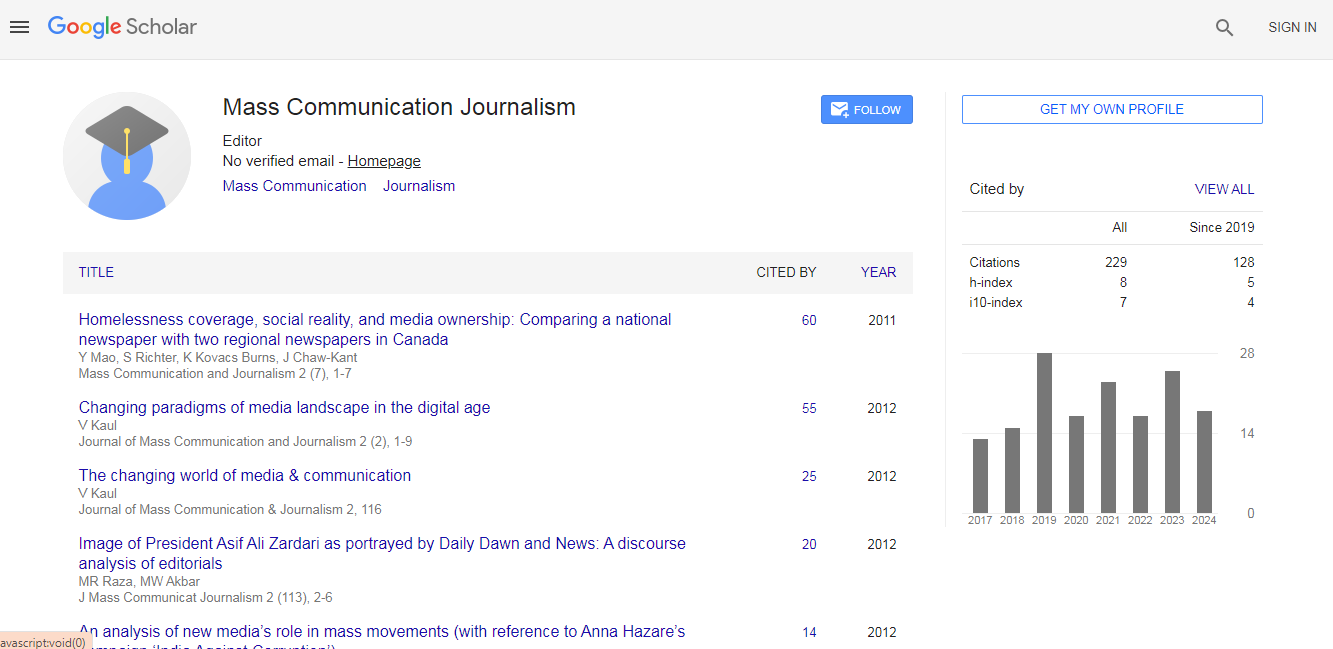
Journal of Mass Communication & Journalism received 205 citations as per Google Scholar report