Short Communication - (2025) Volume 11, Issue 3
Received: 01-May-2025, Manuscript No. ohcr-25-174280;
Editor assigned: 05-May-2025, Pre QC No. P-174280;
Reviewed: 19-May-2025, QC No. Q-174280;
Revised: 22-May-2025, Manuscript No. R-174280;
Published:
29-May-2025
, DOI: 10.37421/2471-8726.2025.11.200
Citation: Chen, Li. ”Maxillofacial Surgery: Precision, Innovation, Patient Outcomes.” Oral Health Case Rep 11 (2025):200.
Copyright: © 2025 Chen L. This is an open-access article distributed under the terms of the Creative Commons Attribution License, which permits unrestricted use, distribution and reproduction in any medium, provided the original author and source are credited.
Maxillofacial surgery stands at the forefront of medical innovation, continually evolving to address complex challenges from trauma and congenital defects to oncological reconstructions and debilitating pain. The integration of advanced technologies and a steadfast focus on patient outcomes are defining the modern practice in this specialized field. One area of profound impact is in maxillofacial trauma, where virtual surgical planning and 3D printing are revolutionizing reconstruction efforts. These digital tools allow for precise planning of intricate surgeries, which translates directly into superior functional and aesthetic results for patients, fundamentally shifting traditional methods toward a more exact, individualized approach [1].
Beyond the operating room, understanding the patient's perspective is paramount. For example, in orthognathic surgery, success is increasingly measured not just by clinical metrics but by patient-reported outcomes and overall satisfaction. What this really means is that functional improvements and aesthetic changes are recognized as direct contributors to a patient's overall quality of life, underscoring the importance of subjective experiences in evaluating surgical success [2].
Similarly, managing chronic conditions such as temporomandibular joint issues has seen a move towards minimally invasive options like arthroscopy. Evidence suggests this approach can be highly effective for specific conditions, making it crucial to identify which patients will benefit most from this targeted surgical intervention, weighing its advantages against other available treatments [3].
When we consider reconstructive challenges, particularly after head and neck cancer surgery, microvascular techniques represent a true transformation. This specialized field emphasizes meticulous planning and surgical expertise to restore both form and function, aiming to give patients the best possible quality of life following oncologic resection [4].
On a related note, the continuous evolution of cleft lip and palate surgery is driven by modern techniques that significantly improve patient outcomes. There's a clear emphasis on comprehensive, multidisciplinary care that combines surgical advancements with long-term management strategies, ultimately striving for better aesthetic results, and critically, optimal speech and feeding functions for affected children [5].
For dental implantology in challenging maxillofacial regions, bone grafting remains an essential technique. Current reviews provide an overview of various materials and methods, emphasizing that choosing the right graft and approach is vital for achieving predictable implant success and long-term stability, especially in situations with significant bone loss [6].
Furthermore, the complexity of maxillofacial infections, which can range from minor to life-threatening, necessitates precise diagnosis and timely management. Distinguishing between odontogenic and non-odontogenic origins is crucial, guiding the appropriate treatment strategy, which often involves a combination of antibiotics and surgical intervention [7].
Addressing severe conditions like trigeminal neuralgia, a debilitating facial pain disorder, often involves surgical management. Here's the thing: various surgical techniques, such as microvascular decompression, have shown substantial efficacy and favorable outcomes. This offers tangible hope and effective solutions for individuals enduring severe facial pain, with surgery frequently providing a highly effective path to relief [8].
The broader landscape of head and neck cancer treatment, including maxillofacial oncology, is undergoing a significant transformation with the advent of immunotherapy. Current applications and future directions of these therapies demonstrate how leveraging the body's own immune system can open new avenues for managing aggressive cancers, potentially improving patient prognosis [9].
Finally, Artificial Intelligence (AI), particularly deep learning, is rapidly becoming a cornerstone in maxillofacial imaging. This technology significantly enhances diagnostic accuracy and treatment planning by allowing for faster and more reliable interpretation of complex imaging data, ultimately delivering substantial benefits to patient care [10].
This collection of advancements highlights the dynamic and impactful nature of contemporary maxillofacial practices.
Maxillofacial surgery encompasses a broad spectrum of interventions, from addressing traumatic injuries to complex congenital anomalies and oncologic resections, all while integrating cutting-edge technologies to enhance patient outcomes. A key area of innovation lies in the use of virtual surgical planning and 3D printing. These digital advancements are proving indispensable in maxillofacial traumatology, allowing surgeons to meticulously plan complex reconstructions. What this really means is moving away from less precise methods to a highly exact, patient-specific approach that yields superior functional and aesthetic results for individuals recovering from severe injuries [1]. This precision minimizes intraoperative surprises and optimizes recovery pathways.
Patient-centered care is a recurring theme across various subspecialties. For orthognathic surgery, the focus extends beyond purely clinical measures to patient-reported outcomes and overall satisfaction. This shift acknowledges that the true measure of success encompasses a patient's quality of life, influenced directly by functional improvements and aesthetic changes post-surgery [2]. Similarly, for individuals suffering from temporomandibular joint issues, minimally invasive options like arthroscopy are gaining traction. A thorough evaluation of the evidence suggests TMJ arthroscopy can be quite effective for specific conditions, emphasizing the need to carefully select patients who stand to gain the most from this targeted surgical approach, balancing its benefits against other treatment modalities [3].
In the realm of reconstructive surgery, particularly after head and neck cancer resections, microvascular techniques have transformed the landscape. This highly specialized work involves meticulous planning and surgical skill to restore both form and function, significantly improving the quality of life for patients who have undergone extensive oncologic surgery [4]. Parallel to this, advancements in cleft lip and palate surgery reflect a commitment to continuous improvement. Modern techniques, combined with comprehensive, multidisciplinary care, are leading to better aesthetic outcomes, and crucially, optimizing speech and feeding functions for affected children through long-term management strategies [5]. This integrated approach ensures holistic care beyond the immediate surgical intervention.
When it comes to dental implantology in challenging maxillofacial areas, bone grafting remains a cornerstone for achieving predictable results. Various materials and techniques are available, and selecting the appropriate graft and method is paramount for ensuring long-term implant success and stability, especially in situations where significant bone loss has occurred [6]. Here's the thing: managing maxillofacial infections requires a nuanced approach. Differentiating between odontogenic and non-odontogenic origins is a critical first step, leading to tailored diagnostic pathways and treatment strategies that often combine antibiotics with surgical interventions to effectively resolve these potentially life-threatening conditions [7].
For patients experiencing the debilitating pain of trigeminal neuralgia, surgical management offers significant relief. Various surgical techniques, such as microvascular decompression, have demonstrated considerable efficacy and favorable outcomes, providing tangible solutions and hope for those suffering from severe facial pain [8]. Beyond surgical solutions, the field of maxillofacial oncology is embracing new therapeutic modalities. Immunotherapy, for instance, is reshaping head and neck cancer treatment. This approach, which harnesses the body's own immune system, presents new avenues for managing aggressive cancers and holds promise for improving patient prognosis [9].
Finally, the integration of Artificial Intelligence (AI), particularly deep learning, into maxillofacial imaging marks a significant leap forward. This technology can interpret complex imaging data faster and more reliably, substantially enhancing diagnostic accuracy and treatment planning for clinicians, ultimately benefiting patient care by providing more precise insights [10]. These advancements collectively illustrate the dynamic progress and diverse scope of modern maxillofacial practice.
The field of maxillofacial surgery is witnessing significant advancements, driven by both technological innovations and a patient-centered approach. Digital tools, such as virtual surgical planning and 3D printing, are fundamentally changing how complex reconstructions are performed in maxillofacial trauma, allowing for incredible precision and leading to better functional and aesthetic results. This move towards highly exact, patient-specific solutions is setting new standards in care. Progress extends across various subspecialties. For orthognathic surgery, patient-reported outcomes and satisfaction are now considered vital indicators of success, recognizing that functional and aesthetic improvements profoundly affect a patient's quality of life. Minimally invasive treatments, like temporomandibular joint arthroscopy, show promise for specific conditions, requiring careful assessment to identify the most suitable candidates. Reconstruction of defects following head and neck cancer surgery is being revolutionized by microvascular techniques, which focus on restoring both form and function to improve patients' post-operative quality of life. Similarly, modern techniques in cleft lip and palate surgery, coupled with multidisciplinary care, are achieving superior aesthetic results and critical improvements in speech and feeding functions. In maxillofacial implantology, diverse bone grafting materials and techniques are crucial for ensuring predictable implant success and long-term stability, especially in cases with significant bone loss. Effective management of maxillofacial infections, differentiating between odontogenic and non-odontogenic sources, guides tailored antibiotic and surgical interventions. For severe facial pain conditions like trigeminal neuralgia, surgical interventions, including microvascular decompression, offer substantial relief. Looking forward, immunotherapy is transforming the treatment landscape for head and neck cancers, offering new hope for improved prognosis. The integration of Artificial Intelligence and deep learning in maxillofacial imaging promises to enhance diagnostic accuracy and refine treatment planning by efficiently interpreting complex data. This collective evolution highlights a dynamic discipline dedicated to improving patient health and well-being.
None
None
1. Hohlweg J, Neuschitzer M, Schiefer J. "Virtual Surgical Planning and 3D Printing in Maxillofacial Traumatology: An Update".J Clin Med 12 (2023):1969.
Indexed at, Google Scholar, Crossref
2. Al-Moraissi E, Abduo A, Al-Haj HA. "Patient-reported outcomes and satisfaction after orthognathic surgery: a systematic review".J Oral Maxillofac Surg 80 (2022):497-511.
Indexed at, Google Scholar, Crossref
3. Nambiar M, Ramakrishnan K, Marathe S. "Effectiveness of Temporomandibular Joint Arthroscopy: A Systematic Review and Meta-analysis".J Oral Maxillofac Surg 80 (2022):1016-1031.
Indexed at, Google Scholar, Crossref
4. O'Connell D, Givi B, Puram S. "Current Concepts in Microvascular Reconstruction for Head and Neck Cancer".J Oral Maxillofac Surg 79 (2021):473-485.
Indexed at, Google Scholar, Crossref
5. Taibah A, Saini V, Garg R. "Advancements in Cleft Lip and Palate Surgery: A Review of Modern Techniques and Outcomes".Ann Maxillofac Surg 13 (2023):165-172.
Indexed at, Google Scholar, Crossref
6. Ruggiero G, Santagata M, Dell'Aversana G. "Bone Grafting Materials and Techniques in Maxillofacial Implantology: A Narrative Review".Materials (Basel) 15 (2022):7190.
Indexed at, Google Scholar, Crossref
7. Patel V, Shah N, Mehta R. "Odontogenic and non-odontogenic maxillofacial infections: a review of etiology, diagnosis, and management".Int J Oral Maxillofac Surg 50 (2021):851-859.
Indexed at, Google Scholar, Crossref
8. Smith J, Brown L, Garcia M. "Surgical Management of Trigeminal Neuralgia: A Review of Current Techniques and Outcomes".J Craniofac Surg 31 (2020):1615-1620.
Indexed at, Google Scholar, Crossref
9. Chen C, Li J, Wang Y. "Immunotherapy in Head and Neck Squamous Cell Carcinoma: Current Status and Future Perspectives".Front Oncol 11 (2022):794951.
Indexed at, Google Scholar, Crossref
10. Singh H, Kaur P, Sharma S. "Artificial Intelligence and Deep Learning in Maxillofacial Imaging: A Comprehensive Review".Dentomaxillofac Radiol 52 (2023):20220367.
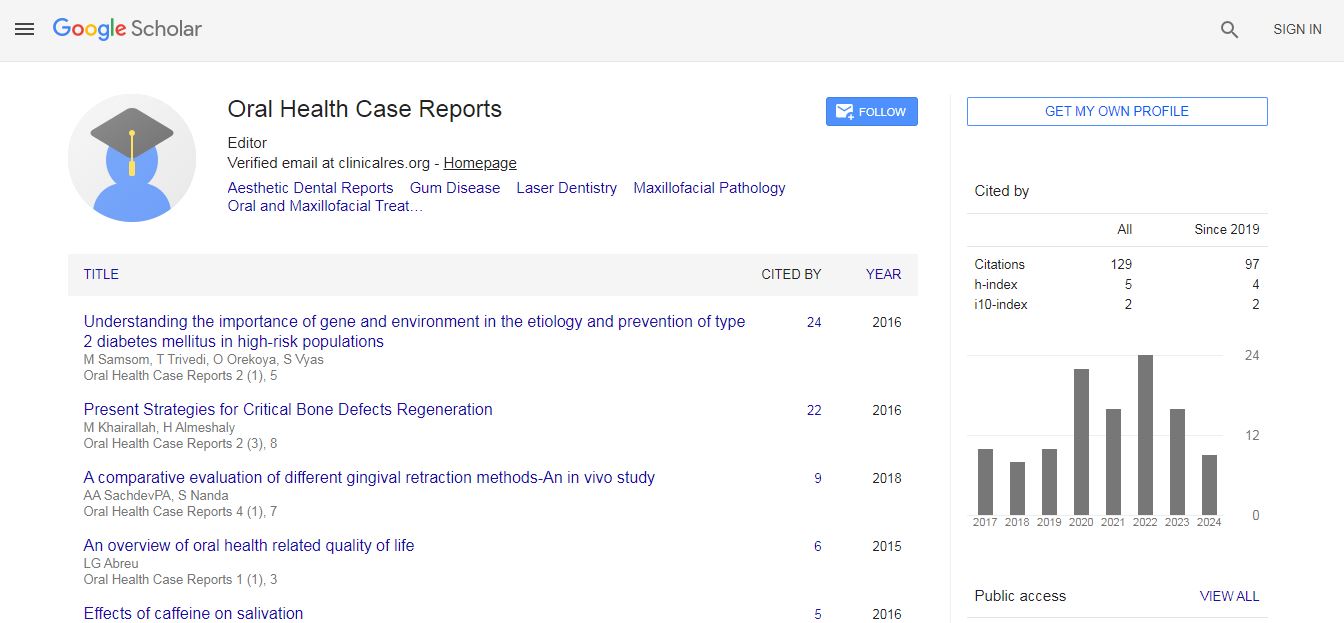
Oral Health Case Reports received 120 citations as per Google Scholar report