Short Communication - (2025) Volume 16, Issue 3
Received: 01-May-2025, Manuscript No. jpm-26-179420;
Editor assigned: 05-May-2025, Pre QC No. P-179420;
Reviewed: 19-May-2025, QC No. Q-179420;
Revised: 22-May-2025, Manuscript No. R-179420;
Published:
29-May-2025
, DOI: 10.37421/2090-0902.2025.16.540
Citation: Dijk, Lucas van. ”Mathematics: Unifying Language of Condensed Matter Physics.” J Phys Math 16 (2025):540.
Copyright: © 2025 Dijk v. Lucas This is an open-access article distributed under the terms of the Creative Commons Attribution License, which permits unrestricted use, distribution and reproduction in any medium, provided the original author and source are credited.
The fundamental understanding of condensed matter physics is intrinsically tied to the sophisticated mathematical frameworks that underpin its study. These frameworks provide the essential language and tools necessary to describe the complex behavior of matter at the solid state and condensed matter levels, enabling predictions and explanations of emergent properties. Advanced mathematical techniques such as group theory, differential geometry, and statistical mechanics are pivotal in this endeavor, offering insights into phenomena like superconductivity, topological insulators, and quantum entanglement [1].
The application of topological concepts, originating from mathematics, has revolutionized the classification and comprehension of exotic phases of matter. Topological invariants, derived from algebraic topology and differential geometry, serve to characterize phases that exhibit robustness against local perturbations. This mathematical perspective has been instrumental in identifying novel materials with unique electronic properties, including topological insulators and superconductors, which hold significant promise for advancements in quantum computing and spintronics [2].
Tensor network methods, rooted in linear algebra and tensor calculus, represent a powerful class of mathematical algorithms designed for the simulation of strongly correlated quantum systems. These methods are particularly effective in managing the high-dimensional Hilbert spaces inherent in condensed matter problems, thereby facilitating more accurate predictions of material properties. Tensor networks efficiently represent quantum states and enable exploration of phase transitions in systems that would otherwise be intractable for conventional computational approaches [3].
The mathematical formulation of quantum field theory (QFT) has found extensive application in condensed matter systems. QFT offers a unified theoretical framework for describing collective excitations and emergent phenomena, such as quasiparticles and phase transitions. Techniques like the renormalization group flow and path integrals are employed to analyze system behavior across different energy scales and to understand critical phenomena [4].
Group theory and symmetry principles are extensively utilized for the classification and prediction of properties in crystalline solids. The abstract mathematical framework of group theory elegantly describes the inherent symmetries within crystal structures, which in turn govern their electronic, optical, and magnetic behaviors. This approach is fundamental for comprehending phenomena such as band structures and selection rules in spectroscopy [5].
Statistical mechanics and its associated mathematical tools are crucial for studying the thermodynamic properties and phase transitions of condensed matter systems. Ensemble averages, partition functions, and critical exponents effectively characterize macroscopic behavior from underlying microscopic interactions. These concepts are widely applied to understand phenomena ranging from melting and boiling to more complex transitions like superconductivity [6].
Differential geometry and the calculus of variations provide a precise mathematical language for describing the behavior of continuous media, including elastic solids and superfluids. Concepts such as curvature, stress-energy tensors, and variational principles are fundamental to understanding deformations, wave propagation, and energy minimization in these systems, forming the basis of continuum mechanics in condensed matter [7].
Effective field theories offer a means for the mathematical construction and analysis of phenomena observed at low energies in condensed matter. These theories simplify complex quantum systems by focusing on relevant degrees of freedom and interactions, often described by non-linear sigma models or gauge theories. The renormalization group is a key tool in constructing these effective theories and understanding universality across different systems [8].
The mathematical framework of random matrix theory has demonstrated remarkable applicability in understanding the spectral properties of disordered systems within condensed matter. The statistical distributions of energy levels in quantum systems exhibiting disorder can be accurately predicted and comprehended using ensembles of random matrices. This approach offers profound insights into phenomena such as Anderson localization [9].
Lie algebras and their representations are essential for describing the symmetries and dynamics of spin systems and magnetic materials. The abstract algebraic structures inherent in Lie theory provide a powerful language for understanding collective spin behavior, crucial for phenomena like ferromagnetism and antiferromagnetism. The relationship between Lie algebra structure and emergent magnetic phases is a key area of study [10].
The exploration of condensed matter physics is deeply intertwined with the rigorous application of advanced mathematical concepts. Mathematical frameworks serve as the bedrock for understanding the intricate behavior of matter at the solid-state and condensed-matter levels. Techniques such as group theory, differential geometry, and statistical mechanics are indispensable for articulating phenomena like superconductivity, topological insulators, and quantum entanglement, providing the theoretical underpinnings for predicting and explaining emergent properties [1].
Mathematical topology offers a powerful lens through which to classify and comprehend exotic phases of matter. The utilization of topological invariants, often derived from the sophisticated fields of algebraic topology and differential geometry, allows for the characterization of material phases that exhibit inherent robustness against localized disturbances. This mathematical approach has been pivotal in the discovery of new materials possessing unique electronic characteristics, such as topological insulators and superconductors, which are anticipated to play a critical role in the future of quantum computing and spintronics [2].
In the realm of simulating strongly correlated quantum systems, tensor network methods, grounded in the principles of linear algebra and tensor calculus, have emerged as exceptionally potent mathematical algorithms. These methods excel at handling the exceedingly high-dimensional Hilbert spaces encountered in condensed matter physics problems, thereby enhancing the accuracy of material property predictions. The capacity of tensor networks to efficiently represent complex quantum states and probe phase transitions in systems intractable by traditional computational means underscores their significance [3].
Quantum field theory (QFT), when formulated mathematically, provides a unifying paradigm for investigating condensed matter systems. It offers a comprehensive framework for describing collective excitations and emergent behaviors, including quasiparticles and phase transitions. The application of methodologies such as renormalization group flow and path integrals allows for the detailed analysis of system dynamics across various energy scales and facilitates a deeper understanding of critical phenomena [4].
The systematic classification and prediction of crystalline solid properties are significantly advanced through the application of group theory and the principles of symmetry. Group theory's abstract mathematical structure elegantly encapsulates the symmetries present in crystal lattices, which directly influence their electronic, optical, and magnetic characteristics. This mathematical insight is fundamental to grasping concepts like band structures and the selection rules governing spectroscopic transitions [5].
Statistical mechanics and its associated mathematical apparatus are vital for analyzing the thermodynamic properties and phase transitions exhibited by condensed matter systems. Concepts such as ensemble averages, partition functions, and critical exponents are employed to elucidate macroscopic behavior from microscopic interactions. These mathematical tools are extensively used to explain a wide range of phenomena, from simple phase changes like melting and boiling to complex transitions such as superconductivity [6].
Differential geometry and the calculus of variations provide a precise and elegant mathematical language for describing the behavior of continuous media, including elastic solids and superfluids. Key mathematical constructs like curvature, stress-energy tensors, and variational principles are essential for understanding phenomena such as material deformation, wave propagation, and energy minimization in these systems, forming the core of continuum mechanics within condensed matter physics [7].
Effective field theories represent a crucial area of mathematical development for describing low-energy phenomena in condensed matter. These theories enable the simplification of complex quantum systems by isolating and characterizing the most relevant degrees of freedom and interactions, often expressed through non-linear sigma models or gauge theories. The renormalization group plays a pivotal role in the construction of these effective theories and the elucidation of universal behaviors [8].
Random matrix theory offers a sophisticated mathematical framework that has proven unexpectedly effective in characterizing the spectral properties of disordered systems in condensed matter. By employing ensembles of random matrices, researchers can statistically predict and understand the distribution of energy levels in quantum systems with disorder, yielding significant insights into phenomena like Anderson localization [9].
The study of spin systems and magnetic materials is significantly enriched by the application of Lie algebras and their representations. These abstract algebraic structures provide a potent mathematical language for describing the symmetries and dynamics governing collective spin behavior, which is fundamental to understanding phenomena such as ferromagnetism and antiferromagnetism. The intricate link between the structure of Lie algebras and the emergent magnetic phases is a key focus of this research area [10].
This collection of research highlights the indispensable role of mathematics in understanding condensed matter physics. Various mathematical frameworks, including group theory, differential geometry, statistical mechanics, quantum field theory, tensor networks, and random matrix theory, are employed to explore diverse phenomena. These include superconductivity, topological insulators, quantum entanglement, and phase transitions. The research emphasizes how abstract mathematical concepts provide the tools to classify exotic states of matter, simulate complex systems, and predict material properties. From the symmetries in crystalline solids to the spectral properties of disordered systems, mathematics offers a unifying language and powerful analytical methods. Key areas of application include understanding collective excitations, emergent phenomena, and the behavior of continuous media. Ultimately, the integration of these mathematical approaches is crucial for advancing our knowledge of condensed matter and driving innovation in related fields.
None
None
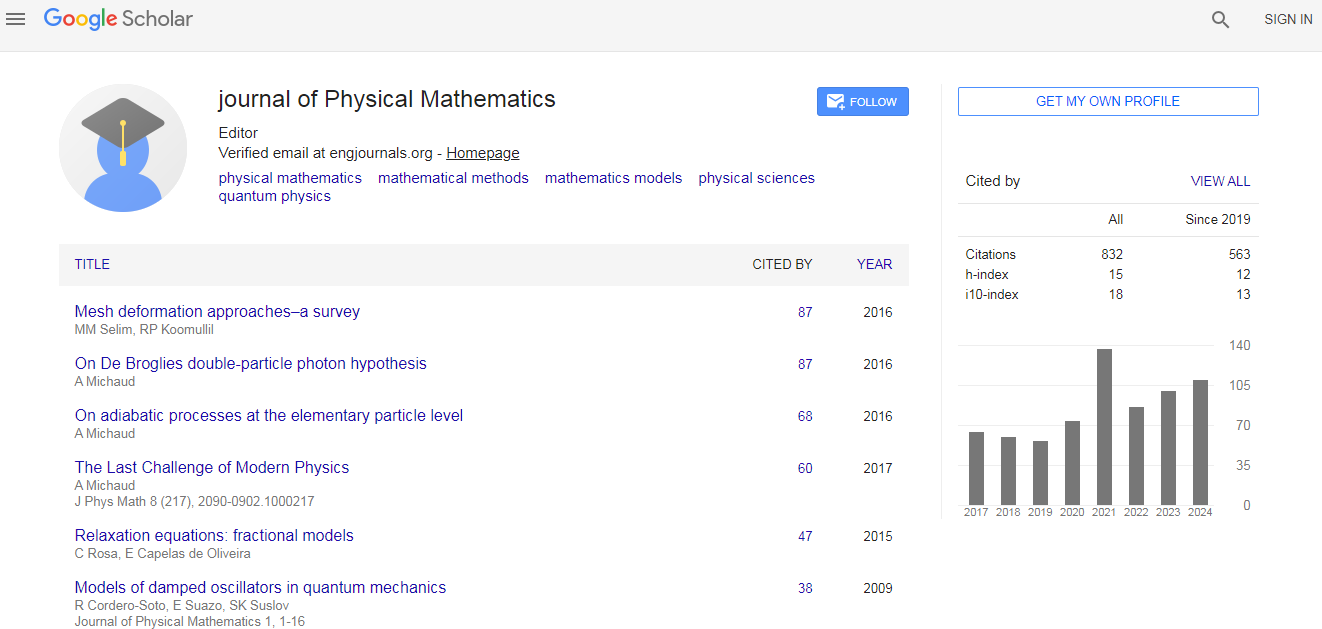
Physical Mathematics received 686 citations as per Google Scholar report