Perspective - (2025) Volume 16, Issue 2
Received: 02-Mar-2025, Manuscript No. jpm-26-179354;
Editor assigned: 04-Mar-2025, Pre QC No. P-179354;
Reviewed: 18-Mar-2025, QC No. Q-179354;
Revised: 24-Mar-2025, Manuscript No. R-179354;
Published:
31-Mar-2025
, DOI: 10.37421/2090-0902.2025.16.527
Citation: Reinhardt, Tobias. ”Mathematical Foundations of Quantum Field Theory.” J Phys Math 16 (2025):527.
Copyright: © 2025 Reinhardt T. This is an open-access article distributed under the terms of the Creative Commons Attribution License, which permits unrestricted use, distribution and reproduction in any medium, provided the original author and source are credited.
The intricate landscape of quantum field theory (QFT) is deeply rooted in sophisticated mathematical structures that provide the bedrock for understanding fundamental physical phenomena. Abstract mathematical frameworks, including Hilbert spaces, Lie groups, and differential geometry, are indispensable for formulating theories such as quantum electrodynamics and the Standard Model, showcasing the power of rigorous axiomatic approaches to tackle complex problems. The development of tools like the renormalization group flow has been pivotal in managing infinities that emerge in calculations, enabling remarkably precise predictions of observable quantities. Furthermore, the integration of algebraic methods and category theory offers a unifying perspective, revealing profound structural connections across different facets of QFT and fostering a deeper comprehension of its underlying principles [1].
An alternative yet complementary approach to understanding QFT involves the use of functional integral methods, prominently featuring path integrals. These integrals, defined over spaces of functions, offer a potent non-perturbative avenue for calculating quantum amplitudes, which are crucial for elucidating phenomena like spontaneous symmetry breaking and the topological characteristics of quantum field theories. Despite their utility, these integrals present significant mathematical challenges in their rigorous definition, yet their applications extend across condensed matter physics and statistical mechanics, underscoring their broad applicability [2].
The algebraic formulation of QFT provides a distinct and powerful lens through which to view the theory, emphasizing the central role of operator algebras and C*-algebras. This perspective offers a framework for defining quantum fields that is independent of specific spacetime manifolds, making it especially well-suited for investigations in curved spacetimes and the pursuit of quantum gravity. The axiomatic nature of this approach inherently leads to a more profound understanding of causality, locality, and the fundamental structure of quantum states, paving the way for new theoretical insights [3].
The persistent challenge of infinities arising in perturbative calculations within QFT has necessitated the development of sophisticated techniques like renormalization. Various renormalization schemes, including dimensional regularization and Pauli-Villars regularization, have been devised and are intricately linked to the renormalization group. These methods are essential for taming the divergences that plague perturbation theory, thereby enabling accurate predictions for scattering amplitudes and other measurable physical quantities, bridging the gap between theoretical constructs and experimental verification [4].
Another significant avenue of mathematical exploration in QFT lies in the intersection of differential geometry and gauge theories. Concepts such as fiber bundles, connections, and curvature are foundational to the description of gauge fields and their interactions, providing the geometric language necessary to articulate these fundamental forces. This geometric perspective also extends to the formulation of QFT on curved spacetimes, bearing crucial implications for our understanding of general relativity and cosmology, and the quest for a unified theory [5].
Within the realm of two-dimensional quantum field theory and string theory, conformal field theories (CFTs) hold a position of considerable importance, underpinned by a rich mathematical structure. The classification of CFTs heavily relies on the theory of infinite-dimensional Lie algebras, particularly the Virasoro algebra, and their representation theory. The insights gained from CFT have also found significant applications in statistical mechanics, particularly in the study of critical phenomena [6].
The representation theory of Lie groups and Lie algebras plays a critical role in the classification of elementary particles and the description of their interactions within the framework of QFT. Symmetries, elegantly described by Lie groups, directly translate into conservation laws and impose constraints on the structure of physical Lagrangians. Prominent examples of this principle can be found in the gauge groups that form the backbone of the Standard Model, illustrating the predictive power of these mathematical tools [7].
Spectral theory offers a crucial perspective on the dynamics and stability of quantum systems by examining the properties of the spectrum of operators, most notably the Hamiltonian. Concepts such as spectral flow and spectral asymmetry are fundamental to understanding various phenomena in QFT, including their connection to anomalies, which represent breakdowns of symmetries in quantum theories. This spectral analysis provides deep insights into the behavior of quantum fields [8].
Extending QFT to curved spacetimes represents a critical step towards achieving a theory of quantum gravity. This endeavor presents substantial mathematical challenges, particularly in rigorously defining quantum fields on non-trivial backgrounds. Concepts like the Unruh effect and Hawking radiation are explored from a robust mathematical viewpoint, leveraging advanced tools from functional analysis and differential geometry to unravel these profound quantum phenomena in relativistic settings [9].
Category theory has emerged as a powerful tool for unifying diverse aspects of QFT, providing a common language that illuminates relationships between seemingly disparate areas. Its application facilitates a deeper understanding of topological quantum field theories and their connections to algebraic structures. This framework holds immense potential for revealing foundational principles of QFT and its intricate links to other domains of mathematics and physics, promising new avenues of research [10].
Quantum field theory (QFT) is fundamentally built upon a sophisticated scaffolding of abstract mathematical structures, with Hilbert spaces, Lie groups, and differential geometry serving as essential components for its formulation. These mathematical tools are not mere conveniences but are integral to constructing and comprehending physical theories such as quantum electrodynamics and the Standard Model. The reliance on rigorous axiomatic approaches, alongside the development of powerful techniques like the renormalization group flow, has been instrumental in managing the inherent infinities encountered in QFT calculations, leading to astonishingly precise predictions of observable phenomena. Furthermore, the integration of algebraic methods and the insights offered by category theory contribute to a unified understanding of QFT, revealing deeper structural connections and enhancing our grasp of its foundational principles [1].
The path integral formulation of QFT, often referred to as functional integral methods, provides a potent non-perturbative means of calculating quantum amplitudes. These integrals, defined over function spaces, are critical for understanding phenomena such as spontaneous symmetry breaking and the topological properties of quantum field theories. Despite their theoretical significance, the rigorous mathematical definition of these path integrals poses considerable challenges, yet their applications extend significantly into condensed matter physics and statistical mechanics, highlighting their widespread relevance and utility [2].
The algebraic formulation of QFT offers a distinct perspective centered on operator algebras and C*-algebras, providing a framework for defining quantum fields that is independent of specific spacetime geometries. This approach is particularly valuable for studying QFT in curved spacetimes and for investigating quantum gravity. Its axiomatic nature fosters a deeper appreciation for concepts like causality, locality, and the structure of quantum states, leading to a more profound theoretical understanding [3].
Renormalization techniques are indispensable for dealing with the infinities that arise in perturbative calculations within QFT. Various schemes, including dimensional regularization and Pauli-Villars regularization, have been developed and are closely tied to the renormalization group. These methods are crucial for taming divergences and enabling precise predictions of scattering amplitudes and other observable quantities, effectively bridging the gap between theoretical models and experimental results [4].
The interplay between differential geometry and QFT, particularly in the context of gauge theories, reveals fundamental insights. Concepts such as fiber bundles, connections, and curvature are essential for describing gauge fields and their interactions. This geometric framework is also vital for formulating QFT on curved spacetimes, with significant implications for our understanding of general relativity and cosmology, pushing the boundaries of theoretical physics [5].
Conformal field theories (CFTs) represent a crucial area within QFT, especially in two dimensions and in string theory, characterized by their rich mathematical underpinnings. The classification of CFTs relies heavily on the representation theory of infinite-dimensional Lie algebras, such as the Virasoro algebra. The study of CFTs has also yielded valuable applications in statistical mechanics and the analysis of critical phenomena, demonstrating their broad impact [6].
Representation theory, specifically concerning Lie groups and Lie algebras, is fundamental to the classification of elementary particles and the description of their interactions in QFT. The symmetries embodied by Lie groups directly lead to conservation laws and dictate the structure of physical Lagrangians. The gauge groups of the Standard Model serve as a prime example of the application and predictive power of these mathematical structures in physics [7].
Spectral theory plays a pivotal role in understanding the dynamics and stability of quantum systems by analyzing the spectrum of operators, particularly the Hamiltonian. Concepts such as spectral flow and spectral asymmetry are critical for comprehending various aspects of QFT, including their connection to anomalies. This spectral analysis provides a powerful lens for exploring the behavior and properties of quantum fields [8].
Developing QFT in curved spacetimes is a paramount objective in the pursuit of quantum gravity. This area presents significant mathematical hurdles, particularly in the rigorous definition of quantum fields on complex backgrounds. Concepts like the Unruh effect and Hawking radiation are investigated using rigorous mathematical tools from functional analysis and differential geometry, offering profound insights into quantum phenomena in relativistic regimes [9].
Category theory offers a unifying framework for diverse areas of QFT, providing a common language that clarifies relationships between different mathematical structures. Its application extends to topological quantum field theories and their algebraic connections. This approach holds great promise for revealing fundamental principles of QFT and its interconnections with other scientific disciplines, opening up new avenues for theoretical exploration [10].
This collection of research explores the mathematical foundations of quantum field theory (QFT). It delves into the use of abstract mathematical structures like Hilbert spaces, Lie groups, and differential geometry for formulating theories such as quantum electrodynamics and the Standard Model. The significance of functional integral methods, particularly path integrals, for non-perturbative calculations and understanding phenomena like symmetry breaking is examined. The algebraic formulation of QFT, using operator algebras, is highlighted for its applicability in curved spacetimes and quantum gravity. The critical role of renormalization techniques in managing infinities and enabling precise predictions is discussed. Geometric methods, especially in gauge theories and on curved spacetimes, are explored, along with the mathematical structure of conformal field theories and the application of Lie group representation theory. Spectral theory is presented as a tool for understanding quantum dynamics, and the challenges and mathematical approaches for QFT in curved spacetime are detailed. Finally, the unifying power of category theory in QFT is underscored.
None
None
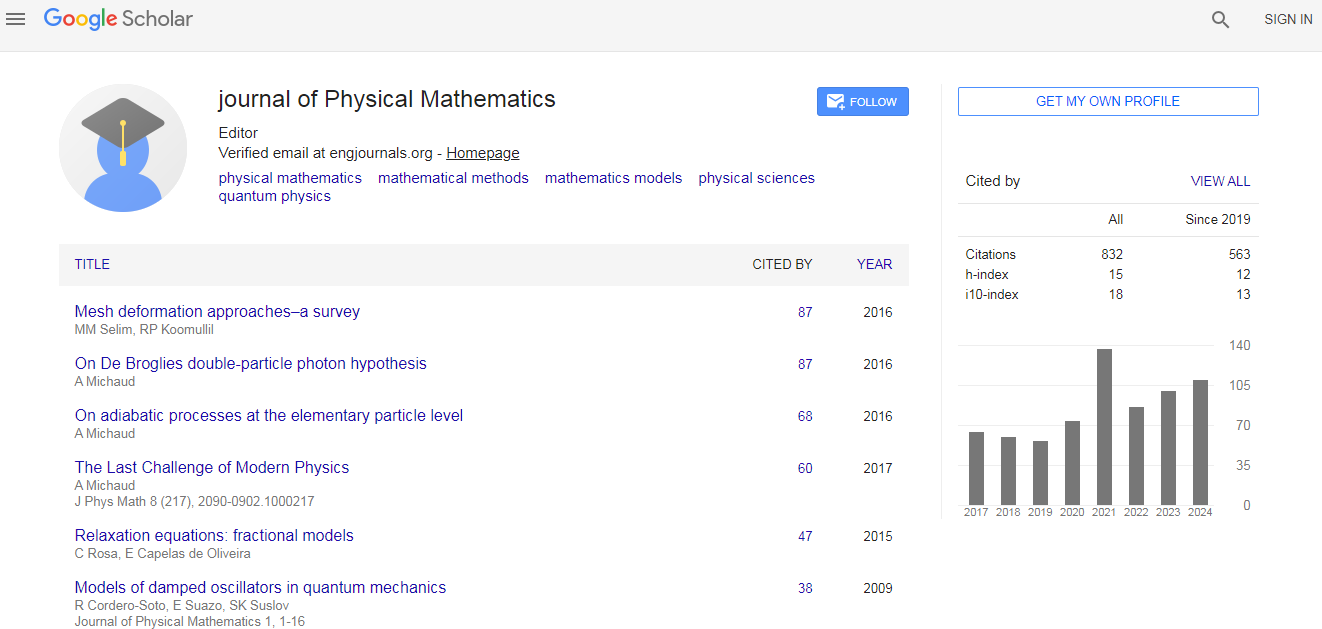
Physical Mathematics received 686 citations as per Google Scholar report