Perspective - (2025) Volume 16, Issue 5
Received: 01-Sep-2025, Manuscript No. jpm-26-179459;
Editor assigned: 03-Sep-2025, Pre QC No. P-179459;
Reviewed: 17-Sep-2025, QC No. Q-179459;
Revised: 22-Sep-2025, Manuscript No. R-179459;
Published:
29-Sep-2025
, DOI: 10.37421/2090-0902.2025.16.557
Citation: Brooks, Nathaniel. ”Mathematical Foundations of Continuum Mechanics and Elasticity.” J Phys Math 16 (2025):557.
Copyright: © 2025 Brooks N. This is an open-access article distributed under the terms of the Creative Commons Attribution License, which permits unrestricted use, distribution and reproduction in any medium, provided the original author and source are credited.
This review delves into the foundational principles of mathematical elasticity and continuum mechanics, exploring how these frameworks model the behavior of deformable solids. It examines the development and application of constitutive laws that relate stress and strain, highlighting their role in understanding phenomena like wave propagation and fracture mechanics within various materials. The work emphasizes the mathematical framework necessary for solving complex boundary value problems and the numerical techniques employed to approximate solutions [1].
Further exploration is dedicated to advanced topics in continuum mechanics, with a specific focus on non-linear elasticity and its diverse applications. This section discusses the mathematical formulation of strain measures, stress tensors, and energy potentials pertinent to large deformations. The paper also covers critical aspects of material stability and bifurcation phenomena, which are essential for comprehending material failure and its response under extreme conditions. Computational methods for solving non-linear elastic problems are also presented [2].
Another significant area of investigation is the mathematical modeling of viscoelastic materials within the established framework of continuum mechanics. This part of the review explores constitutive relations that effectively capture time-dependent material behavior, including phenomena such as creep and stress relaxation. It meticulously examines the role of internal variables and relaxation functions in accurately describing the response of polymers and other viscoelastic substances. The article also touches upon the spectral analysis of various viscoelastic models [3].
In parallel, a comprehensive mathematical analysis of wave propagation in elastic media is presented. This coverage includes the fundamental theory of elastic waves, encompassing both longitudinal and shear waves, and details their behavior in both isotropic and anisotropic materials. The paper discusses the rigorous derivation of wave equations from the governing equations of motion and constitutive relations, and further explores phenomena like reflection, refraction, and dispersion. Methods for analyzing wave interaction with boundaries are also thoroughly included [4].
This collection of research also addresses the critical mathematical theory of fracture mechanics, specifically within the context of continuum mechanics. It introduces fundamental concepts such as stress intensity factors and energy release rates, which are crucial for understanding crack propagation. The work discusses Griffith's criterion and its various extensions, as well as the mathematical formulation of cohesive zone models for simulating fracture initiation and growth. Practical applications to material failure are also explored [5].
An important segment of this review is dedicated to the mathematical aspects of elasticity as applied to porous media. This section scrutinizes how the internal pore structure and fluid-solid interactions collectively influence the overall mechanical response of the material. The paper discusses the development of effective medium theories and homogenization techniques, which are essential for deriving macroscopic constitutive equations. Applications within geomechanics and biomechanics are specifically highlighted [6].
Furthermore, a detailed presentation of the mathematical framework for the theory of thermoelasticity is provided. This theory integrates the significant effects of temperature changes on material deformation and stress. The paper covers the derivation of the governing equations, which incorporate thermal strain and heat conduction. Solutions for a variety of boundary value problems involving thermal loads are discussed, along with the intricate coupling effects between mechanical and thermal fields [7].
The research also explores the vital area of mathematical modeling of damage mechanics in materials. The focus here is on constitutive models that accurately describe the evolution of material damage under applied mechanical loading, which ultimately leads to material softening and failure. The paper discusses various damage variables and their corresponding evolution laws, alongside ensuring the thermodynamic consistency of these models. Practical applications related to structural integrity assessment are presented [8].
Concurrently, an examination of the mathematical theory of plasticity within continuum mechanics is undertaken. This involves introducing fundamental concepts such as yield criteria, flow rules, and hardening rules, which collectively govern the behavior of plastic deformation. The work discusses different plasticity models, including incremental plasticity and damage-coupled plasticity. The practical application of these theories to metal forming and structural analysis is thoroughly explored [9].
Finally, a dedicated article focuses on the mathematical aspects of fluid-structure interaction within the broader field of continuum mechanics. This addresses the complex interplay that occurs between deformable solid structures and the surrounding fluid flows. The paper discusses coupled mathematical models and advanced numerical methods specifically designed for simulating phenomena such as aeroelasticity and hydroelasticity. Applications relevant to aerospace and marine engineering are thoroughly considered [10].
This work delves into the foundational principles of mathematical elasticity, exploring how continuum mechanics models the behavior of deformable solids. It examines the development and application of constitutive laws that relate stress and strain, highlighting their role in understanding phenomena like wave propagation and fracture mechanics within various materials. The work emphasizes the mathematical framework necessary for solving complex boundary value problems and the numerical techniques employed to approximate solutions [1].
Further investigation is directed towards advanced topics in continuum mechanics, with a keen focus on non-linear elasticity and its practical applications. This section meticulously discusses the mathematical formulation of strain measures, stress tensors, and energy potentials essential for analyzing large deformations. The paper also thoroughly covers crucial aspects of material stability and bifurcation phenomena, which are indispensable for understanding material failure and its response under extreme conditions. Computational methods utilized for solving non-linear elastic problems are also presented [2].
Another significant area of research involves the mathematical modeling of viscoelastic materials within the established framework of continuum mechanics. This part of the review scrutinizes constitutive relations that effectively capture time-dependent material behavior, encompassing phenomena such as creep and stress relaxation. It meticulously examines the role of internal variables and relaxation functions in accurately describing the response of polymers and other viscoelastic substances. The article also touches upon the spectral analysis of various viscoelastic models [3].
In parallel, a comprehensive mathematical analysis of wave propagation in elastic media is presented. This coverage includes the fundamental theory of elastic waves, encompassing both longitudinal and shear waves, and details their behavior in both isotropic and anisotropic materials. The paper discusses the rigorous derivation of wave equations from the governing equations of motion and constitutive relations, and further explores phenomena like reflection, refraction, and dispersion. Methods for analyzing wave interaction with boundaries are also thoroughly included [4].
This collection of research also addresses the critical mathematical theory of fracture mechanics, specifically within the context of continuum mechanics. It introduces fundamental concepts such as stress intensity factors and energy release rates, which are crucial for understanding crack propagation. The work discusses Griffith's criterion and its various extensions, as well as the mathematical formulation of cohesive zone models for simulating fracture initiation and growth. Practical applications to material failure are also explored [5].
An important segment of this review is dedicated to the mathematical aspects of elasticity as applied to porous media. This section scrutinizes how the internal pore structure and fluid-solid interactions collectively influence the overall mechanical response of the material. The paper discusses the development of effective medium theories and homogenization techniques, which are essential for deriving macroscopic constitutive equations. Applications within geomechanics and biomechanics are specifically highlighted [6].
Furthermore, a detailed presentation of the mathematical framework for the theory of thermoelasticity is provided. This theory integrates the significant effects of temperature changes on material deformation and stress. The paper covers the derivation of the governing equations, which incorporate thermal strain and heat conduction. Solutions for a variety of boundary value problems involving thermal loads are discussed, along with the intricate coupling effects between mechanical and thermal fields [7].
The research also explores the vital area of mathematical modeling of damage mechanics in materials. The focus here is on constitutive models that accurately describe the evolution of material damage under applied mechanical loading, which ultimately leads to material softening and failure. The paper discusses various damage variables and their corresponding evolution laws, alongside ensuring the thermodynamic consistency of these models. Practical applications related to structural integrity assessment are presented [8].
Concurrently, an examination of the mathematical theory of plasticity within continuum mechanics is undertaken. This involves introducing fundamental concepts such as yield criteria, flow rules, and hardening rules, which collectively govern the behavior of plastic deformation. The work discusses different plasticity models, including incremental plasticity and damage-coupled plasticity. The practical application of these theories to metal forming and structural analysis is thoroughly explored [9].
Finally, a dedicated article focuses on the mathematical aspects of fluid-structure interaction within the broader field of continuum mechanics. This addresses the complex interplay that occurs between deformable solid structures and the surrounding fluid flows. The paper discusses coupled mathematical models and advanced numerical methods specifically designed for simulating phenomena such as aeroelasticity and hydroelasticity. Applications relevant to aerospace and marine engineering are thoroughly considered [10].
This collection of research papers provides a comprehensive overview of the mathematical theories underpinning continuum mechanics and elasticity. It covers fundamental concepts like constitutive laws, stress-strain relationships, and boundary value problems. Advanced topics include non-linear elasticity, viscoelasticity, and wave propagation in elastic media. The research also delves into specialized areas such as fracture mechanics, elasticity of porous media, thermoelasticity, damage mechanics, and plasticity. Furthermore, it addresses the complex field of fluid-structure interaction. The papers emphasize the mathematical frameworks and computational techniques necessary for understanding and predicting the behavior of deformable materials under various conditions, with applications spanning engineering and scientific disciplines.
None
None
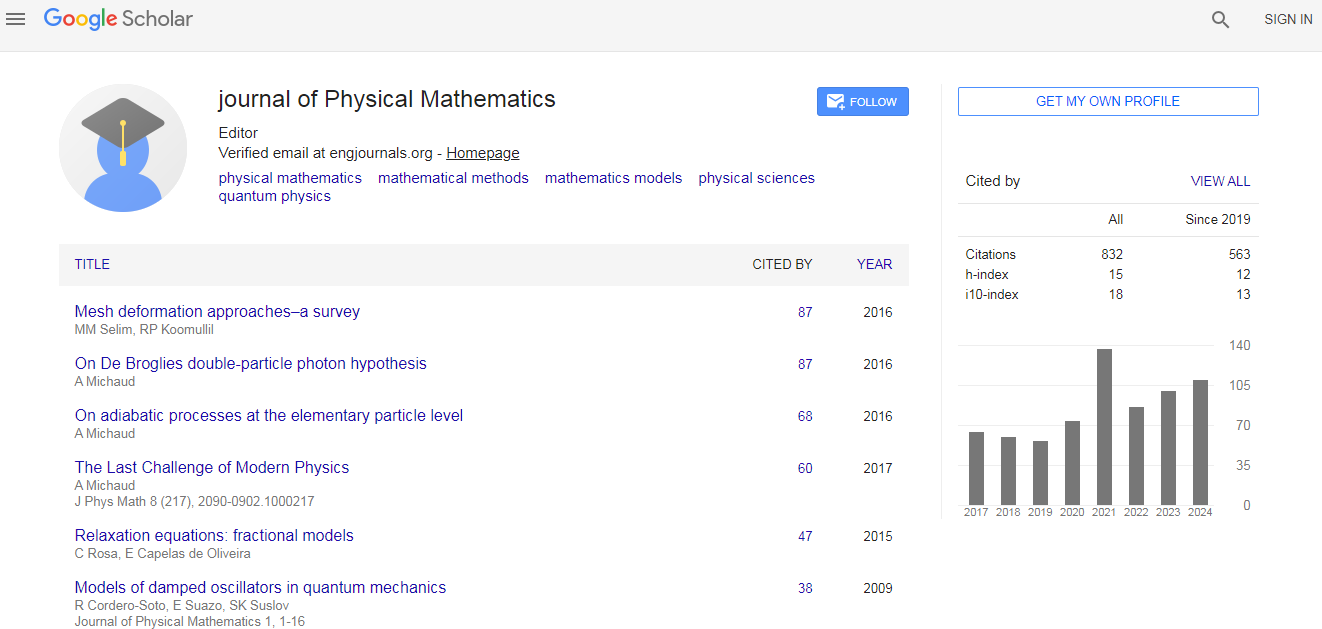
Physical Mathematics received 686 citations as per Google Scholar report