Opinion - (2025) Volume 9, Issue 1
Received: 01-Jan-2025, Manuscript No. jma-25-172661;
Editor assigned: 03-Jan-2025, Pre QC No. P-172661;
Reviewed: 17-Jan-2025, QC No. Q-172661;
Revised: 22-Jan-2025, Manuscript No. R-172661;
Published:
29-Jan-2025
, DOI: 10.37421/2684-4265.2025.09.361
Citation: Chatterjee, Nandini R.. ”Mastering Anatomy: Key to Clinical Success.” J Morphol Anat 09 (2025):361.
Copyright: © 2025 Chatterjee R. Nandini This is an open-access article distributed under the terms of the Creative Commons Attribution License, which permits unrestricted use, distribution and reproduction in any medium, provided the original author and source are credited.
The intricate and diverse landscape of human anatomy remains a cornerstone of medical understanding, profoundly influencing diagnostic precision, therapeutic interventions, and patient outcomes. A series of systematic reviews and analyses underscore the critical importance of detailed anatomical knowledge across various regions and physiological systems. Understanding the glenoid labrum's complex anatomy is crucial for diagnosing and treating shoulder instability and pain. This review compiles current knowledge on its structure, variations, and attachments, highlighting how these details inform surgical approaches and rehabilitation strategies. It emphasizes the diverse morphological presentations, impacting how we interpret imaging and plan interventions[1].
Similarly, the posterolateral corner of the knee, a critical yet often misunderstood region due to its intricate ligamentous and tendinous structures, requires clear anatomical definition. A precise understanding here helps prevent and treat complex knee injuries, as damage often leads to chronic instability if not addressed correctly[2].
A detailed look at the distal biceps tendon insertion reveals significant anatomical variability, which profoundly affects surgical repair and patient outcomes. Synthesizing findings on different insertion patterns assists surgeons in tailoring procedures more effectively. This suggests that standard approaches might not always be optimal, demanding a nuanced appreciation of individual anatomical differences[3].
Moving beyond specific joint structures, fascia, often overlooked, plays a crucial role in body mechanics, pain perception, and systemic health. Its clinical relevance extends from connective tissue disease to chronic pain syndromes, arguing for its recognition as a vital organ. Understanding fascia's intricate layers and connections provides new avenues for therapeutic interventions beyond traditional muscle and bone focus[4].
Connective tissue and fascia form an integrated system throughout the body, providing structural support, facilitating movement, and transmitting mechanical forces. An overview of their complex organization and functional interconnectedness helps us grasp how localized injuries can have widespread effects and why treatments focusing on connective tissue can be effective for musculoskeletal issues[5].
Returning to limb stability, the lateral ankle ligaments are key to ankle integrity, and their precise anatomy is essential for accurate diagnosis and successful treatment of sprains and chronic instability. Synthesizing current anatomical data, especially variations, influences surgical repair. A deep understanding of these structures is fundamental for orthopedic surgeons to effectively restore function and prevent recurrent injuries[6].
In the upper extremity, understanding peripheral nerve anatomy in the hand and wrist is paramount for microsurgery, nerve repair, and understanding neuropathies. This comprehensive overview of spatial relationships and variations of these nerves is vital for minimizing iatrogenic injury and ensuring functional recovery, preventing complications in hand surgery[7].
The flexor retinaculum, a fibrous band in the wrist, is crucial in carpal tunnel syndrome, forming the roof of the carpal tunnel. Clarifying its anatomical characteristics and variations is essential for surgical release procedures. A precise understanding helps surgeons avoid damaging vital structures while effectively decompressing the median nerve, improving patient outcomes[8].
Beyond musculoskeletal components, adipose tissue is far more than just fat storage; it is a dynamic endocrine organ deeply involved in metabolic regulation, inflammation, and energy homeostasis. Exploring its diverse anatomical locations and physiological functions highlights its role in systemic health and disease. It means recognizing adipose tissue as a complex signaling hub, not just passive insulation, with implications for treating obesity and related conditions[9].
Finally, the lumbar multifidus muscle is a key stabilizer of the spine, and understanding its anatomy is vital for addressing low back pain. A detailed examination of its structure and variations directly impacts rehabilitation strategies. Precise anatomical knowledge helps target exercises and interventions more effectively, supporting spinal health and function[10].
Collectively, these studies highlight a persistent theme: a thorough and nuanced appreciation of anatomical structures, their variations, and their functional roles is not merely academic, but directly translates into improved clinical practice and enhanced patient care across orthopedic, neurological, and metabolic disciplines. This body of work underscores the continuous need for research into anatomical specifics to refine medical and surgical strategies.
Understanding the glenoid labrum's complex anatomy is crucial for diagnosing and treating shoulder instability and pain. This review compiles current knowledge on its structure, variations, and attachments, highlighting how these details inform surgical approaches and rehabilitation strategies, with diverse morphological presentations impacting imaging and intervention planning[1]. The posterolateral corner of the knee, a critical and often misunderstood region due to its intricate ligamentous and tendinous structures, clarifies its anatomy by identifying key stabilizing components and their relationships. A more precise understanding helps prevent and treat complex knee injuries, as damage here often leads to chronic instability if not addressed correctly[2]. A detailed look at the distal biceps tendon insertion reveals significant anatomical variability, profoundly affecting surgical repair and patient outcomes. This review synthesizes findings on different insertion patterns, helping surgeons tailor procedures more effectively, recognizing that standard approaches might not always be optimal and demanding a nuanced appreciation of individual anatomical differences[3].
Fascia, often overlooked, plays a crucial role in body mechanics, pain perception, and systemic health. This article underscores its clinical relevance, from connective tissue disease to chronic pain syndromes, arguing for its recognition as a vital organ. Understanding fascia's intricate layers and connections provides new avenues for therapeutic interventions beyond traditional muscle and bone focus[4]. Connective tissue and fascia form an integrated system throughout the body, providing structural support, facilitating movement, and transmitting mechanical forces. This overview outlines their complex organization and functional interconnectedness. Understanding these ubiquitous tissues helps us grasp how localized injuries can have widespread effects and why treatments focusing on connective tissue can be so effective for musculoskeletal issues[9].
The lateral ankle ligaments are key to ankle stability, and their precise anatomy is essential for accurate diagnosis and successful treatment of sprains and chronic instability. This review synthesizes current anatomical data, highlighting variations that can influence surgical repair. A deep understanding of these structures is fundamental for orthopedic surgeons to effectively restore function and prevent recurrent injuries[5]. Understanding the peripheral nerve anatomy in the hand and wrist is paramount for microsurgery, nerve repair, and understanding neuropathies. This review provides a comprehensive overview of the spatial relationships and variations of these nerves, vital for minimizing iatrogenic injury. Meticulous anatomical knowledge ensures functional recovery and prevents complications in hand surgery[6]. The flexor retinaculum, a fibrous band in the wrist, is crucial in carpal tunnel syndrome, forming the roof of the carpal tunnel. This systematic review clarifies its anatomical characteristics and variations, essential for surgical release procedures. A precise understanding helps surgeons avoid damaging vital structures while effectively decompressing the median nerve, improving patient outcomes[7].
Adipose tissue is far more than just fat storage; it is a dynamic endocrine organ deeply involved in metabolic regulation, inflammation, and energy homeostasis. This article explores its diverse anatomical locations and physiological functions, highlighting its role in systemic health and disease. Recognizing adipose tissue as a complex signaling hub, not just passive insulation, has implications for treating obesity and related conditions[8]. The lumbar multifidus muscle is a key stabilizer of the spine, and understanding its anatomy is vital for addressing low back pain. This systematic review provides a detailed examination of its structure and variations, which directly impacts rehabilitation strategies. Precise anatomical knowledge helps target exercises and interventions more effectively, supporting spinal health and function[10].
Overall, these studies emphasize that meticulous anatomical research is not just an academic pursuit; it fundamentally shapes clinical practice. Recognizing the diverse morphological presentations of structures like the glenoid labrum or the variable insertion patterns of the distal biceps tendon allows for personalized medical and surgical strategies. Understanding complex regions, such as the posterolateral corner of the knee or the delicate peripheral nerves of the hand and wrist, prevents iatrogenic damage and ensures better functional recovery. The evolving understanding of tissues like fascia and adipose tissue as dynamic, interconnected systems, rather than passive components, broadens therapeutic horizons for chronic pain, metabolic disorders, and systemic health. These findings collectively advocate for integrating detailed anatomical insights into diagnosis, treatment planning, and rehabilitation protocols to improve patient outcomes across orthopedic, neurological, and broader medical disciplines. This constant refinement of anatomical knowledge is crucial for advancing healthcare.
Understanding specific anatomical structures is crucial for effective diagnosis, treatment, and rehabilitation across various medical fields. Reviews highlight the glenoid labrum's complex anatomy and morphological variations, essential for addressing shoulder instability and pain. The intricate ligamentous and tendinous structures of the posterolateral knee corner require precise understanding to prevent chronic instability. Distal biceps tendon insertion patterns show significant variability, impacting surgical repair outcomes. Fascia, often an overlooked organ, plays a vital role in body mechanics, pain perception, and systemic health, offering new therapeutic avenues. Lateral ankle ligaments are fundamental for stability; their detailed anatomy helps in treating sprains and preventing recurrent injuries. Meticulous knowledge of peripheral nerve anatomy in the hand and wrist is critical for microsurgery and avoiding iatrogenic injury. The flexor retinaculum's anatomical characteristics are key to surgical success in carpal tunnel syndrome, ensuring median nerve decompression. Adipose tissue is a dynamic endocrine organ, not just for storage, involved in metabolic regulation and inflammation, with broad implications for health. Connective tissue and fascia form an integrated system, providing support and force transmission, explaining widespread effects of localized injuries. The lumbar multifidus muscle, a key spine stabilizer, demands precise anatomical knowledge to guide rehabilitation for low back pain.
None
None
Indexed at, Google Scholar, Crossref
Indexed at, Google Scholar, Crossref
Indexed at, Google Scholar, Crossref
Indexed at, Google Scholar, Crossref
Indexed at, Google Scholar, Crossref
Indexed at, Google Scholar, Crossref
Indexed at, Google Scholar, Crossref
Indexed at, Google Scholar, Crossref
Indexed at, Google Scholar, Crossref
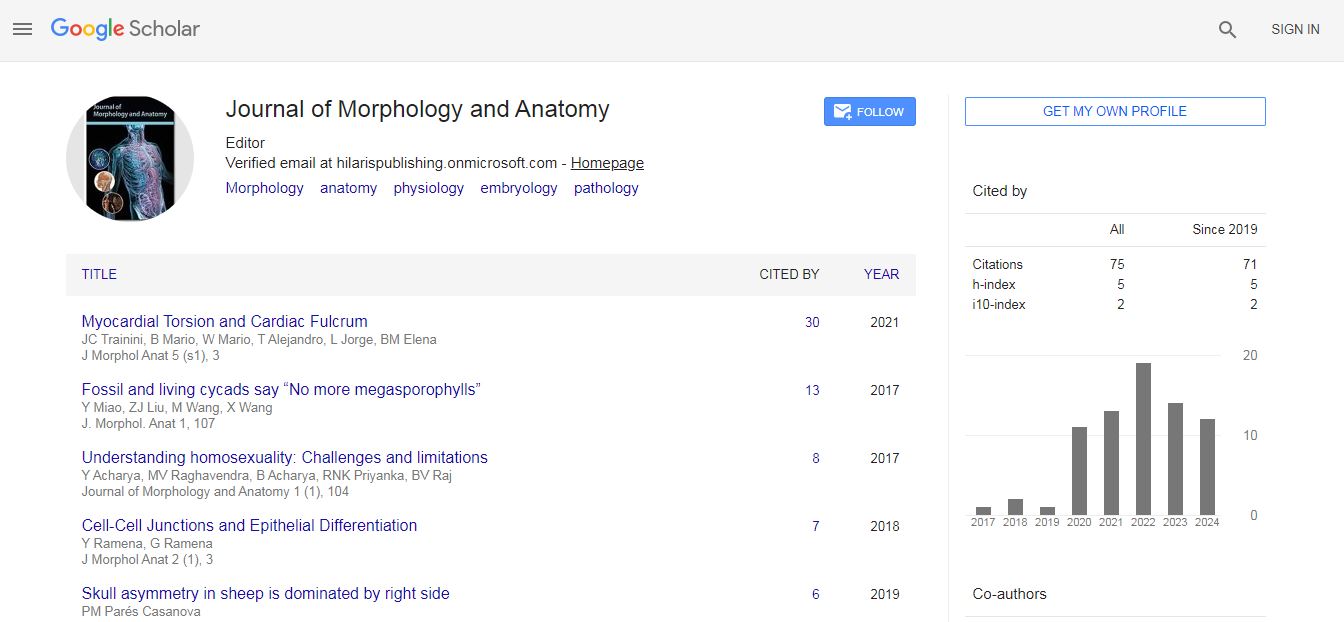
Journal of Morphology and Anatomy received 63 citations as per Google Scholar report