Commentary - (2025) Volume 15, Issue 3
Received: 30-May-2025, Manuscript No. jmcj-25-176498;
Editor assigned: 02-Jun-2025, Pre QC No. P-176498;
Reviewed: 13-Jun-2025, QC No. Q-176498;
Revised: 20-Jun-2025, Manuscript No. R-176498;
Published:
27-Jun-2025
, DOI: 10.37421/2165-7912.2025.15.626
Citation: Mei Ling Tan. "Mass Communication: Shaping Health and Society." J Mass Communicat Journalism 15 (2025): 626.
Copyright: © 2025 T. Ling Mei This is an open-access article distributed under the terms of the Creative Commons Attribution License, which permits unrestricted use, distribution and reproduction in any medium, provided the original author and source are credited.
This paper reviews how social media platforms are used in public health initiatives. It highlights their role in disseminating health messages, fostering community engagement, and supporting behavior change, while acknowledging challenges like misinformation and privacy concerns. The findings suggest that carefully designed social media campaigns can effectively influence health outcomes [1].
This review examines how media functions during public health crises, focusing on its capacity to inform, engage, and shape public perception. It emphasizes the dual role of media in disseminating critical information and potentially contributing to panic or misinformation, highlighting the need for responsible communication strategies [2].
This review explores the relationship between digital health literacy and how individuals seek health information, particularly for chronic diseases. It reveals that effective mass communication relies on individuals' ability to access, understand, and apply digital health information, highlighting disparities that can impact health outcomes [3].
This article applies the social ecological model to climate change communication, illustrating how mass communication can drive social change by influencing individuals, communities, and policy. It highlights the importance of tailored messages and multi-level interventions to foster environmental action and awareness [4].
This study examines the ethical dilemmas faced by journalists reporting on the COVID-19 pandemic. It highlights challenges such as balancing public interest with privacy, avoiding sensationalism, and verifying information in a rapidly evolving crisis, underlining the crucial role of ethical journalistic practices in shaping public trust [5].
This review synthesizes research on how social media use affects adolescent mental health. It identifies both positive aspects, like social support and identity formation, and negative ones, such as cyberbullying and increased anxiety, underscoring the complex influence of mass communication channels on youth development [6].
This review examines how global health messages are communicated in the digital age. It highlights the potential for widespread information dissemination and cultural exchange, but also addresses significant challenges such as overcoming language barriers, cultural sensitivities, and combating misinformation to achieve effective global health outcomes [7].
This review examines how social media platforms influence health-related behaviors and consumer choices. It shows that mass communication through these channels can shape perceptions, norms, and purchasing decisions, highlighting the power of digital media in influencing societal health trends and commercial engagement [8].
This review examines how mass media shapes public attitudes toward vaccination. It reveals that media narratives, whether accurate or misleading, significantly influence public trust and uptake of vaccines, emphasizing the critical role of responsible communication in public health campaigns and opinion formation [9].
This review and meta-analysis assesses the effectiveness of mass media campaigns in improving health education outcomes. It concludes that well-designed campaigns can significantly impact knowledge, attitudes, and behaviors, demonstrating mass communication's potent ability to educate and promote healthier lifestyles across populations [10].
This paper reviews how social media platforms are used in public health initiatives. It highlights their role in disseminating health messages, fostering community engagement, and supporting behavior change, while acknowledging challenges like misinformation and privacy concerns. The findings suggest that carefully designed social media campaigns can effectively influence health outcomes [1]. This review examines how media functions during public health crises, focusing on its capacity to inform, engage, and shape public perception. It emphasizes the dual role of media in disseminating critical information and potentially contributing to panic or misinformation, highlighting the need for responsible communication strategies [2].
This review explores the relationship between digital health literacy and how individuals seek health information, particularly for chronic diseases. It reveals that effective mass communication relies on individuals' ability to access, understand, and apply digital health information, highlighting disparities that can impact health outcomes [3]. This article applies the social ecological model to climate change communication, illustrating how mass communication can drive social change by influencing individuals, communities, and policy. It highlights the importance of tailored messages and multi-level interventions to foster environmental action and awareness [4].
This study examines the ethical dilemmas faced by journalists reporting on the COVID-19 pandemic. It highlights challenges such as balancing public interest with privacy, avoiding sensationalism, and verifying information in a rapidly evolving crisis, underlining the crucial role of ethical journalistic practices in shaping public trust [5]. This review synthesizes research on how social media use affects adolescent mental health. It identifies both positive aspects, like social support and identity formation, and negative ones, such as cyberbullying and increased anxiety, underscoring the complex influence of mass communication channels on youth development [6].
This review examines how global health messages are communicated in the digital age. It highlights the potential for widespread information dissemination and cultural exchange, but also addresses significant challenges such as overcoming language barriers, cultural sensitivities, and combating misinformation to achieve effective global health outcomes [7]. This review examines how social media platforms influence health-related behaviors and consumer choices. It shows that mass communication through these channels can shape perceptions, norms, and purchasing decisions, highlighting the power of digital media in influencing societal health trends and commercial engagement [8].
This review examines how mass media shapes public attitudes toward vaccination. It reveals that media narratives, whether accurate or misleading, significantly influence public trust and uptake of vaccines, emphasizing the critical role of responsible communication in public health campaigns and opinion formation [9]. This review and meta-analysis assesses the effectiveness of mass media campaigns in improving health education outcomes. It concludes that well-designed campaigns can significantly impact knowledge, attitudes, and behaviors, demonstrating mass communication's potent ability to educate and promote healthier lifestyles across populations [10].
This body of work explores the multifaceted role of mass communication channels, including social media and traditional media, in shaping public health, societal behaviors, and attitudes. Social media platforms are vital tools for public health initiatives, disseminating health messages, encouraging community involvement, and supporting behavior change. This includes acknowledging challenges like misinformation and privacy concerns. During public health crises, media acts as a critical informant, engaging the public and influencing perception, though it also carries the risk of spreading panic or false information, underscoring the necessity for responsible communication. Digital health literacy is key to how individuals seek and understand health information, especially for chronic diseases, with disparities potentially affecting health outcomes. Mass communication also drives social change, as exemplified by applying the social ecological model to climate change communication, emphasizing tailored messages for environmental action. Journalism, particularly during events like the COVID-19 pandemic, faces ethical challenges in balancing public interest with privacy and verifying information. Social media's influence extends to adolescent mental health, presenting both opportunities for social support and risks like cyberbullying. Furthermore, global health communication in the digital age faces hurdles such as language barriers, cultural sensitivities, and misinformation. Overall, this research demonstrates the potent ability of well-designed mass media campaigns to significantly impact health education outcomes, influence health-related behaviors, consumer choices, and shape public attitudes toward critical issues like vaccination.
None
None
Indexed at, Google Scholar, Crossref
Indexed at, Google Scholar, Crossref
Indexed at, Google Scholar, Crossref
Indexed at, Google Scholar, Crossref
Indexed at, Google Scholar, Crossref
Indexed at, Google Scholar, Crossref
Indexed at, Google Scholar, Crossref
Indexed at, Google Scholar, Crossref
Indexed at, Google Scholar, Crossref
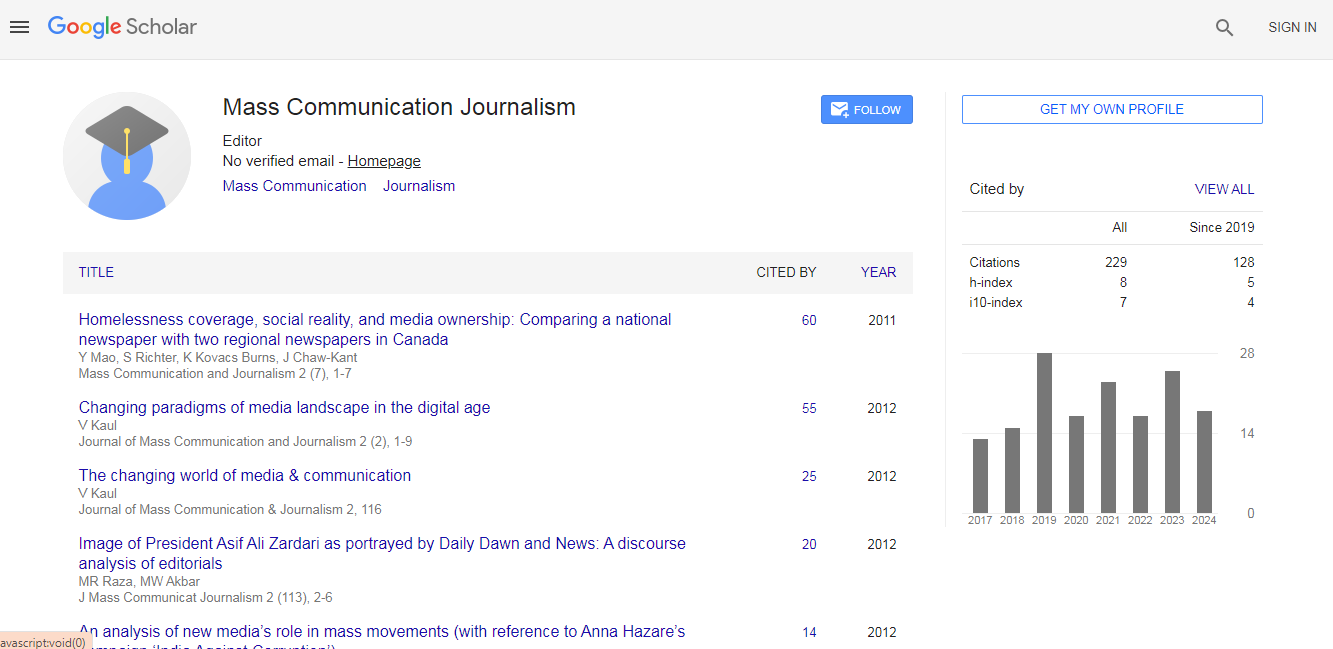
Journal of Mass Communication & Journalism received 205 citations as per Google Scholar report