Commentary - (2025) Volume 15, Issue 5
Received: 01-Sep-2025, Manuscript No. jbpbt-25-178518;
Editor assigned: 03-Sep-2025, Pre QC No. P-178518;
Reviewed: 17-Sep-2025, QC No. Q-178518;
Revised: 22-Sep-2025, Manuscript No. R-178518;
Published:
29-Sep-2025
, DOI: 10.37421/2155-9821.2025.15.694
Citation: Collins, Benjamin R.. ”Machine Learning: Revolutionizing Bioprocess Control and Efficiency.” J Bioprocess Biotech 15 (2025):694.
Copyright: © 2025 Collins R. Benjamin This is an open-access article distributed under the terms of the Creative Commons Attribution License, which permits unrestricted use,
distribution and reproduction in any medium, provided the original author and source are credited.
The field of bioprocess control is undergoing a significant transformation driven by the integration of machine learning (ML) techniques. These advanced algorithms are proving instrumental in analyzing the complex, high-dimensional data generated by modern bioprocesses, enabling more precise and adaptive control strategies than ever before. Specifically, ML algorithms offer powerful capabilities for predictive modeling, allowing for the anticipation of process behavior and potential issues. They are also crucial for real-time anomaly detection, providing immediate alerts when deviations from normal operating conditions occur. Furthermore, ML facilitates the optimization of critical process parameters, directly contributing to improvements in yield, product quality, and overall process efficiency. Prominent among these ML tools are Support Vector Machines (SVMs), Artificial Neural Networks (ANNs), and Random Forests (RFs), which collectively enhance bioprocess monitoring and control systems [1].
Deep learning, a sophisticated subset of ML, has emerged as a particularly potent force in advancing bioprocess monitoring. Its ability to automatically learn intricate patterns and features directly from raw sensor data addresses many limitations of traditional modeling approaches. Deep neural networks have demonstrated remarkable success in applications such as cell culture and fermentation, significantly improving the prediction of cell growth, product formation, and the early identification of process deviations. This progress signifies a substantial leap towards the realization of intelligent and autonomous bioprocess management systems [2].
In the realm of fermentation processes, the application of ensemble ML models has shown great promise for accurately predicting critical quality attributes (CQAs). By aggregating predictions from multiple individual models, ensemble methods achieve enhanced accuracy and robustness, which are paramount for consistent product quality. This approach is vital for optimizing fermentation conditions and ensuring compliance with stringent regulatory requirements in both pharmaceutical and industrial biotechnology sectors [3].
A critical challenge in bioprocesses is real-time fault detection and diagnosis. Machine learning provides a robust framework for addressing this through anomaly detection algorithms. These algorithms can swiftly identify deviations from established normal operating conditions, enabling prompt intervention and significantly minimizing the risk of costly batch failures. This capability is indispensable for maintaining process integrity and safeguarding product safety, particularly in large-scale manufacturing environments where disruptions can have severe economic consequences [4].
Reinforcement Learning (RL) presents a unique paradigm for bioprocess control optimization. Unlike supervised learning methods, RL agents learn optimal control policies through interactive trial and error, either with the actual process or its simulation. This dynamic approach allows for the continuous optimization of feeding strategies, pH, and temperature, aiming to maximize productivity and minimize operational costs. RL represents a more proactive and adaptive strategy for managing complex bioprocesses [5].
The integration of ML with Process Analytical Technology (PAT) is another significant development for enhancing bioprocess understanding and control. By employing ML models in conjunction with real-time data from spectroscopic and chromatographic measurements, researchers can achieve improved monitoring of product concentration, substrate consumption, and microbial state. This synergy between PAT and ML is fundamental for enabling real-time release testing and moving towards truly continuous manufacturing paradigms [6].
Adaptive bioprocess control is significantly advanced by techniques such as Gaussian Process Regression (GPR). GPR's inherent ability to provide probabilistic predictions, along with a quantification of uncertainty, is crucial for making robust decisions in the often variable and noisy environment of bioprocesses. GPR's capacity to adapt to changing process conditions and inherent uncertainties leads to more reliable control strategies, especially when dealing with significant noise and variability [7].
Hypbrid control strategies that combine fuzzy logic with ML offer a powerful approach to managing bioprocesses. This fusion leverages the interpretability of fuzzy logic for handling imprecision with the learning capabilities of ML for complex nonlinearities. Such hybrid systems have demonstrated improved performance in controlling key parameters like dissolved oxygen and pH, ultimately leading to enhanced microbial growth and higher product yields [8].
Transfer learning represents an innovative solution for bioprocess modeling, particularly in scenarios where large datasets are scarce. This technique allows models trained on one bioprocess to be effectively adapted for new, related processes with significantly reduced data requirements. This is highly advantageous in bioprocessing, where acquiring extensive datasets for every new strain or product can be both time-consuming and prohibitively expensive, thereby improving prediction accuracy for essential metrics like biomass and product formation [9].
As ML models become increasingly integral to bioprocess control, understanding their decision-making processes is paramount for fostering trust and ensuring regulatory compliance. Explainable Artificial Intelligence (XAI) techniques are being developed to interpret these complex models, rendering them more transparent and comprehensible for bioprocess engineers. This interpretability is essential for validating ML-based control strategies and ensuring their safe and effective implementation in critical industrial applications [10].
Machine learning (ML) algorithms are fundamentally reshaping bioprocess control by enabling sophisticated analysis of intricate, high-dimensional data. This analytical power translates into more precise and adaptive control strategies, essential for modern biopharmaceutical and industrial biotechnology applications. ML excels in predictive modeling, allowing for foresight into process dynamics and potential outcomes. Its role in real-time anomaly detection is critical for immediate identification of deviations, thereby preventing costly errors. Furthermore, ML’s capacity to optimize crucial process parameters directly impacts improvements in product yield, quality, and overall efficiency. Key ML algorithms such as Support Vector Machines (SVMs), Artificial Neural Networks (ANNs), and Random Forests (RFs) are pivotal in enhancing both the monitoring and control of bioprocesses [1].
Deep learning, a subset of ML, is significantly advancing bioprocess monitoring by enabling neural networks to automatically discern complex patterns and features from raw sensor data. This self-learning capability overcomes the limitations often encountered with traditional modeling techniques. Applications in areas like cell culture and fermentation have demonstrated deep learning's efficacy in improving predictions of cell growth, product formation, and the early detection of process abnormalities. This technological advancement is a critical step towards achieving intelligent and autonomous management of bioprocesses [2].
Within fermentation processes, ensemble ML models are proving highly effective for the accurate prediction of critical quality attributes (CQAs). By integrating the predictive power of multiple base models, ensemble methods offer superior accuracy and robustness, which are indispensable for maintaining consistent product quality. These techniques are instrumental in optimizing fermentation conditions to meet stringent regulatory demands in the pharmaceutical and industrial biotechnology sectors [3].
The capability of ML to facilitate real-time fault detection and diagnosis in bioprocesses is a significant contribution. Frameworks employing anomaly detection algorithms can promptly identify deviations from normal operational parameters, allowing for immediate corrective actions and minimizing the occurrence of batch failures. This function is vital for preserving the integrity of the process and ensuring product safety, particularly in large-scale manufacturing where process interruptions can be extremely detrimental [4].
Reinforcement Learning (RL) offers a distinct approach to bioprocess control optimization, enabling agents to learn optimal control policies through dynamic interaction and feedback. This methodology allows for continuous adjustment of control parameters like feeding strategies, pH, and temperature to maximize productivity and minimize costs. RL represents a more proactive and adaptive strategy for managing the complexities of bioprocesses [5].
Integrating Machine Learning with Process Analytical Technology (PAT) enhances bioprocess understanding and control by leveraging real-time data. ML models, when applied to data from spectroscopic and chromatographic sensors, improve the monitoring of product concentration, substrate consumption, and microbial states. This integration is fundamental for implementing real-time release testing and achieving continuous manufacturing processes [6].
Gaussian Process Regression (GPR) provides a robust framework for adaptive bioprocess control by offering probabilistic predictions and quantifying uncertainty. This is critical for reliable decision-making in bioprocesses that are subject to noise and variability. GPR's ability to adapt to changing process conditions ensures more dependable control strategies [7].
Hypbrid control strategies that merge fuzzy logic with ML offer a unique advantage in bioprocess management. This combination harnesses the interpretability of fuzzy logic for handling imprecise data with the sophisticated learning capabilities of ML for complex, nonlinear systems. Such hybrid approaches have demonstrated enhanced control over parameters like dissolved oxygen and pH, leading to improved microbial growth and product yields [8].
Transfer learning addresses the challenge of data scarcity in bioprocess modeling. By enabling models trained on one bioprocess to be adapted for new, related processes with less data, it accelerates model development and improves predictive accuracy for essential bioprocess metrics like biomass and product formation. This is particularly valuable in bioprocessing where data acquisition can be costly and time-consuming [9].
Explainable Artificial Intelligence (XAI) is becoming increasingly important as ML models grow more complex. XAI techniques aim to make ML decision-making processes transparent and understandable for bioprocess engineers. This interpretability is crucial for building trust, validating ML-based control strategies, and ensuring their safe and reliable implementation in industrial bioprocesses [10].
Machine learning (ML) is revolutionizing bioprocess control through enhanced data analysis, predictive modeling, and real-time anomaly detection. Techniques like deep learning, ensemble models, and reinforcement learning are optimizing fermentation processes, improving critical quality attribute prediction, and enabling adaptive control. Integration with Process Analytical Technology (PAT) and the use of explainable AI (XAI) further enhance process understanding, monitoring, and the safety of ML-driven strategies. Gaussian Process Regression (GPR) and hybrid fuzzy logic-ML approaches offer robust control in dynamic environments, while transfer learning addresses data limitations. These advancements collectively lead to improved yield, product quality, and process efficiency in biomanufacturing.
None
None
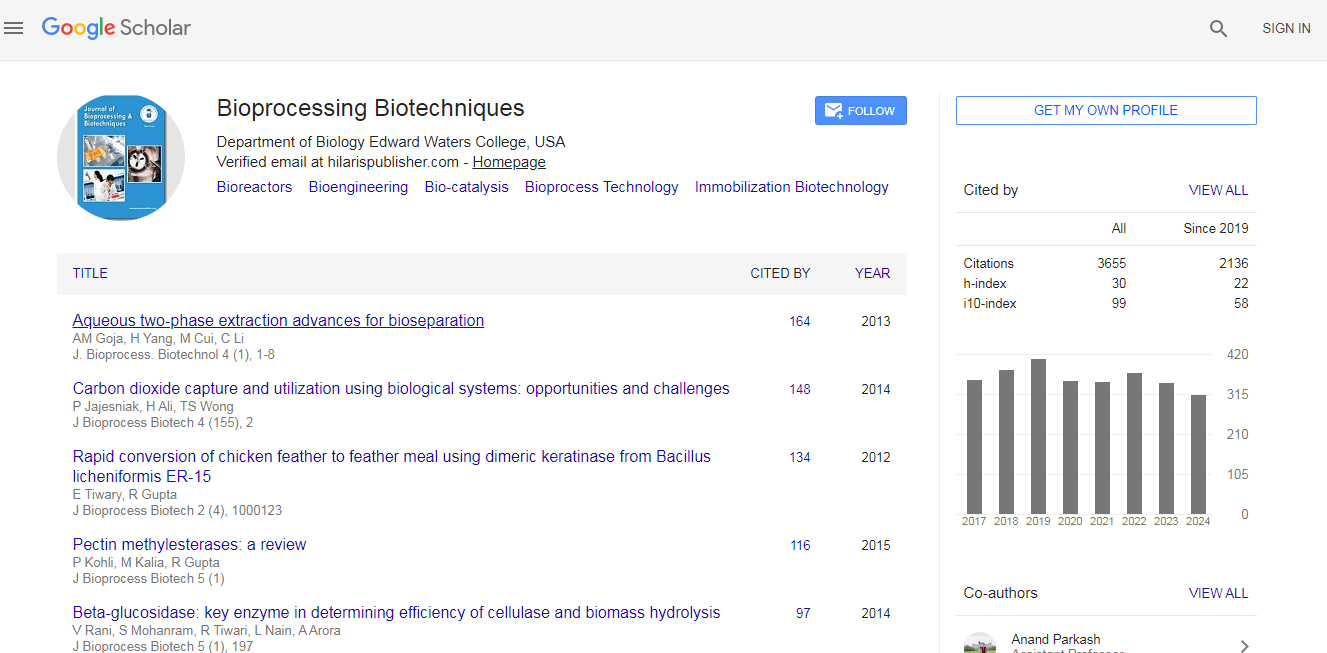
Journal of Bioprocessing & Biotechniques received 3351 citations as per Google Scholar report