Short Communication - (2025) Volume 11, Issue 6
Received: 01-Nov-2025, Manuscript No. ldt-25-178466;
Editor assigned: 03-Nov-2025, Pre QC No. P-178466;
Reviewed: 17-Nov-2025, QC No. Q-178466;
Revised: 22-Nov-2025, Manuscript No. R-178466;
Published:
29-Nov-2025
, DOI: 10.37421/2472-1018.2025.11.340
Citation: Rahman, Noor. ”Lung Disease Research: Precision Medicine, Gene Therapy, AI.” J Lung Dis Treat 11 (2025):340.
Copyright: © 2025 Rahman N. This is an open-access article distributed under the terms of the Creative Commons Attribution License, which permits unrestricted use, distribution and reproduction in any medium, provided the original author and source are credited.
The landscape of lung disease research is undergoing a significant transformation, driven by advancements in understanding disease mechanisms and the pursuit of more effective therapeutic strategies. Personalized medicine, tailored to individual patient characteristics, is emerging as a cornerstone in the approach to various pulmonary conditions. This paradigm shift aims to move beyond generalized treatments towards interventions that address specific molecular and genetic profiles of diseases. Novel therapeutic targets are being identified through rigorous research, offering new avenues for drug development and clinical application. Conditions such as Chronic Obstructive Pulmonary Disease (COPD) and idiopathic pulmonary fibrosis (IPF) are prime examples where a deeper understanding of pathogenesis is paving the way for treatments that extend beyond mere symptom management. Gene editing technologies, such as CRISPR-Cas9, hold considerable promise for correcting genetic defects underlying certain lung diseases. Furthermore, advanced drug delivery systems are being developed to ensure that therapeutic agents reach their target sites within the lungs more efficiently and with fewer systemic side effects. This focus on innovation in both understanding and treating lung diseases underscores a dynamic and rapidly evolving field dedicated to improving patient outcomes and quality of life. The integration of these cutting-edge approaches is crucial for addressing the complex challenges posed by a wide spectrum of respiratory illnesses. The scientific community is actively exploring new frontiers in pulmonary medicine, seeking to translate laboratory discoveries into tangible clinical benefits for patients worldwide. This concerted effort reflects a commitment to pushing the boundaries of what is currently possible in the fight against lung diseases. The future of respiratory care hinges on continued investment in research and development, fostering collaboration among researchers, clinicians, and industry partners to accelerate progress. The development of novel therapeutic targets and the refinement of existing treatment modalities are key components of this ongoing endeavor. The pursuit of precision in diagnosis and treatment is paramount to achieving meaningful advancements in patient care. The complexity of lung diseases necessitates a multifaceted approach, encompassing genetic, molecular, and environmental factors. The insights gained from basic science research are increasingly being translated into clinical practice, promising a new era of lung disease management. This era is characterized by a focus on individualized care and the application of innovative technologies to address unmet medical needs. The ongoing exploration of the lung microbiome represents another significant area of research, highlighting the intricate interplay between microbial communities and respiratory health. The potential to modulate these communities for therapeutic benefit is a promising avenue for future interventions. The application of artificial intelligence and machine learning in medical imaging is revolutionizing diagnostic capabilities, enabling earlier and more accurate detection of lung abnormalities. The ability of AI to analyze complex datasets is proving invaluable in augmenting clinical decision-making. The field of regenerative medicine is also offering new hope for repairing damaged lung tissue, with stem cell therapy and tissue engineering showing potential for restoring lung function. The development of advanced biomarkers is crucial for early diagnosis, prognosis, and monitoring of lung diseases, providing essential tools for personalized treatment strategies. Finally, the ongoing efforts to improve patient outcomes in chronic lung diseases necessitate a multidisciplinary approach, integrating various aspects of care to optimize management and enhance quality of life. The COVID-19 pandemic has further underscored the critical importance of research into viral lung infections and their long-term consequences, prompting accelerated efforts in understanding disease mechanisms and developing effective interventions. The intricate relationship between genetic factors and lung disease susceptibility is being elucidated through genomic studies, paving the way for personalized risk assessment and gene-targeted therapies. The continuous evolution of drug delivery systems is central to enhancing therapeutic efficacy and minimizing adverse effects associated with lung disease treatments. The recognition of the lung microbiomeâ??s role in respiratory health and disease opens up novel therapeutic possibilities through targeted modulation of these microbial communities. The transformative potential of artificial intelligence in pulmonary diagnostics, particularly in image analysis, is poised to significantly improve early detection and treatment planning. The exploration of regenerative medicine strategies offers a promising outlook for repairing lung tissue damage and restoring function in debilitating respiratory conditions. The identification of advanced biomarkers through multi-omics approaches is vital for precision medicine, enabling tailored diagnostic and prognostic assessments. The integration of care models and technological advancements in remote monitoring addresses the complex needs of patients with chronic lung diseases, improving disease management and patient engagement. The ongoing research into the genetic basis of lung diseases is crucial for developing targeted therapies and personalized risk prediction strategies. The development of novel drug delivery systems aims to optimize the therapeutic impact of medications for various pulmonary conditions. The growing understanding of the lung microbiome is revealing new therapeutic avenues for a range of respiratory diseases. The application of artificial intelligence in medical imaging promises to enhance diagnostic accuracy and efficiency in pulmonary care. Regenerative medicine approaches are being explored to restore lung structure and function in chronic lung diseases. The pursuit of advanced biomarkers is essential for precise diagnosis, prognosis, and monitoring of lung conditions. The multidisciplinary management of chronic lung diseases is being enhanced by integrated care models and technological innovations. The recent pandemic has highlighted the urgent need for research into viral lung infections and their long-term effects. The genetic underpinnings of lung diseases are being uncovered, leading to personalized treatment approaches. Advanced drug delivery systems are crucial for improving the effectiveness of lung disease therapies. The lung microbiome is emerging as a key factor in respiratory health and disease, with potential therapeutic implications. Artificial intelligence is revolutionizing pulmonary diagnostics through advanced image analysis. Regenerative medicine offers hope for repairing damaged lung tissue and restoring function. Biomarkers are critical for early detection and personalized management of lung conditions. Improving patient outcomes in chronic lung diseases requires a comprehensive and integrated approach to care. The COVID-19 pandemic has intensified research into viral lung infections and their long-term health impacts. Genetic research is uncovering new targets for personalized therapies in lung diseases. [1] The landscape of lung disease research is rapidly evolving, with a focus on personalized medicine and novel therapeutic targets. Advances in understanding disease pathogenesis, particularly for conditions like COPD and idiopathic pulmonary fibrosis, are paving the way for treatments that go beyond symptom management. Gene editing technologies and advanced drug delivery systems hold promise for more effective and targeted interventions. [2] Precision medicine is a growing area in lung cancer treatment, moving beyond broad-spectrum chemotherapy. Targeted therapies and immunotherapies are showing remarkable efficacy for specific molecular subtypes of non-small cell lung cancer. Liquid biopsies are also emerging as a less invasive method for diagnosis, monitoring, and treatment selection. [3] The role of the lung microbiome in respiratory health and disease is gaining significant attention. Dysbiosis has been linked to various lung conditions, including asthma, COPD, and cystic fibrosis, suggesting that modulating the microbiome could be a future therapeutic strategy. [4] Artificial intelligence (AI) and machine learning (ML) are transforming diagnostic capabilities in lung disease. From analyzing chest X-rays and CT scans for early detection of abnormalities to predicting treatment responses, AI offers a powerful tool to augment clinical decision-making. [5] The development of novel drug delivery systems for lung diseases aims to improve drug efficacy and reduce systemic side effects. Nanoparticle-based delivery, inhaled therapeutics, and targeted delivery mechanisms are active areas of research for conditions like asthma and cystic fibrosis. [6] Understanding the genetic underpinnings of lung diseases is crucial for developing targeted therapies. Genome-wide association studies (GWAS) and exome sequencing are identifying novel genetic variants associated with conditions like COPD and asthma, opening avenues for gene therapy and personalized risk assessment. [7] The COVID-19 pandemic has significantly accelerated research into viral lung infections and their long-term sequelae. Understanding the mechanisms of viral entry, immune response, and tissue repair in the lungs is vital for developing effective treatments and managing post-viral respiratory syndromes. [8] Regenerative medicine holds promise for repairing damaged lung tissue. Stem cell therapy and tissue engineering approaches are being explored for conditions like emphysema and pulmonary fibrosis, aiming to restore lung function and structure. [9] The development of advanced biomarkers is crucial for early diagnosis, prognosis, and monitoring of lung diseases. Proteomics, metabolomics, and advanced imaging techniques are providing new insights into disease states and potential therapeutic targets. [10] Improving patient outcomes in chronic lung diseases requires a multidisciplinary approach. Integrated care models, remote patient monitoring, and patient education programs are essential for managing complex conditions like asthma and cystic fibrosis effectively.
The progressive evolution in the field of pulmonary fibrosis research signifies a move towards personalized medicine, focusing on identifying novel therapeutic targets that go beyond symptomatic relief. Key advancements in understanding the pathogenesis of conditions like COPD and idiopathic pulmonary fibrosis are now guiding the development of more impactful treatments. Notably, gene editing technologies and sophisticated drug delivery systems are being actively investigated for their potential to deliver highly targeted and effective interventions. [1] In the realm of non-small cell lung cancer, precision medicine is reshaping treatment paradigms, shifting away from generalized chemotherapy towards targeted therapies and immunotherapies that demonstrate significant efficacy in specific molecular subtypes. The advent of liquid biopsies is also providing a less invasive means for diagnosis, disease monitoring, and the selection of appropriate treatment regimens. [2] The lung microbiomeâ??s influence on respiratory health and disease is increasingly recognized as a critical area of research. Aberrations in microbial composition, known as dysbiosis, have been associated with a range of lung conditions, including asthma, COPD, and cystic fibrosis, suggesting that therapeutic interventions aimed at modulating the microbiome could represent a future treatment strategy. [3] Artificial intelligence (AI) and machine learning (ML) are revolutionizing diagnostic capabilities in pulmonary medicine. These technologies are being applied to analyze medical images such as chest X-rays and CT scans for the early detection of abnormalities, and to predict patient responses to various treatments, thereby serving as powerful tools to support clinical decision-making. [4] The design and development of advanced drug delivery systems are a primary focus in the treatment of lung diseases, with the overarching goal of enhancing therapeutic efficacy while minimizing undesirable systemic side effects. Research is actively exploring nanoparticle-based delivery, inhaled therapeutics, and targeted delivery mechanisms for conditions such as asthma and cystic fibrosis. [5] Unraveling the genetic basis of lung diseases is paramount for the development of precisely targeted therapies. Large-scale studies, including genome-wide association studies (GWAS) and exome sequencing, are instrumental in identifying novel genetic variants linked to conditions like COPD and asthma, which in turn opens up possibilities for gene therapy and personalized risk assessment. [6] The COVID-19 pandemic has profoundly accelerated research into viral lung infections and their potential long-term health consequences. A comprehensive understanding of the mechanisms underlying viral entry into lung cells, the subsequent immune response, and the processes of tissue repair is vital for the development of effective treatments and the management of post-viral respiratory syndromes. [7] Regenerative medicine is emerging as a promising field for the repair of damaged lung tissue. Approaches involving stem cell therapy and tissue engineering are under investigation for conditions like emphysema and pulmonary fibrosis, with the ultimate aim of restoring normal lung function and structure. [8] The development of sophisticated biomarkers is essential for the early diagnosis, prognosis, and effective monitoring of lung diseases. Advancements in proteomics, metabolomics, and cutting-edge imaging techniques are providing novel insights into disease states and identifying potential therapeutic targets. [9] Enhancing patient outcomes in chronic lung diseases necessitates a comprehensive, multidisciplinary approach. This includes the implementation of integrated care models, the utilization of remote patient monitoring technologies, and the establishment of robust patient education programs, all of which are crucial for the effective management of complex conditions like asthma and cystic fibrosis. [10]
Lung disease research is rapidly advancing, focusing on personalized medicine and novel therapeutic targets for conditions like COPD and pulmonary fibrosis. Gene editing and advanced drug delivery systems show promise. Precision medicine, including targeted therapies and immunotherapies, is transforming lung cancer treatment, with liquid biopsies emerging as a key diagnostic tool. The lung microbiome's role in respiratory health is gaining attention, suggesting potential therapeutic modulation. Artificial intelligence is revolutionizing diagnostics by analyzing medical images for early detection and treatment response prediction. Regenerative medicine, using stem cells and tissue engineering, offers hope for repairing damaged lung tissue. Advanced biomarkers from proteomics and metabolomics are crucial for early diagnosis and monitoring. Improving patient outcomes in chronic lung diseases requires a multidisciplinary approach, integrating care models and remote monitoring. The COVID-19 pandemic has spurred research into viral lung infections and their long-term effects. Genetic research is identifying variants associated with lung diseases, paving the way for gene therapy and personalized risk assessment. Efforts are underway to improve drug delivery systems for enhanced efficacy and reduced side effects.
None
None
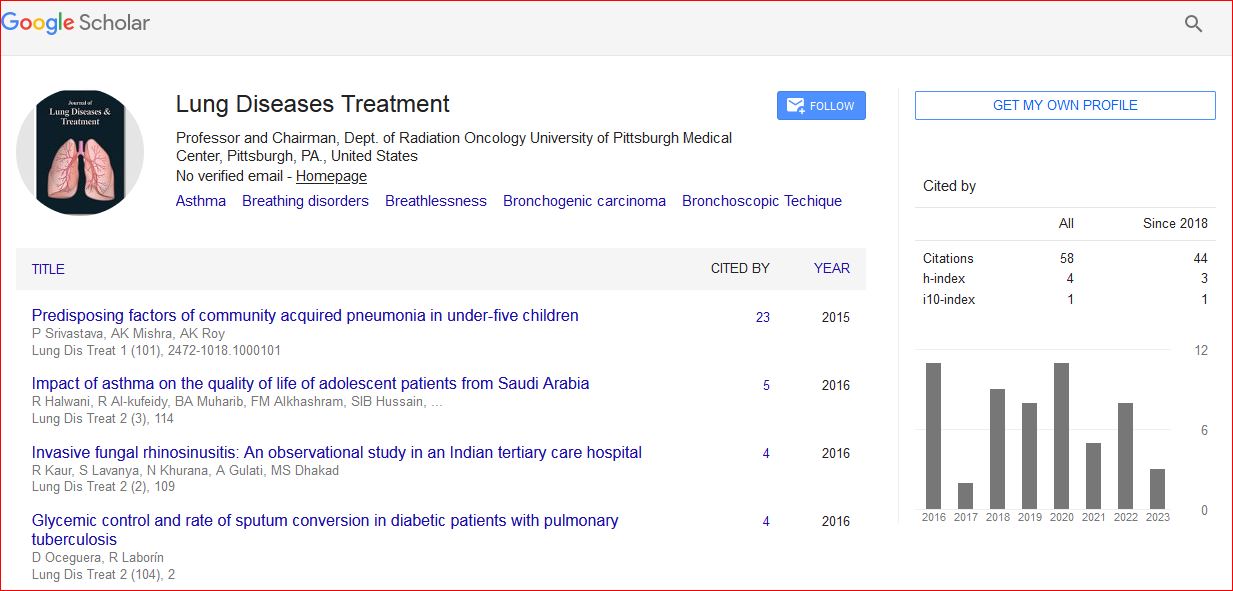
Journal of Lung Diseases & Treatment received 247 citations as per Google Scholar report