Perspective - (2025) Volume 16, Issue 6
Received: 28-Nov-2025, Manuscript No. gjto-25-176209;
Editor assigned: 01-Feb-0025, Pre QC No. P-176209;
Reviewed: 15-Dec-2025, QC No. QC-176209;
Revised: 22-Dec-2025, Manuscript No. R-176209;
Published:
29-Dec-2025
, DOI: 10.37421/2229-8711.2025.16.478
Citation: Farkas, Bence. ”LSTMs: Revolutionizing Medicine and Technology.” Global J Technol Optim 16 (2025):478.
Copyright: © 2025 Farkas B. This is an open-access article distributed under the terms of the Creative Commons Attribution License, which permits unrestricted use, distribution and reproduction in any medium, provided the original author and source are credited.
Deep learning models, particularly Long Short-Term Memory (LSTM) networks, have transformed various scientific and medical domains due to their exceptional ability to process sequential data. These powerful architectures are increasingly vital for making sense of complex, time-dependent information. For instance, LSTMs offer a comprehensive approach to cardiovascular disease prediction, leveraging electronic health records, medical imaging, and genetic data to forecast disease onset, progression, and patient outcomes. This capability holds significant promise for enhancing diagnostic accuracy and enabling personalized treatment strategies [1].
Similarly, LSTM-based models are crucial for disease prognosis prediction across a spectrum of medical fields. They excel at synthesizing findings from sequential patient data, including electronic health records and physiological signals, to accurately forecast disease progression, recurrence, and responses to treatment. The unique strength of LSTMs lies in their capacity to capture long-term dependencies within clinical data, making them invaluable for predicting longitudinal patient outcomes [2].
In the realm of neurodegenerative conditions, deep learning, including LSTM architectures, is being applied to the detection and diagnosis of Alzheimer's disease. By analyzing multi-modal data such as Magnetic Resonance Imaging (MRI) scans, Positron Emission Tomography (PET) scans, and cognitive assessments, LSTMs can identify subtle, temporal patterns that indicate early stages and progression of the disease. This offers critical insights for improved early diagnosis and personalized intervention strategies through effective modeling of sequential disease biomarkers [3].
Beyond direct patient care, deep learning and recurrent neural networks like LSTMs are making strides in drug discovery. They are employed to model chemical structures, predict molecular properties, and design novel compounds by processing sequences like SMILES strings. This methodology significantly contributes to more efficient hit identification, lead optimization, and overall accelerates the drug development pipeline [4].
LSTMs are also instrumental in human activity recognition using wearable sensor data. They effectively capture temporal dependencies and intricate patterns from time-series data collected by accelerometers, gyroscopes, and other physiological sensors. This leads to accurate and robust activity classification, which is essential for pervasive health monitoring, rehabilitation programs, and developing smart environment interactions [5].
Furthermore, deep learning applications, especially LSTMs, systematically explore and analyze protein sequences. These models can discern complex patterns within protein primary structures to predict secondary and tertiary structures, functional annotations, and post-translational modifications. By adeptly learning from sequential amino acid data, LSTMs contribute substantially to advancements in bioinformatics, aiding in protein engineering and drug target identification [6].
Predictive analytics using Electronic Health Records (EHRs) also greatly benefits from deep learning approaches, including LSTMs. LSTMs are particularly adept at handling the sequential, time-stamped nature of EHR data to predict diverse clinical outcomes such as disease onset, hospital readmissions, and patient deterioration. This significantly bolsters clinical decision support systems and fosters proactive patient care [7].
In genomic analysis, LSTMs play a vital role in tasks involving sequential genomic data, such as gene prediction, regulatory element identification, and variant calling. Their ability to recognize complex, long-range dependencies within Deoxyribonucleic Acid (DNA) and Ribonucleic Acid (RNA) sequences accelerates fundamental genomic research, deepening our understanding of genetic mechanisms [8].
Emotion recognition from speech signals is another area where deep learning models, including LSTMs, prove highly effective. They capture temporal dynamics and contextual information from audio features, enabling accurate classification of emotional states. This has profound implications for mental health monitoring, human-computer interaction, and the development of personalized support systems based on vocal cues [9].
Finally, the classification of electroencephalography (EEG) signals sees LSTMs as key contributors. LSTMs are powerful in capturing the intricate temporal dynamics of EEG data, which is crucial for applications like brain-computer interfaces, seizure detection, and sleep stage classification. This ability to learn from sequential patterns considerably improves diagnostic and therapeutic insights in neurophysiology [10].
Deep learning, especially Long Short-Term Memory (LSTM) networks, stands out as a critical tool in modern biomedical and technological advancements. Its unique capacity to process and understand sequential data has led to significant breakthroughs across various fields. One major area of impact is in medical diagnostics and prognosis. For instance, comprehensive reviews show how deep learning models, including LSTMs, are applied to cardiovascular disease prediction, leveraging diverse data sources such as electronic health records, medical imaging, and genetic information to forecast disease onset, progression, and patient outcomes [1]. Similarly, LSTMs are thoroughly examined for their role in predicting disease prognosis across various medical domains, processing sequential patient data like physiological signals to forecast disease progression, recurrence, and treatment responses. Their ability to capture long-term dependencies in clinical data makes them invaluable for longitudinal patient outcome prediction [2]. Furthermore, deep learning, particularly LSTM architectures, contributes to the detection and diagnosis of Alzheimer's disease by analyzing multi-modal data, identifying subtle, temporal patterns indicative of early stages and progression, which improves early diagnosis and personalized interventions [3].
The capabilities of LSTMs extend deeply into the realm of Electronic Health Records (EHRs) and predictive analytics. These models are exceptionally adept at handling the sequential, time-stamped nature of EHR data. This allows them to predict various clinical outcomes with high accuracy, including disease onset, hospital readmissions, and patient deterioration. Such advancements significantly enhance clinical decision support systems, moving healthcare towards more proactive patient care strategies [7].
Beyond direct clinical applications, LSTMs play a transformative role in drug discovery and molecular biology. In drug discovery, recurrent neural networks like LSTMs are used to model chemical structures, predict molecular properties, and design novel compounds by processing sequences such as SMILES strings. This approach contributes to more efficient hit identification, lead optimization, and generally accelerates the drug development pipeline [4]. Concurrently, LSTMs are systematically applied in analyzing protein sequences, modeling complex patterns within primary structures to predict secondary and tertiary structures, functional annotations, and post-translational modifications. By effectively learning from sequential amino acid data, LSTMs offer significant advancements in bioinformatics, accelerating protein engineering and drug target identification [6].
Genomic analysis and biosignal processing also benefit immensely from LSTM applications. These models are particularly effective for tasks involving sequential genomic data, such as gene prediction, regulatory element identification, and variant calling. Their capacity to recognize complex, long-range dependencies within DNA and RNA sequences fosters fundamental genomic research and enhances our understanding of genetic mechanisms [8]. Moreover, LSTMs are central to classifying electroencephalography (EEG) signals. They effectively capture intricate temporal dynamics in EEG data, which is essential for applications like brain-computer interfaces, seizure detection, and sleep stage classification, thereby improving diagnostic and therapeutic insights in neurophysiology [10].
Finally, the analysis of human behavior and interactions is greatly improved by LSTM technologies. For instance, LSTMs are used for human activity recognition using wearable sensor data, where they effectively capture temporal dependencies and complex patterns in time-series data from accelerometers, gyroscopes, and other physiological sensors. This enables accurate activity classification crucial for pervasive health monitoring and smart environment interactions [5]. Likewise, deep learning models, including LSTMs, are explored for emotion recognition from speech signals. They capture temporal dynamics and contextual information in audio features, leading to accurate classification of emotional states, with implications for mental health monitoring and human-computer interaction [9].
This collection of reviews underscores the significant impact of deep learning, particularly Long Short-Term Memory (LSTM) networks, across a wide array of biomedical and technological applications. These models excel at processing sequential and time-dependent data, leading to enhanced predictive and analytical capabilities. They are pivotal in advancing cardiovascular disease prediction, disease prognosis, and the early diagnosis of Alzheimer's disease by analyzing complex patient information and multi-modal data. Beyond clinical applications, LSTMs accelerate drug discovery through molecular property prediction and compound design. They are also crucial for human activity recognition using wearable sensors, enabling pervasive health monitoring. Furthermore, LSTMs are fundamental in bioinformatics for analyzing protein and genomic sequences, deciphering complex patterns within biological data. Their utility extends to predictive analytics using Electronic Health Records (EHRs), improving clinical decision support, and to the classification of biosignals like EEG for neurophysiology insights. The ability of LSTMs to capture long-range dependencies in diverse sequential datasets consistently drives innovation, offering more personalized and accurate solutions in medicine and beyond.
None
None
Haochen L, Yang L, Qizhi C. "Deep learning-based predictive models for cardiovascular disease: A comprehensive review".Front Cardiovasc Med 10 (2023):1184768.
Indexed at, Google Scholar, Crossref
M. AAJ, T. RD, M. SU. "LSTM-based deep learning models for prognosis prediction of diseases: a systematic review".J Big Data Anal Healthc 5 (2021):1-17.
Indexed at, Google Scholar, Crossref
R. M, S. AK, K. RK. "Deep learning models for the detection and diagnosis of Alzheimer's disease: a comprehensive review".Diagnostics 13 (2023):252.
Indexed at, Google Scholar, Crossref
W. ZZ, S. Z, G. YL. "Deep Learning in Drug Discovery: Current Trends and Future Prospects".Mol 25 (2020):2928.
Indexed at, Google Scholar, Crossref
M. ZU, S. AM, M. IHK. "Wearable sensor-based human activity recognition using deep learning: A systematic review".Sensors 22 (2022):9483.
Indexed at, Google Scholar, Crossref
X. Z, K. Y, Y. W. "Application of deep learning in protein sequence analysis: a review".Brief Bioinform 21 (2020):2162–2179.
Indexed at, Google Scholar, Crossref
S. S, P. K, S. B. "Deep learning models for predictive analytics in electronic health records: a systematic review".Artif Intell Med 118 (2021):102143.
Indexed at, Google Scholar, Crossref
W. L, Z. W, G. L. "Applications of deep learning in genomics: A comprehensive review".Brief Bioinform 23 (2022):bbab390.
Indexed at, Google Scholar, Crossref
J. DR, X. GZ, H. CZ. "Deep Learning for Emotion Recognition in Speech: A Review".Appl Sci 11 (2021):3163.
Indexed at, Google Scholar, Crossref
Z. DZ, Y. W, W. S. "Deep learning-based models for EEG signal classification: A comprehensive review".Comput Biol Med 123 (2020):103932.
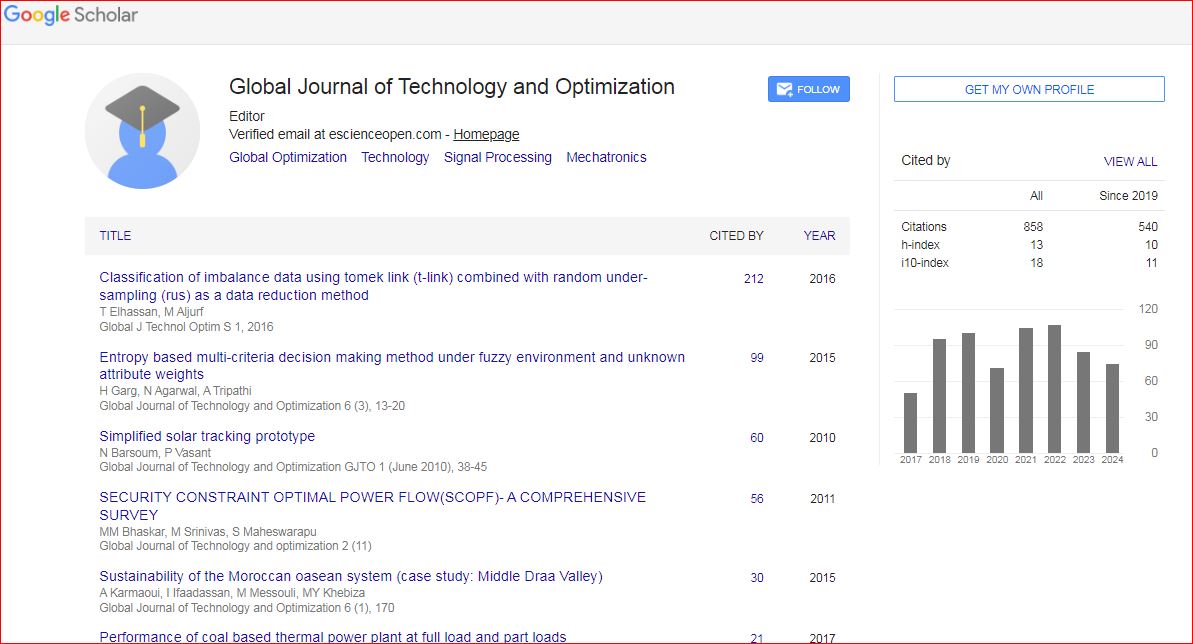
Global Journal of Technology and Optimization received 847 citations as per Google Scholar report