Commentary - (2025) Volume 17, Issue 5
Received: 02-Oct-2025, Manuscript No. jbabm-26-182354;
Editor assigned: 05-Oct-2025, Pre QC No. P-182354;
Reviewed: 19-Oct-2025, QC No. Q-182354;
Revised: 23-Oct-2025, Manuscript No. R-182354;
Published:
30-Oct-2025
, DOI: 10.37421/1948-593X.2025.17.512
Citation: Meer, Johan P. van der. ”Liquid Biopsies: Revolutionizing Personalized Cancer Care.” J Bioanal Biomed 17 (2025):512.
Copyright: © 2025 Meer d. van P. Johan This is an open-access article distributed under the terms of the Creative Commons Attribution License, which permits unrestricted use, distribution and reproduction in any medium, provided the original author and source are credited.
Recent advancements in liquid biopsy technologies are significantly transforming the landscape of cancer diagnosis and management. These non-invasive techniques, which analyze circulating tumor DNA (ctDNA), RNA, proteins, or cells present in bodily fluids such as blood, offer dynamic insights into tumor genetics, facilitate early detection, enable the monitoring of treatment responses, and aid in the surveillance for recurrence. The effective integration of sophisticated sequencing methods, machine learning algorithms, and bioinformatics tools is paramount to fully harness the potential of liquid biopsies, thereby paving the way for truly personalized oncology [1].
The growing utility of liquid biopsies for detecting minimal residual disease (MRD) is becoming increasingly apparent. Through the application of highly sensitive assays capable of identifying even sparse ctDNA fragments, oncologists are empowered to ascertain the presence of residual cancer cells post-treatment, accurately predict relapse risks, and make informed decisions regarding adjuvant therapy, ultimately leading to improved patient outcomes [2].
The interpretation of the complex data generated by liquid biopsies necessitates the leveraging of machine learning and artificial intelligence. These computational approaches play a crucial role in enhancing the accuracy of biomarker identification, refining tumor classification, and improving the prediction of therapeutic responses, thereby enabling more precise and individualized cancer care strategies [3].
Significant progress is being made in the clinical validation and regulatory approval of liquid biopsy assays. A number of tests are already available for specific cancer types, with non-small cell lung cancer being a prominent example. Continued rigorous research and extensive clinical trials are indispensable for broadening the application of these assays across a wider spectrum of malignancies and diverse patient populations [4].
Beyond ctDNA, circulating tumor cells (CTCs) constitute another critical element within the realm of liquid biopsies. Innovations in the isolation and characterization of CTCs provide complementary information to ctDNA analyses, offering valuable insights into tumor heterogeneity, metastatic processes, and mechanisms of treatment resistance [5].
The development of highly sensitive technologies such as ultrasensitive digital droplet PCR (ddPCR) and next-generation sequencing (NGS) has markedly improved the sensitivity and specificity of liquid biopsy assays. This enhancement allows for the detection of low-frequency mutations and tumor-specific biomarkers at the very earliest stages of cancer development [6].
Liquid biopsies are progressively being integrated for the longitudinal monitoring of treatment responses. Shifts in ctDNA levels can signal tumor shrinkage or the emergence of resistance mechanisms considerably earlier than conventional imaging techniques, facilitating timely therapeutic adjustments and optimizing patient management [7].
There is active exploration into the application of liquid biopsies for cancer screening and early detection among asymptomatic individuals. Although this area holds considerable promise, substantial challenges remain in achieving adequate specificity to mitigate false positive results and in identifying clinically actionable findings [8].
Exosomes and other extracellular vesicles (EVs) originating from tumors are emerging as significant biomarkers in liquid biopsies. These EVs encapsulate a complex cargo of proteins, nucleic acids, and lipids that can accurately reflect the status of the primary tumor and its surrounding microenvironment, thereby introducing a novel dimension to non-invasive cancer diagnostics [9].
The successful integration of liquid biopsy into routine clinical practice hinges on the establishment of standardized protocols for sample collection, processing, analytical procedures, and data interpretation. Addressing these standardization hurdles is essential to ensure the reproducibility and reliability of liquid biopsy findings and to facilitate widespread clinical adoption [10].
Recent breakthroughs in liquid biopsy technologies are revolutionizing cancer diagnosis and management. These non-invasive methods, analyzing circulating tumor DNA (ctDNA), RNA, proteins, or cells in bodily fluids like blood, offer real-time insights into tumor genetics, early detection, treatment response monitoring, and recurrence surveillance. The integration of advanced sequencing techniques, machine learning, and bioinformatics is crucial for unlocking the full potential of liquid biopsies, paving the way for personalized oncology [1].
The utility of liquid biopsies for minimal residual disease (MRD) detection is rapidly expanding. By sensitive assays that can detect even rare ctDNA fragments, oncologists can identify the presence of residual cancer cells after treatment, predict relapse risk, and guide adjuvant therapy decisions, thereby improving patient outcomes [2].
Leveraging machine learning and artificial intelligence is essential for interpreting the complex data generated by liquid biopsies. These computational tools can enhance the accuracy of biomarker identification, tumor classification, and the prediction of therapeutic response, enabling more precise and personalized cancer care [3].
The clinical validation and regulatory approval of liquid biopsy assays are progressing, with several tests already available for specific cancer types, particularly non-small cell lung cancer. Continued research and larger clinical trials are vital for expanding their application across a broader range of malignancies and patient populations [4].
Beyond ctDNA, circulating tumor cells (CTCs) represent another key component of liquid biopsies. Advances in isolation and characterization of CTCs provide complementary information to ctDNA analysis, offering insights into tumor heterogeneity, metastasis, and treatment resistance mechanisms [5].
The development of ultrasensitive digital droplet PCR (ddPCR) and next-generation sequencing (NGS) technologies has significantly improved the sensitivity and specificity of liquid biopsy assays, enabling the detection of low-frequency mutations and tumor-specific biomarkers at very early stages of cancer [6].
Liquid biopsies are increasingly being employed for longitudinal monitoring of treatment response. Changes in ctDNA levels can indicate tumor shrinkage or resistance development much earlier than conventional imaging, allowing for timely adjustments to therapy and improved patient management [7].
The field is actively exploring the use of liquid biopsies for cancer screening and early detection in asymptomatic individuals. While promising, challenges remain in achieving sufficient specificity to avoid false positives and in identifying clinically actionable findings [8].
Exosomes and other extracellular vesicles (EVs) derived from tumors are emerging as valuable biomarkers in liquid biopsies. These EVs carry a cargo of proteins, nucleic acids, and lipids that can reflect the state of the primary tumor and its microenvironment, offering a new dimension to non-invasive cancer diagnostics [9].
The integration of liquid biopsy into clinical practice requires standardized protocols for sample collection, processing, analysis, and data interpretation. Addressing these standardization challenges is crucial for ensuring the reproducibility and reliability of liquid biopsy results and for widespread clinical adoption [10].
Liquid biopsies, utilizing non-invasive methods to analyze bodily fluids for cancer biomarkers like ctDNA, RNA, proteins, and cells, are revolutionizing oncology. They offer real-time insights into tumor genetics, early detection, and treatment monitoring, particularly for minimal residual disease. Advanced technologies such as NGS and ddPCR enhance sensitivity, while machine learning aids data interpretation. Circulating tumor cells (CTCs) and extracellular vesicles (EVs) provide complementary information. Clinical validation and standardization are progressing, aiming for broader adoption. Longitudinal monitoring of treatment response is enhanced, and screening in asymptomatic individuals is being explored, though challenges remain. Ultimately, liquid biopsies promise more personalized and effective cancer care.
None
None
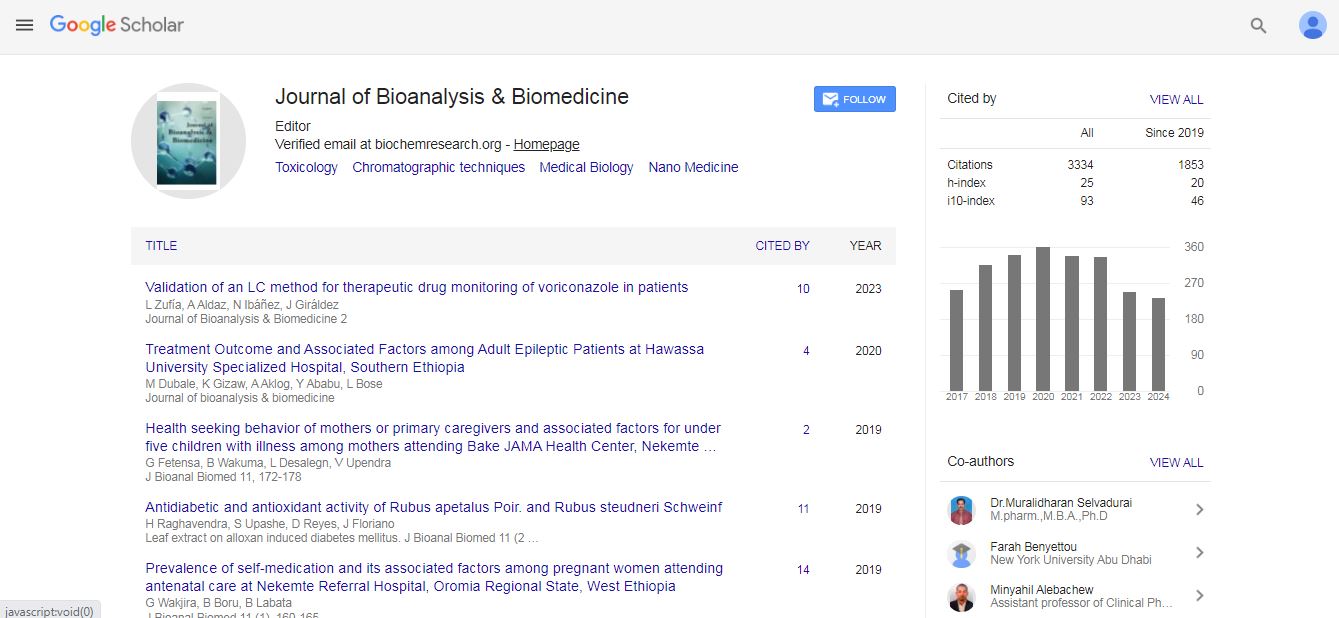
Journal of Bioanalysis & Biomedicine received 3099 citations as per Google Scholar report